Arab Finance: As the global private capital landscape undergoes a fundamental reset in 2026, institutional investors are increasingly pivoting away from traditional benchmarks toward high-conviction, infrastructure-heavy assets. While deal volumes have shifted, the surge in total investment value highlights a move toward capital-intensive projects in digital connectivity and energy, where existing pent-up demand provides a hedge against global inflationary pressures.
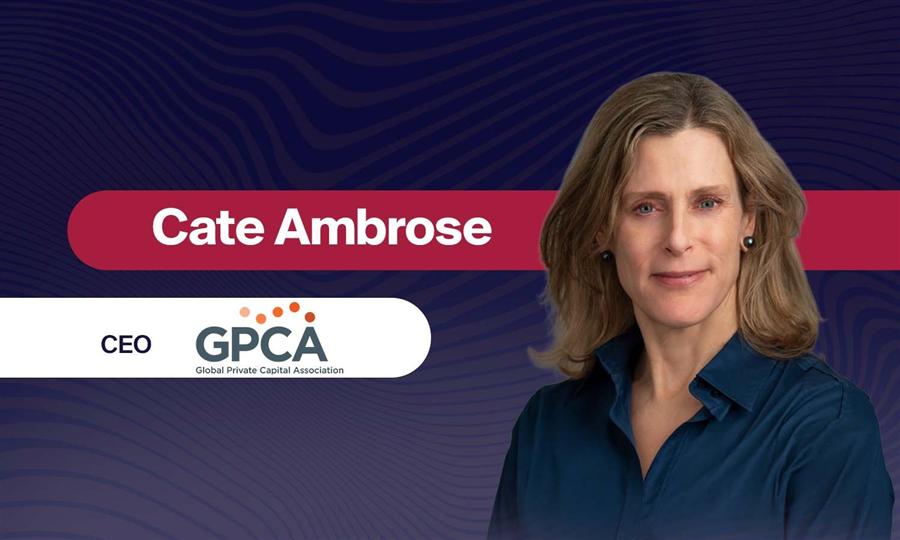
We sat down with Cate Ambrose, CEO of the Global Private Capital Association (GPCA), to discuss the association's latest data on the $2 trillion in assets managed by its members. From the rapid expansion of private credit to Egypt’s strategic positioning as a regional energy and fintech bridge, Ambrose provides a unique vantage point on how capital is being redefined across high-growth global markets.
1-For those following the private capital space, GPCA is a staple name. How would you describe the association’s primary mission today and the unique vantage point you have over the $2 trillion in assets your members manage?
The association’s mission is to connect and influence key market participants by promoting the sectors, strategies, and deals that will drive investment returns and meet societal needs. Our members include fund and institutional investors such as private equity, growth equity, venture capital, private credit, real assets, pension plans, and sovereign wealth funds. We generate proprietary data, intelligence, and deal cases to drive transparency and showcase innovation across global markets.
2-You mentioned that the traditional definition of "emerging markets" is evolving. How is GPCA currently redefining these high-growth regions for global investors?
Correct. We do not use the term "emerging markets". It has been over 40 years since that terminology emerged. Today’s world is one where incredible wealth, success, and innovation exist in many different places. We are not simply changing the specific definition of one group of countries for another; rather, we need to reset our wider understanding. Capital and its future are already global.
3-Your latest 2026 report shows a significant surge in total investment value even as deal volumes have shifted. What does this tell us about the size and maturity of the deals currently being pursued?
Investors are pursuing high-conviction, capital-intensive deals in the digital infrastructure space. Examples include Princeton Digital Group in Southeast Asia or TERRANOVA in Latin America. They are also targeting buyouts in areas like healthcare and education, such as global private school operator Nord Anglia.
In venture and tech, we see fewer but larger bets on AI-enabled services and fintech. Many of these are debt financings rather than new equity commitments. UAE-based Tamara’s $1.4 billion asset-backed financing is a great example. Investors are still committing capital to opportunities globally but focus on a selective group of companies in specific sectors and thematic areas.
4-Private credit has reached record levels. Why are investors increasingly looking toward credit in growth markets as a safer or more flexible alternative to traditional bank lending right now?
Changing lending conditions and intensifying competition in the US have led private capital allocators to use a wider geographic lens. Meanwhile, a pullback in bank lending in regions like Africa and Latin America has opened opportunities for private credit investors to step in.
Private credit deal fundamentals outside the US are proving attractive to investors. They are less leveraged, at an average of 3x debt to earnings as opposed to 4x or 5x in the US. They frequently feature shorter maturities and higher gross yields for investors.
5-Infrastructure deployment has seen a massive influx of capital. What is it about the current global economic climate, specifically regarding inflation, that makes long-duration assets so attractive to your members?
Pervasive uncertainty due to tariffs, military clashes, and intensifying geopolitical competition means investors are gravitating to real assets opportunities. These offer downside protection and, in many cases, inflation-linked revenue streams. In our markets, infrastructure is about growth and meeting pent-up demand for basic services like transportation, power, and digital connectivity
6-You have noted a "stark difference" between digital infra in the US and other growth markets. Can you explain the difference between investing for "future demand" and investing for "existing pent-up demand"?
Digital infrastructure spending in the US has been dominated by speculation on future demand for AI and the vast "hyperscaling" of compute and storage it requires. In Asian, Latin American, and African economies, digital infrastructure spend is not about future demand. Instead, an existing infrastructure gap exists for telecoms towers and data centers to support services like 5G. In these markets, demand already exceeds supply
7-Are there specific lessons from the success in India or Southeast Asia that other regions, like Africa or Latin America, should consider adopting?
India has attracted a broad swath of domestic investors to its local capital markets. Inflows to public exchanges have generated tailwinds for private capital. Fund managers have been able to sell down their holdings in booming local equity markets.
8-Given the report’s focus on energy and infrastructure, how is Egypt currently positioned within GPCA’s radar, particularly as a hub for regional energy projects?
Egypt has experienced macro turbulence and foreign exchange volatility in recent years. However, it remains a key target for private capital investors active in the region. It possesses the size and population to serve as a bridge between Africa and the Gulf Council Countries (GCC).
In 2024, EBRD, Meridiam, and Hassan Allam committed $300 million to renewable energy platform HAU Energy in Egypt. We have also seen deals in healthcare (Alameda Hospitals), retail (Kazyon), and fintech (MNT-Halan).
9-As global bank lending tightens, are you seeing Egyptian companies and projects increasingly turning to private capital and credit to sustain their growth?
Egypt has been less active in private credit than peer markets in the GCC or Africa. Key factors will be local policy support and the continuation of the economic stabilization program that began in 2024. Private credit funds will also prefer companies that can generate hard-currency revenue.
10-Based on 2026 data, what is the general sentiment among your members regarding the Egyptian market’s resilience compared to other emerging peers in the MENA region?
Investors continue to commit capital to Egypt in 2026. Delivery platform Breadfast raised $50 million from Mubadala and Olayan. Adenia acquired Parkville Pharmaceuticals, marking its first deal in Egypt. DPI completed a follow-on round for Kazyon. The year has started with several large deal announcements.
11-Exit values have been remarkably high, with public markets playing a large role. Are we seeing a "normalization" of the IPO market for growth companies?
Total exit value across GPCA markets rose to $98.8 billion in 2025, the second-highest year on record, with public markets generating 39% of liquidity. After a muted 2024, China, Southeast Asia, Latin America, Africa, and the Middle East all posted year-over-year gains in public market exit value. In early 2026, Hong Kong and India are leading in proceeds and deal activity alongside the US. While the global IPO market has not returned to its 2021 peak, it is well above the slumps of 2022 through 2024.
12-Your report touches on the energy sources needed to power the digital boom. How central is the "energy transition" to the infrastructure deals being signed today?
The digital boom requires huge amounts of energy as traditional businesses digitalize. We prefer to see it as "energy addition" rather than "energy transition". We observe a need to create new energy capacity, not just replace existing sources. This involves implementing renewable energy projects and making traditional sources more sustainable. Private capital plays a growing role in both.
13-What is the number one concern or "red flag" that limited partners (LPs) are discussing with you behind closed doors as they look at the remainder of 2026?
Private capital allocators globally are laser-focused on fund managers with a proven track record of returning capital in a timely manner. Exits are key.
14-If you were to forecast the narrative of next year's report, do you expect a broader diversification of deals, or will the trend of large-scale, high-conviction investments continue to dominate?
The long-term trend we are focusing on is the expansion of private credit and infrastructure opportunities across GPCA’s markets. These asset classes will likely account for a growing share of all private markets’ activity in the years ahead.