Egypt's favorable climate and fertile land have fostered ideal conditions for orange cultivation, allowing the country to produce high-quality oranges that are sought after both domestically and internationally.
Oranges are a key export commodity for Egypt, generating substantial foreign exchange earnings and contributing to the country's trade balance. The export of Egyptian oranges reaches markets around the globe, showcasing the country's capability to meet international quality standards and satisfy diverse consumer preferences.
In this Factsheet, we will explore the position of Egyptian oranges in global markets and how this product contributes to attracting foreign exchange to the country.
- Egypt produces several types of oranges, with the four dominant types being Baladi, Valencia, Navel, and Sweet (Sukkary) oranges.
- Oranges in Egypt are cultivated across a total area of 345,000 feddan, representing 2% of the country’s cropped area. These lands produced around 3.6 million tons of oranges in the marketing year 2022/23. Notably, Egypt’s production has been stable over the past few years.
- Egypt accounted for 8% of the world’s total orange production in 2023/24. This share has put the country in 5th place among the world’s largest orange producers after Brazil, China, the EU, and Mexico.
- The Beheira governorate, including Nobaria city, is responsible for 47% of Egypt’s production with 1.4 million tons. Ismailia and Sharkia came in 2nd and 3rd places with 16%, and 13%, respectively.
- In 2023, Egypt exported around 50%, or 1.6 million tons, of its domestic production of oranges, attracting $800 million to the country.
- Egypt’s orange exports remarkably grew by 13% year-on-year (YoY) between 2022 and 2023. The crop made up 80% of Egypt’s citrus exports, 22% of the country’s agricultural exports, and 2.2% of its non-oil exports.
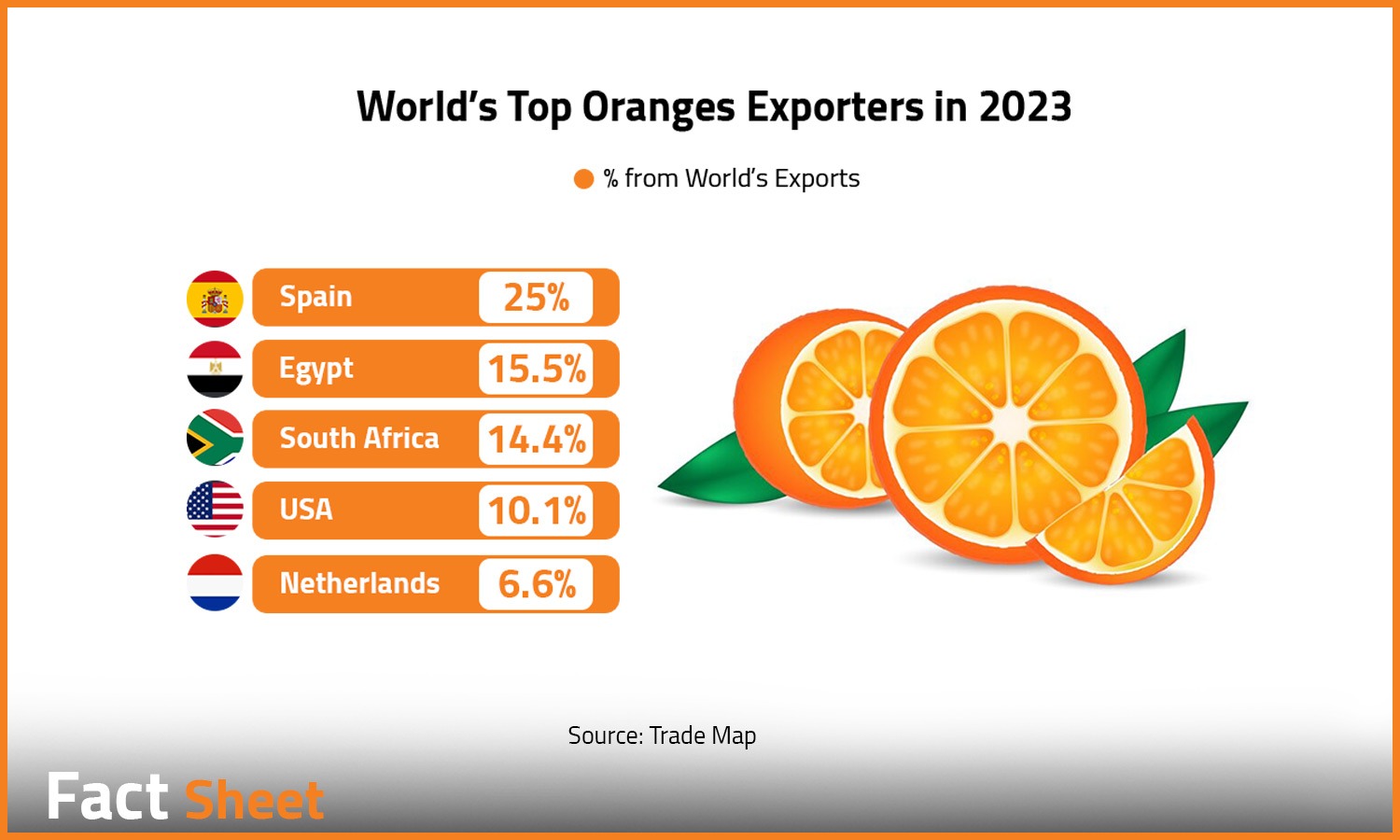
- In 2023, Egypt dominated 15.5% of the world’s orange market, becoming the second-largest supplier, following Spain. South Africa also plays a crucial role as a supplier in the same market as Egyptian oranges. However, due to their distinct seasonal patterns, the two countries do not compete for market share.
- Egypt exported to 125 markets in 2023. Russia was the top destination with exports of $106.2 million, representing 13.3% of Egypt’s orange exports. The Netherlands and Saudi Arabia came in the following places with shares of 12.1%, and 11.4%, respectively.
- The US Department of Agriculture (USDA) has projected Egypt’s production to grow slightly by 2.7% to reach 3.7 million tons in the marketing year 2023/24. The increase in production is attributed to ideal weather conditions and temperatures during the flowering of the trees.
- Exports are expected to further hike by 25% to reach 2 million tons in 2023/24. The top importing markets are likely to remain the same, led by the Netherlands, Russia, and Saudi Arabia.
By: Amina Hussein
Related News