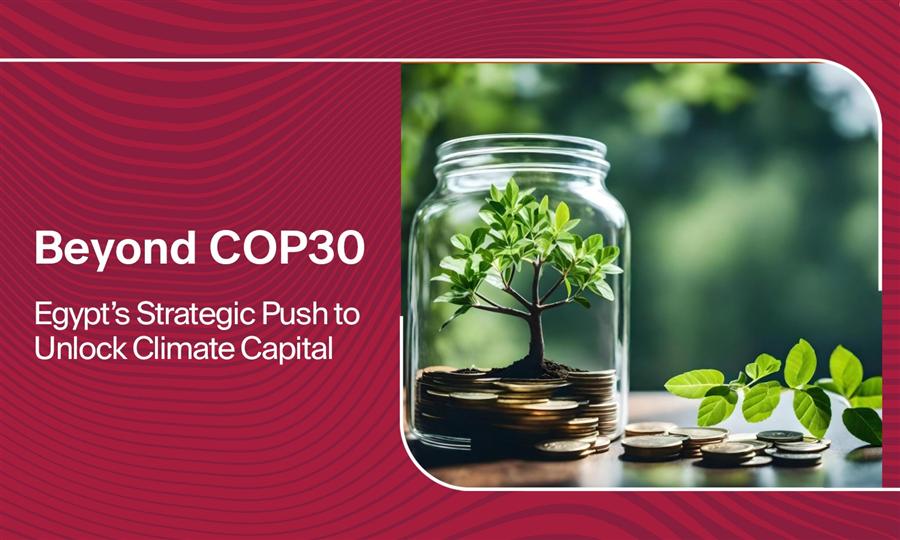
The conclusion of the 30th United Nations Climate Change Conference (COP30) in Belém, Brazil, marks a pivotal moment for developing nations seeking to convert climate ambition into economic progress.
With the international community committing to mobilize $1.3 trillion annually by 2035 for climate action—triple current funding levels—the landscape of global finance climate has shifted fundamentally.
For Egypt, a nation historically vulnerable to climate impacts and positioned at the intersection of Africa, Asia, and Europe, this unprecedented financial commitment presents both transformative opportunities and complex implementation challenges.
Although COP30 ended without addressing fossil fuels, the summit concluded after two weeks of intensive negotiations with a mixed set of outcomes that advanced climate finance and adaptation. The most significant outcome was an agreement on mobilizing at least $1.3 trillion annually by 2035 for climate action from all sources—public and private.
In his comment to Arab Finance, Abdelrhman Ashraf, an economist with experience in national planning and the United Nations (UN) system, expresses his opinion: “This is the first time climate finance is becoming a real economic driver. By operationalizing the Baku to Belém Roadmap, COP is now mobilizing towards $1.3 trillion annually by 2035, with at least $300 billion in public and sustainable finance for developing countries.”
By the end of COP30, 122 countries, representing approximately 70-74% of global emissions, had submitted new or updated Nationally Determined Contributions (NDCs). COP30 also launched two voluntary initiatives aimed at closing the ambition gap and accelerating the implementation of national climate and adaptation strategies. Progress under these programs will be reported at COP31 in November 2026.
For Egypt, these global commitments present an opportune moment to leverage its existing institutional advantages. The country enters this new climate finance era from a position of strength, having already championed innovative climate financing through its National Water, Food, and Energy (NWFE) platform, launched during COP27 in Sharm El-Sheikh.
In November, Rania Al-Mashat, Minister of Planning, Economic Development, and International Cooperation, announced that Egypt had mobilized $4.5 billion in concessional financing for renewable energy projects totaling 5.2 gigawatts in generation capacity.
Egypt's 2025/2026 economic and social development plan further underscores this, targeting EGP 637 billion, approximately 55% of total public investments, in green projects. This commitment signals the country’s intent to transform climate challenges into engines of economic growth.
The outcomes of COP30 offer promising opportunities for developing countries, including Egypt, to embed climate action as a central pillar of economic growth.
“Egypt and other developing countries will benefit dramatically,” Ashraf says. “The renewed policies shift climate action from a policy and slogan area to a core part of macroeconomic planning, which will be reflected in economic growth.”
Drawing on his experience with national institutions such as the Ministry of Planning, Ashraf notes, “It is clear that climate investments in Egypt, especially in water security and energy transition, are now designed not only to protect the economy but also to unlock new growth pathways.”
Yet these opportunities come along with significant structural and financial challenges that Egypt must address to fully harness climate-aligned investments.
“There are many problems related to policy coherence and execution capacity,” Ashraf highlights. “However, the main problem in Egypt is the cost of capital and the debt overhang. Egypt. Like many emerging markets, Egypt faces high currency pressures and limited fiscal space.”
He adds a cautionary note on conventional climate finance models, saying: “If climate finance comes as standard-rate loans in hard currency without considering Egypt’s situation, it could actually intensify debt vulnerabilities rather than relieve them.”
To navigate these hurdles and maximize the economic gains from COP30 pledges, Ashraf stressed the need for innovative financial approaches. “The most effective mechanism is a risk-sharing mechanism,” he explains.
He points out, “Even the Baku to Belém Roadmap makes it clear that the numbers will only materialize if private finance is crowded in through guarantees and innovative instruments.”
For Egypt, this means pushing for access to Article 6 carbon markets by utilizing high-quality measurement, reporting, and verification (MRV) systems so that emission reduction and nature-based projects generate reliable foreign currency revenues.
Ashraf further suggests that “Egypt can scale up green bonds and green sukuk, becoming the first sovereign green bond issuer in the MENA region,” thereby unlocking further climate finance and investment opportunities.
COP30's commitment to mobilize $1.3 trillion annually in climate finance by 2035 represents more than a global pledge; it offers Egypt a strategic inflection point to convert environmental imperatives into sustained economic momentum.
With institutional foundations like NWFE already attracting billions in green investments and the 2025/2026 plan allocating over half of public capital to sustainable projects, Egypt is well-positioned to lead green economic growth.
By prioritizing policy coherence, high-quality MRV systems, and concessional financing blends, Egypt can ensure COP30's outcomes deliver net economic gains rather than additional burdens. The path forward demands bold execution to turn global climate finance into a cornerstone of resilient prosperity.
By Sarah Samir