Egypt's retail industry is undergoing a period of transformation, as demand for supermarkets, hypermarkets, and shopping malls surged in recent decades. This has been driven by the country's growing urban population, rising household incomes, and the expansion of the middle class.
Government initiatives aimed at stabilizing the economy have further supported this evolution. As the competitive landscape changes, both private and public retail businesses are adjusting to new opportunities and challenges. A major step toward updating Egypt's retail system is the introduction of Carry On, a unified government-owned retail chain.
By unifying state-affiliated retail outlets under a single brand identity, this initiative seeks to improve operational efficiency and standardize customer experiences nationwide.
Evolution of Retail in Egypt
While traditional souks and bazaars persist, Egypt’s retail sector has undergone significant modernization over the past few decades. The expansion of urban populations, rising household incomes, and a growing middle class have accelerated the shift toward modern retail formats, including supermarkets, hypermarkets, and shopping malls.
Government efforts to stabilize the economy and encourage investment have further supported this transition, spurring retail infrastructure development across major cities.
Egypt's wholesale and retail trade sectors recorded 7.1% growth during the second quarter (Q2) of fiscal year (FY) 2025/2026, according to the Minister of Planning and Economic Development.
Looking ahead, the retail sector is expected to grow by approximately 11% over the next four years, as per Rasha Azab of Majid Al Futtaim, speaking at Cityscape Egypt 2025.
Retail sales are also projected to surpass $201.4 billion by 2030, according to Savills, citing Oxford Economics. In FY 2024/2025, wholesale and retail trade contributed 3.66% to Egypt’s gross domestic product (GDP) growth.
This momentum has created a competitive environment, where both private and public retail actors are redefining their roles. As economist Mohsen E. Helaly notes, “Carry On is positioning itself as a unified national retail platform that benefits from scale and centralized operations. By bringing consumer complexes under one brand, it can negotiate better with suppliers, manage procurement more efficiently, and maintain more consistent pricing across locations.”
The Birth of a National Retail Giant
In Egypt, consumer retail complexes is not a new concept. They have been around since the 1960s, providing a diverse selection of essential food items, including rice, sugar, cooking oil, meat, poultry, fish, vegetables, and fruits, all priced below current market rates.
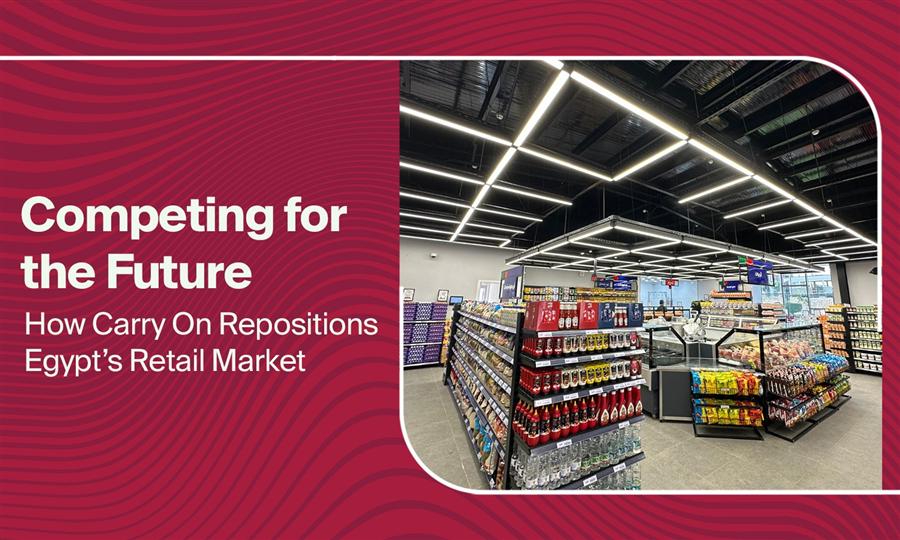
Carry On was officially launched in 2025, marking Egypt’s largest unified government-owned retail chain. The project is a national initiative designed to overhaul state-affiliated retail food outlets and consolidate them under a unified government brand. It aims to modernize consumer experience by standardizing visual identity and operational efficiency across the state’s retail network.
The initiative targets the integration of 40,000 state-affiliated retail food outlets into a centralized, unified network. This restructuring consolidates three primary segments under a standardized operational framework: consumer retail complexes, ration-card distribution points, and "My Gamaiti" project outlets.
On September 29th, 2025, the Governor of Cairo, together with the Minister of Supply and Internal Trade, inaugurated the first three branches in Kolayat Al-Bannat, Amireya, and Sayeda Zaynab. These openings were part of a national strategy to modernize and consolidate state?owned retail outlets under a single, recognizable brand identity.
By transitioning from independent entities to a cohesive system, the network will adopt a single visual identity, standardized pricing policies, and a consistent service model across all locations. In this regard, Carry On will be a connected retail chain across the country.
“Compared to private chains and international players, Carry On’s strength lies in its understanding of the local market and consumer behavior. International brands may compete on brand image and premium offerings, while private chains often rely on flexibility and niche strategies,” according to Helaly.
“Carry On, however, can compete strongly on accessibility, price stability, and wide geographic coverage, particularly in high-density and underserved areas,” he adds.
Supply Chain Optimization and Transparency
The chain operates under the Holding Company for Food Industries, aligning with state directives to ensure consistent access to high-quality, affordable goods for citizens. Designed to merge Egypt’s fragmented public retail ecosystem into a cohesive national brand, the Ministry of Supply launched Carry On as part of a broader plan to create the largest unified government retail chain in the country.
This unification contributes to the formalization of Egypt’s retail sector. As Helaly explains, “Unifying these complexes under one structure supports the broader formalization of the retail sector. It creates more standardized pricing, clearer procurement systems, and stronger compliance with tax and regulatory requirements.”
Such structural consolidation enhances transparency, boosting distribution. “This reduces fragmentation in the market and improves transparency across the supply chain. Over time, such a structure can enhance inventory management, strengthen distribution channels, and generate more reliable data for policymakers and stakeholders,” Helaly points out.
Moreover, Carry On’s modernization strategy may influence consumer behavior. Helaly adds, “When formal retail offers competitive prices, consistent product availability, and a more organized shopping experience, many consumers naturally see added value.”
This shift could reduce reliance on informal markets and accelerate the transition toward a more structured domestic trade system. Helaly explains that “informal markets still maintain advantages in terms of proximity and flexibility.”
“The real challenge will be maintaining affordability while ensuring reliability and scale. If Carry On succeeds in balancing these factors, it can gradually influence consumer preferences in favor of formal retail,” he explains.
The retail industry in Egypt is about to enter a critical period characterized by quick modernization, changing customer demands, and a conscious drive for more formalization. The steady increase in retail growth indicators, from rising sales volumes to the sector's increasing contribution to GDP, reflects an economy in transition and a marketplace influenced by both demographic shifts and strategic policy direction. Within this changing environment, the introduction of Carry On stands out as a revolutionary state-led initiative aimed at redefining public retail.
By Sarah Samir