The Egyptian government has stepped up efforts to regulate the mobile phone market following significant price increases, despite the expansion in domestic manufacturing in recent years. Prime Minister Mostafa Madbouly has directed relevant ministries to assess market conditions, identify the drivers of rising prices, and develop measures to ensure the availability of affordable devices. The government is also seeking to deepen local manufacturing, attract international brands, increase domestic value added, and strengthen competition, while linking incentives for manufacturers to higher local content.
In this Factsheet, we highlight recent developments in the Egyptian mobile phone market.
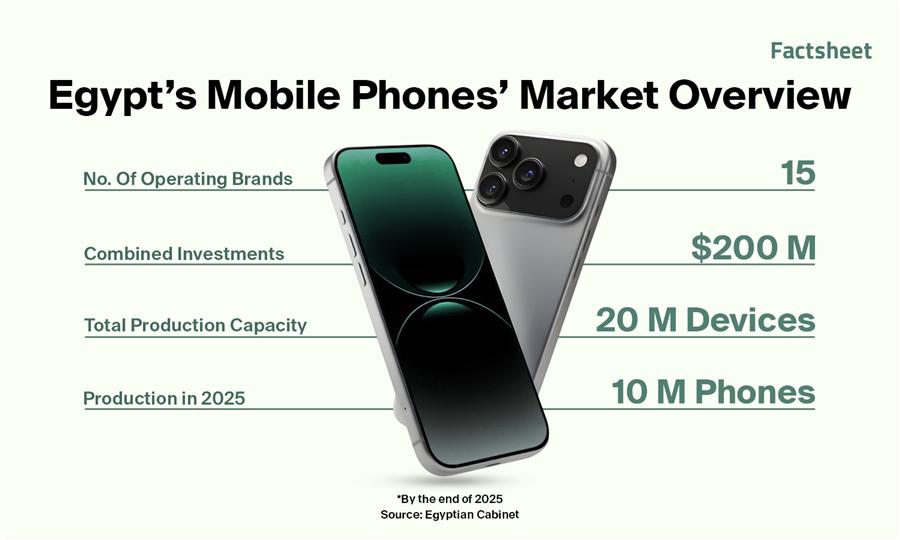
- Egypt's mobile phone manufacturing industry has attracted 15 international and local brands, with combined investments estimated at approximately $200 million and an annual production capacity of up to 20 million devices. Domestic production more than tripled in 2025, exceeding 10 million phones, compared with approximately 3.3 million in 2024. Local value added also surpassed 40%. Manufacturing operations are distributed across several industrial zones.
- Several global manufacturers have established production and assembly facilities in Egypt, including those of Samsung, OPPO, Xiaomi, vivo, and Infinix, alongside domestic manufacturer SICO. Notable investments include Samsung's manufacturing complex in Beni Suef, Xiaomi's facility in 6th of October City, and OPPO's factory in 10th of Ramadan City, backed by planned investments of approximately $50 million. HONOR is also expanding its presence through its first overseas factory outside China, located in 10th of Ramadan City. The facility has an annual production capacity of three million devices and is expected to create around 1,000 jobs.
- The government aims to increase domestic mobile phone production to 14–15 million devices in 2026, up from approximately 10 million in 2025, targeting meeting more than 70% of demand for mobile phones in Egypt by the end of the year. With annual domestic consumption estimated at 18–20 million devices, expanding production is expected to reduce reliance on finished-phone imports while creating opportunities for exports.
- Egypt introduced a mobile phone governance system in January 2025 through the Telephony application, enabling the registration of imported devices and the electronic payment of applicable taxes and customs duties. The combined charges on imported mobile phones can reach 38.5% of the device's value, including customs duties, value-added tax (VAT), and other fees. In January 2026, the government ended the exceptional exemption allowing Egyptian travelers to bring in one phone without customs charges, while maintaining exemptions for tourists and Egyptians residing abroad under specified conditions. These measures aim to curb smuggling, promote formal imports, and support locally manufactured alternatives.
- Despite the expansion of domestic assembly, the industry remains dependent on imported components, particularly electronic chips, memory and storage units, and other essential inputs. Egypt imported approximately $1.83 billion worth of products, including mobile phones, communication equipment, and related parts, with China accounting for around 74% of these imports.
By: Amina Hussein
Related News