The Minister of Finance presented the draft state budget for fiscal year (FY) 2026/27 to the House of Representatives, outlining a framework to address citizens’ essential needs, upgrade public services, and support economic activity. The government has articulated a set of fiscal priorities, including fostering a constructive partnership with the business community, maintaining disciplined yet supportive fiscal policies, and advancing a coherent debt strategy. In parallel, emphasis is placed on strengthening social protection and human development.
This factsheet reviews the key features of the FY2026/27 budget and its targeted fiscal indicators.
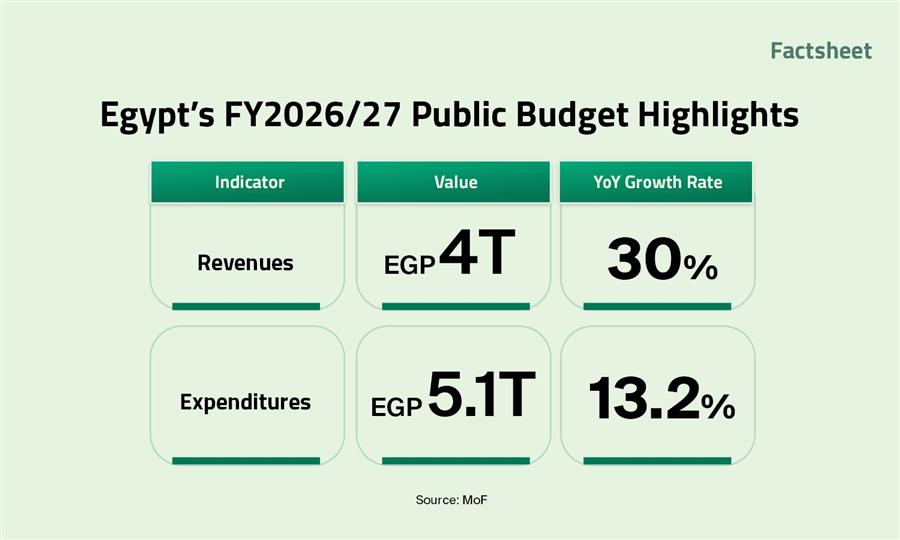
- The government targets a 30% annual increase in total public revenues in FY2026/27, bringing them to EGP 4 trillion. Tax revenues are projected to reach EGP 3.53 trillion, equivalent to 14.4% of gross domestic product (GDP), reflecting a 26.7% annual rise compared to an estimated EGP 2.79 trillion by the end of FY2025/26.
- The planned expansion in tax revenues is underpinned by the continued implementation of facilitative real estate, tax, and customs packages designed to ease compliance for citizens and investors. The strategy emphasizes voluntary inclusion without imposing additional burdens, aiming to integrate 100,000 new taxpayers into a simplified and integrated system supported by unprecedented incentives. Complementary measures include the establishment of three specialized tax service centers and the introduction of a premium tax card that offers added benefits to compliant taxpayers.
- The government projects total public expenditures of EGP 5.1 trillion in FY2026/27, marking an annual increase of 13.2%. Within this envelope, EGP 80 billion is allocated to support production, manufacturing, entrepreneurship, and exports. This includes EGP 48 billion for export rebates, EGP 6.7 billion for tourism support, and EGP 6 billion in concessional financing to strengthen productive sectors and enhance competitiveness.
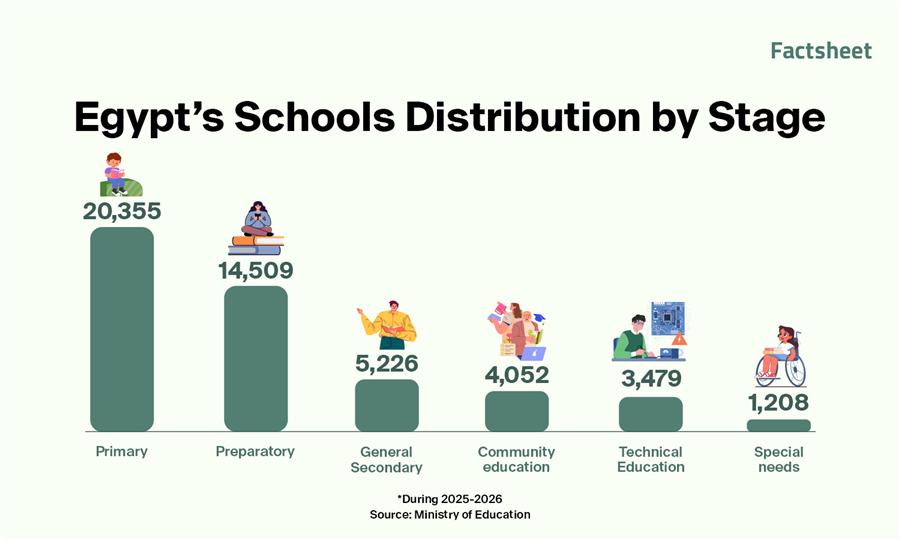
- Sectoral allocations prioritize human development and service delivery, with EGP 90.5 billion directed to the Unified Procurement Authority to secure pharmaceuticals and medical supplies. Additional provisions include EGP 7.8 billion for textbook printing and EGP 7 billion for school nutrition programs. Public wages account for EGP 821 billion, while EGP 832.3 billion is allocated to subsidies and social protection, benefiting millions of citizens and households.
- Additional spending focuses on essential services and resource security, with EGP 120 billion allocated to the energy sector to ensure reliable service provision. Housing initiatives receive EGP 13 billion for affordable units and EGP 4.3 billion for upgrading informal areas. Furthermore, EGP 69.1 billion is dedicated to purchasing locally produced wheat, aiming to strengthen domestic supply and gradually reduce dependence on imported wheat.
- The draft budget for FY2026/27 targets sustained fiscal discipline, with the overall deficit projected at 4.9% of GDP and maintained at similar levels over the medium term. The Ministry of Finance aims to continue generating primary surpluses through FY2029/30, supporting debt reduction and reinforcing fiscal and macroeconomic stability. In parallel, the debt-to-GDP ratio is expected to follow a downward trajectory, declining to around 75.5% in FY2026/27 and further to nearly 68% by FY2029/30.
By: Amina Hussein
Related News