Starting May 2026, China implemented a zero-tariff agreement with 53 African countries, extending a policy that was initially applied to 33 least developed African countries in December 2024. This move reflects China’s strategic response to growing global protectionism and its intent to deepen economic ties with Africa, expand African access to the Chinese market, and strengthen its influence across the continent. It comes amid ongoing uncertainty surrounding the renewal of the United States’ African Growth and Opportunity Act (AGOA), which was recently extended only on a short-term basis until December 2026. Hence, this policy presents opportunities for Egypt to diversify its exports and strengthen trade partnerships with China.
In this factsheet, we give an overview of the Egyptian-Chinese bilateral trade relations and examine Egypt’s opportunities under China’s tariff exemptions.
- Egypt-China non-oil bilateral trade volume reached $19.18 billion in 2025, recording a year-over-year (YoY) growth rate of 20%. The trade balance was in China’s favor as Egypt’s exports to China hit $18.66 billion, while imports reached $0.53 billion.
- China is Egypt’s largest supplier of non-oil products, with a market share of 22.5% in 2025. On the other hand, China ranked 22nd among the top destinations for Egyptian exports, with a share of 1% of Egypt’s total exports during the same year.
- Egypt’s imports from China in 2025 were concentrated in the engineering, textiles, and building materials sectors. The country’s top imported products from China were parts of telephone sets (2.8%) and flat panel display modules (2.4%), valued at $0.52 billion and $0.45 billion, respectively.
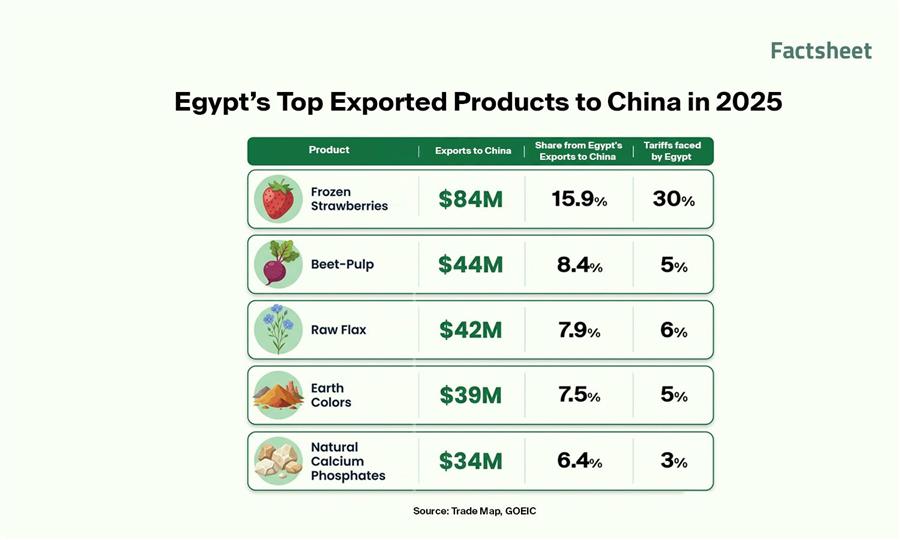
- Egypt mainly exports agricultural and food products and building materials to China. In 2025, the top five products exported from Egypt to China accounted for 46.1% of Egypt’s exports to its partner. These included frozen strawberries, beet pulp, raw flax, earth colors, and natural calcium phosphates, with exports valued at $84 million, $44 million, $42 million, $39 million, and $34 million, respectively.
- Among Egypt’s top exported products to China, frozen strawberries are the key winner under the new zero-tariff agreement. Before the implementation of the new policy, Egyptian frozen strawberries faced a 30% tariff in the Chinese market, indicating that the zero-tariff could unlock potential for Egypt in the Chinese market.
- Other products will also benefit from the policy, as the remaining four products face average tariffs ranging between 3% and 6%.
By: Amina Hussein
Related News