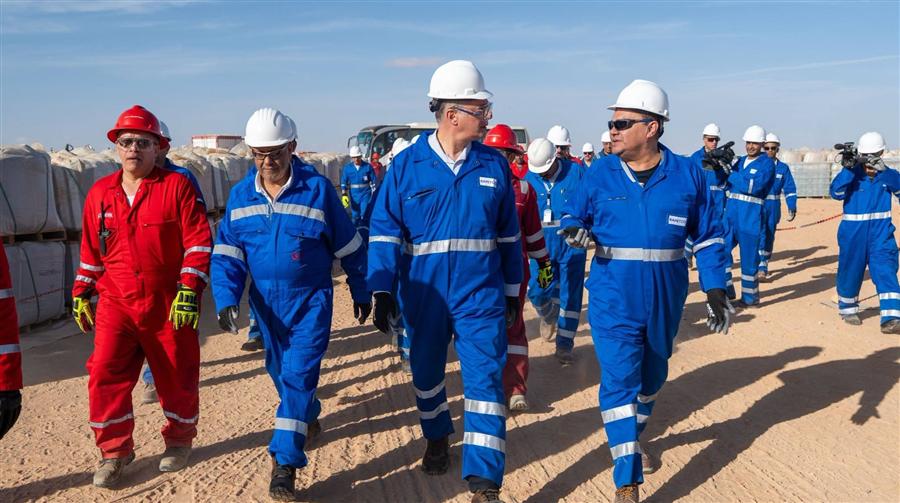
Arab Finance: Egypt aims to quadruple gas production at the Obaiyed H-18 well to about 12 million cubic feet per day, up from about 3 million, through multistage hydraulic fracturing, Minister of Petroleum and Mineral Resources Karim Badawi said.
Badawi outlined the target while inspecting operations at the well in the Western Desert’s Obaiyed field, operated by Egypt-based oil and gas producer Badr El-Din Petroleum Company (Bapetco). Technical challenges had reduced the well’s output, and conventional methods had been insufficient to restore production to the targeted level.
The work is part of a broader initiative launched by the ministry with investment partners and major international service and technology companies to expand hydraulic fracturing and horizontal drilling. Badawi stressed that these techniques are central to the petroleum sector’s five-year plan to increase oil and gas production, make better use of Egypt’s resources and offset natural declines at existing fields.
The initiative seeks to improve producing wells, revive those with declining output and develop resources that conventional methods could not extract economically. Badawi said the technologies had delivered results in the US, Saudi Arabia and other countries, as well as in Egypt, particularly the Western Desert.
Hydraulic fracturing creates pathways in rock formations that allow oil and gas to flow more readily into a well. Combining it with horizontal drilling provides access to a larger portion of hydrocarbon-bearing formations, helping recover more of the available resources.
Beyond improving existing wells, a preliminary study presented by Houston-based energy services provider National Energy Services Reunited Corp. (NESR) identified potential to add between 50,000 and 100,000 barrels per day to Egypt’s oil production by applying hydraulic fracturing to unconventional resources in the Western Desert.
The ministry cited NESR’s experience across 15 countries and its record in developing unconventional gas resources at Saudi Arabia’s Jafurah field, as achieving the estimated additional output would depend on completing technical and economic assessments and identifying commercially viable projects.
Horizontal drilling is also being expanded. Egypt-based oil producer General Petroleum Company (GPC) has drilled 15 horizontal wells in its Sinai fields, with four more under development. At several locations, these wells have recorded higher production rates than conventional vertical wells.
Egypt-based oil and gas producer Belayim Petroleum Company (Petrobel) has also drilled the SIDRI-48 horizontal well, providing access to reservoirs with complex rock characteristics. Near-term development plans include two horizontal wells at GPC’s Nees field.
The Egyptian General Petroleum Corporation (EGPC) is overseeing the initiative’s work program under the ministry’s supervision, coordinating with the Egyptian Natural Gas Holding Company (EGAS), South Valley Egyptian Petroleum Holding Company (Ganope), production companies and investment partners.
A unified implementation plan has been prepared, and technical data from 38 production companies have been reviewed to identify suitable wells and reservoirs and rank opportunities by economic viability. Discussions with operators, partners and international service and technology providers are also addressing collaboration opportunities, implementation requirements and the availability of equipment and technology.
Houston-based energy technology company SLB and Houston-based oilfield services company Halliburton have been commissioned to study three opportunities in Abu Roash reservoirs operated by GPC. Technical assessments and contractual procedures for other prospective projects are being finalized, with study results expected progressively during the third quarter of fiscal year 2026/2027.
Alongside this technical work, Badawi said EGPC and international companies were developing economic models and investment incentives to encourage wider use of the technologies.
The ministry is preparing contractual and financial arrangements that include performance-based contracts, integrated service agreements and turnkey contracts. These models aim to improve spending efficiency, shorten implementation schedules and distribute project risks more evenly among participants.
Proposed measures also include flexible payment arrangements for hydraulic fracturing costs and faster recovery of capital expenditure. The ministry is exploring mechanisms to renew agreements and consolidate concession areas to sustain exploration, appraisal and production activity.
The next phase will extend studies and implementation across onshore and offshore areas, drawing on previous operational results and seismic survey data to identify further opportunities to increase oil and gas production.