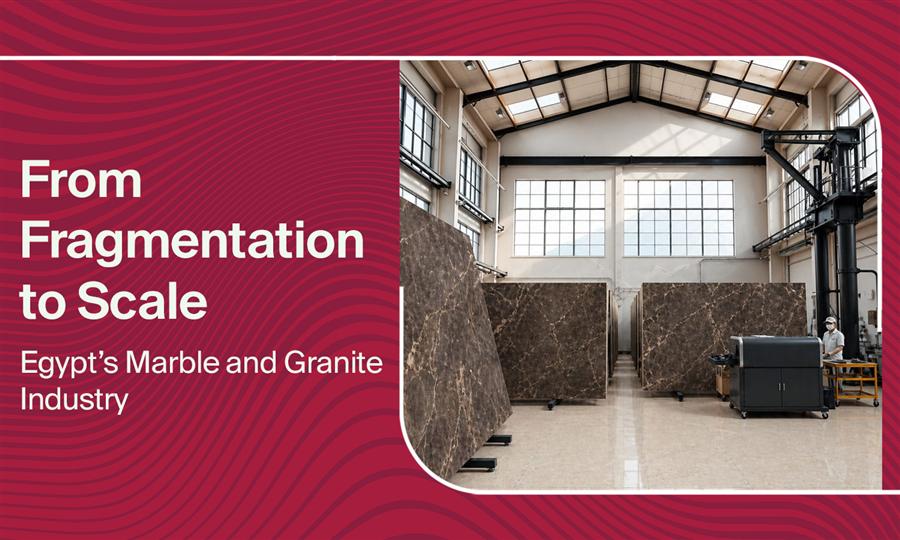
Egypt’s marble and granite sector, long a fragmented collection of small-scale workshops, is now undergoing a transformative pivot. Production is being pushed into organized, high-efficiency industrial zones as part of a government strategy to position the industry as a key pillar of the national export economy. In this context, Egypt is banking on industrial clustering to propel its global competitiveness through the concentration of resources, infrastructure, and specialized labor in hubs such as Shaq Al-Taaban, Galala, and Aswan.
Despite these ambitions, the sector is dealing with falling short-term export figures, rising global competition, and persistent structural challenges. The stakes are high: success would not only enhance Egypt’s profile as a regional hub for stone exports but also showcase how industrial clustering, investment in technology, and public-private cooperation can transform raw materials into value-added products with global reach.
Sector Transformation
Egypt’s marble and granite industry has undergone a profound transformation, shifting from fragmented workshops to organized industrial zones. This restructuring reflects the government’s ambition to elevate the sector into a cornerstone of Egypt’s export economy.
Yet, the industry faces headwinds. Exports of marble, granite, travertine, and onyx fell by 23% year-on-year in the first quarter (Q1) of 2026 to $60.9 million, according to data from the General Organization for Export and Import Control (GOEIC).
At the heart of this transformation, the Shaq Al-Taaban industrial zone has become the centerpiece of Egypt’s marble and granite sector. Once a cluster of scattered workshops, it is now a regulated hub where manufacturers benefit from concentrated infrastructure, specialized labor, and reduced logistics costs.
Economist Dina Samir ElWakkad says this transformation has “created significant advantages compared to scattered production sites. The concentration of factories in one location has improved efficiency, reduced logistics costs, and provided access to specialized labor and supporting services.”
Complementary zones in Galala and Aswan strengthen the ecosystem. “Aswan serves as a key extraction hub for high-quality granite, while Galala focuses on advanced processing and export-oriented production. Together, these zones create a more integrated and competitive stone industry,” ElWakkad explains.
From Raw Materials to Value-Added Products
Building on this transformation, Egypt’s construction boom, driven by mega-projects such as the New Capital and New Alamein, has fueled domestic demand for marble and granite. According to ElWakkad, this demand has enabled manufacturers to expand production, invest in technology, and raise quality standards, ultimately boosting the competitiveness of Egyptian exports.
She further emphasizes that “the development of marble and granite zones helps Egypt move from exporting raw materials to exporting higher-value finished products, increasing export revenues and foreign currency earnings. It also supports job creation, expands the formal economy, and generates positive spillover effects across transportation, engineering, and related industries.”
Similarly, Mohamed Aboeldahab, Founder of Eldahab Trade and a marble and granite industry professional, tells Arab Finance: “Egypt enjoys promising export opportunities, particularly in Gulf and African markets, as well as a number of European and global markets that value the quality and diversity of Egyptian raw materials and the added value of Egyptian products. Moreover, Egypt’s geographic location and regional trade agreements grant marble and granite exports a significant competitive advantage.”
Supporting the Industry’s Development
Reflecting this potential, Minister of Industry Khaled Hashem has underscored the government’s commitment to raising marble and granite exports to $1 billion annually. Recent efforts include meetings with manufacturers in Shaq Al-Taaban, measures to regularize unlicensed producers in cooperation with Cairo Governorate, and streamlined licensing through the Industrial Development Authority (IDA).
In parallel, Aboeldahab highlights the need to accelerate infrastructure upgrades, particularly in electricity, roads, and logistics, to support higher production and attract investment. He also calls for incentives to expand industrial land and technical training institutes and increase participation in international exhibitions to promote Egyptian products.
Moreover, he stresses, “It is also essential to support the quarrying sector and facilitate exploration activities, as quarries represent the primary source of the industry. Egypt possesses vast reserves of raw materials with diverse colors and technical properties, and there are still promising resources that have not yet been sufficiently discovered or utilized.”
He further points out “the importance of supporting both existing and new manufacturers by offering new industrial land with suitable incentives to encourage expansion and investment, alongside establishing specialized schools and technical institutes to train workers, streamlining investment and export procedures, and increasing participation in international exhibitions to promote the Egyptian product.”
Overcoming Challenges and Boosting Egypt’s Global Position
Despite these initiatives, the sector continues to face persistent challenges. High extraction costs, intense competition from Türkiye, Italy, and China, and a shortage of skilled technical labor weigh on growth.
Therefore, Aboeldahab stresses that overcoming these obstacles requires “stronger cooperation between the public and private sectors, greater support for exports, along with attracting more local and foreign investment and investing in technical training and modern technology.”
“Such measures would enhance the competitiveness of Egyptian products and reinforce Egypt’s position as a regional and global hub for the marble and granite industry and exports,” Aboeldahab says.
He notes that “the sector’s exports are poised for strong growth in the coming years, supported by ongoing development and infrastructure projects in Egypt, Saudi Arabia, the UAE, and other markets, where Egyptian marble and granite have already played a significant role.”
“New markets have begun implementing major development projects, while others are preparing to launch them, opening substantial opportunities for Egyptian companies,” Aboeldahab adds.
Ultimately, the shift from disparate workshops to integrated industrial zones is already transforming the sector, delivering efficiencies in production, logistics, and labor while aligning with the government’s lofty export ambitions. Nevertheless, the road ahead is not without hurdles, as structural challenges, including global competition, high extraction costs, and shortages of skilled labor, continue to weigh on growth. Overcoming these challenges will require continued investment in infrastructure, technology, and training, and greater collaboration among public and private stakeholders.
By Sarah Samir