By the end of February 2026, a new round of the Israel-Iran conflict erupted, expanding beyond the two nations to involve major oil and gas producers in the Arab Gulf region. One of the most significant developments was Iran’s decision to close the Strait of Hormuz, a critical shipping route for petroleum exports from Gulf countries. The move disrupted global oil markets and triggered a 15% surge in oil prices in the days that followed.
In this factsheet, we shed light on the strategic importance of the Strait of Hormuz in global oil trade, identify the economies most affected by its closure, and examine the potential alternatives available for Arab countries for re-routing their oil and petroleum product exports.
- The Strait of Hormuz lies between Oman and Iran, linking the Persian Gulf to the Gulf of Oman and the Arabian Sea. Despite its narrow width, it accommodates the world’s largest oil tankers and serves as one of the most critical routes for global oil shipments.
- In the first quarter (Q1) of 2025, oil and petroleum products flows through the strait averaged 20 million barrels per day (Mbbl/d), equivalent to about 20% of global petroleum liquids consumption, estimated at 102.1 Mbbl/d, and 27% of the world’s maritime oil trade, estimated at 75.5 Mbbl/d.
- Crude oil and condensates’ flows averaged 14.2 Mbbl/d, while petroleum products’ flows averaged 5.9 Mbbl/d.
- Combined, Saudi Arabia, the UAE, Iraq, Kuwait, and Qatar are the origin of 12.4 Mbbl/d of crude oil and condensates transported through the Strait of Hormuz. Saudi Arabia alone transmits 5.3 Mbbl/d of crude oil and condensates, with a share of 38%, followed by Iraq with 3.2 Mbbl/d and the UAE with 1.8 Mbbl/d.
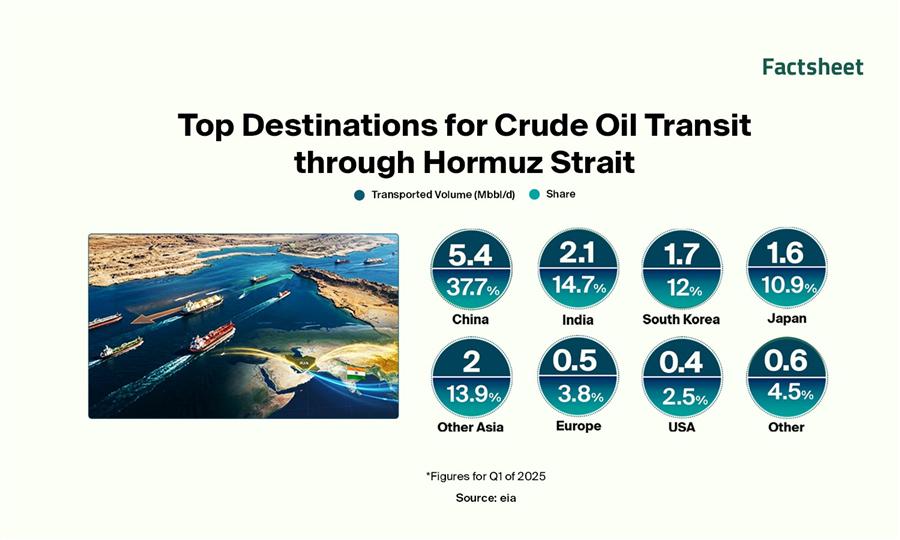
- The majority of petroleum liquids passing through the strait are directed to Asian countries. Major Asian economies collectively receive 12.7 Mbbl/d of crude oil and condensates transported through the Strait of Hormuz. China receives around 5.4 Mbbl/d, or 38% of the flows, followed by India with 2.1 Mbbl/d, South Korea with 1.7 Mbbl/d, and Japan with 1.6 Mbbl/d. In Q1 2025, Europe received 3.8% of these flows, equivalent to 0.5 Mbbl/d, while the US received 0.4 Mbbl/d.
- Saudi Arabia and the UAE have developed infrastructure allowing part of their oil exports to bypass the Strait of Hormuz. Saudi Aramco operates the 5 Mbbl/d East–West crude oil pipeline, transporting oil from the Abqaiq facilities near the Persian Gulf to the Yanbu port on the Red Sea. Meanwhile, the UAE runs a 1.8 Mbbl/d pipeline that carries crude from inland fields to Fujairah, enabling shipments to avoid the strait.
- Another alternative route is the SUMED pipeline. The pipeline is operated by the Arab Petroleum Pipelines Company (SUMED), an Arab joint venture led by Egypt. The Egyptian General Petroleum Corporation (EGPC) holds a 50% stake, alongside partners from Gulf countries. The pipeline runs across Egypt from Ain Sokhna to Sidi Kerir, with a capacity of about 2.5 Mbbl/d.
By: Amina Hussein
Related News