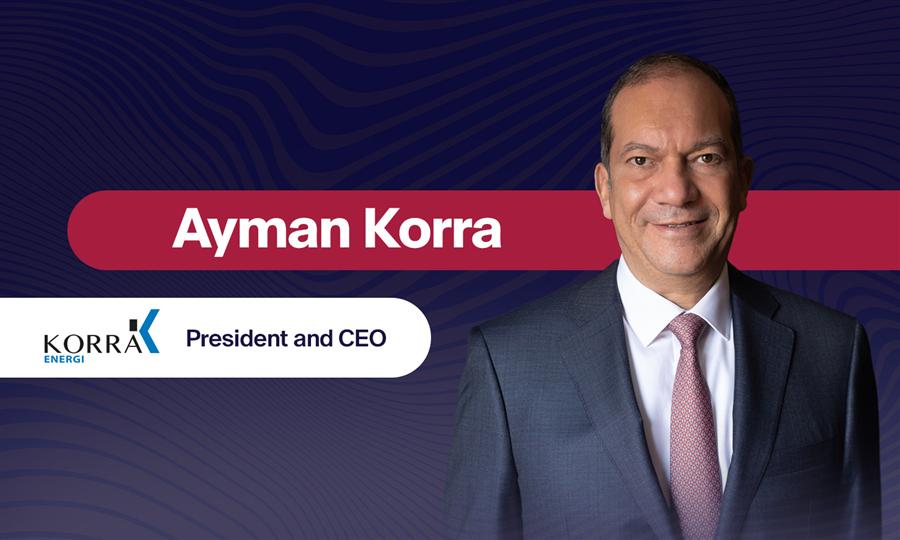
Arab Finance: As part of the Egyptian government’s aggressive economic reform strategy to deepen private-sector participation and stimulate local capital markets, the state has placed a renewed and keen focus on accelerating initial public offerings (IPOs) on the Egyptian Exchange (EGX). This strategic push to broaden corporate ownership structures comes at a time of heightened investor appetite for high-growth, resilient industries. Stepping directly into this momentum is Korra Energi, a market leader boasting over 25 years of engineering excellence and an impressive EGP 12.6 billion pipeline of active projects.
With the company officially launching its IPO to list 11% of its shares, Arab Finance sat down with Ayman Korra, President and CEO of Korra Energi, to discuss the strategic timing of the company’s market debut, the group’s unique energy-efficiency and agricultural export business model, and their roadmap for regional expansion across the GCC and Africa.
1-How would you define Korra Energi’s core mission today, and how has the company evolved over the past 25 years?
Let’s start with who Korra Energi is: a market leader specializing in integrated energy and construction solutions for over 25 years. The company leverages a portfolio of 1,471 delivered projects, a team of over 3,000 specialists, and has achieved a landmark cumulative reduction of 1,064,754 tons of carbon dioxide (CO2).
Our core mission is driven by a vision of "Building & Developing Lands (E’ammar El Arad)" by creating greater efficiency and building a better world for the industries and communities around us.
The company has evolved through the years to become the preferred partner for energy efficiency and high-value engineering projects. We lead with a strong track record and one-of-a-kind projects that allow facilities to increase energy efficiency, save costs, and reduce carbon emissions. Among our recently executed projects are the co-generation plant at Sidi Kerir Petrochemicals Co. (SIDPEC), Esh El Mallaha Petroleum Co’s (Eshpetco) hybrid solar plant, First Cement’s Waste Heat Recovery Plant, and a tri-generation plant that was inaugurated by President Abdel Fattah el-Sisi.
We also take pride in being the top choice for constructing pharmaceutical factories, holding the largest market share in this sector. Our expertise has been trusted with 38 landmark projects, including AstraZeneca, Minapharm, Jamjoom, Mevac, and Nerhadou.
2-Korra operates across a diverse spectrum. What are the group's main services, and what makes your business model unique compared to standard contracting companies?
Korra’s main services are grouped under Korra Energi and Korra Agri:
Korra Energi: Maintains a dominant footprint in sustainable green energy and construction, with proficiency in electromechanical (MEP) works and expertise in heating, ventilation, and air conditioning (HVAC) and power generation systems. All of this is supported by comprehensive facility management and after-sales services.
Korra Agri: One of Egypt’s largest exporters of fresh and frozen strawberries, processed in a state-of-the-art facility designed to meet global standards. Holding over 14 international quality certifications, including ISO 22000, GlobalGAP, British Retail Consortium (BRC), Sedex Members Ethical Trade Audit (SMETA), and Food and Drug Administration (FDA) approval. Korra Agri is proud to be the first company in Egypt to export heat-sealed packs directly to European and British markets, serving over 25 countries worldwide.
Our uniqueness lies in our integrated mix of solutions, ensuring all your needs are covered under one roof.
Our construction division is prominent due to its MEP expertise, which is why we lead in highly sophisticated engineering projects, such as pharmaceutical factories and hospitals, as well as complex renovation projects.
We also stand out with our energy efficiency projects that result in win-win solutions for all parties. By utilizing idle resources without disrupting productivity, we reduce both costs and emissions for facilities. As energy prices continue to rise, every kilowatt saved matters, directly reducing the country's USD energy import costs.
3-What are the strategic reasons behind choosing May 2026 as the definitive window to launch this IPO?
We are strong believers in the EGX's potential. The current economic reforms are very encouraging, and we think this is the perfect timing to list on the EGX. Investor appetite for new IPOs on the EGX is at a historic high, especially for a unique, market-leading company like ours that specializes in energy efficiency and renewable energy.
4-Given that an 11% free float is relatively small and the 7.2% discount against the fair value is not lucrative for retail buyers, what is the strategic rationale behind both decisions? And what message does it send to institutional investors regarding long-term value creation?
As a family, we truly believe the company has huge potential, so an 11% free float is quite good. We want all Egyptians to share in our success. The listing consists of 247 million shares, which we believe is a reasonable number. As for the valuation, we strictly followed the independent financial advisor’s (IFA) rules for a fully independent evaluator.
However, it is also worth noting that other valuations by investment banks have priced our shares at around EGP 3.5, indicating that the actual discount is well over 7.2%. Furthermore, while the independent evaluation reached EGP 3.5 per share, it applied a discount for minority shareholders.
Ultimately, we are confident that as we disclose our achievements in the coming years, investors will recognize the value they stand to gain by owning Korra shares.
5-With Egypt aggressively reforming its energy subsidies and adjusting electricity tariffs, how is this shifting the mindset of your industrial clients toward energy efficiency solutions?
Everyone now realizes the utmost importance of energy saving. Such actions are no longer a luxury but a necessity for decarbonization and competitive survival, driving a rapidly increasing urgency among clients for these solutions. Furthermore, because Egypt imports a portion of its energy sources, saving energy directly translates to reducing USD-denominated import costs for the entire national economy.
Our applied applications collectively save our clients around $203.8 million in yearly costs, a massive impact that builds deep trust once these results are proven on the ground. For example, our pioneering waste heat recovery project at a major cement facility reduced the factory's electrical grid dependency by more than 30%.
Another waste heat recovery project utilizing organic rankine cycle (ORC) technology saves 65 million standard cubic meters of natural gas consumption annually; since this is a resource the country imports in USD, the project directly minimizes the financial burden on the economy. This optimization applies not only to new solutions but also to existing energy systems.
By being the first to introduce absorption chiller technology to the market, Korra was able to save 0.5 gigawatts of electrical power, representing roughly 1% of Egypt's total installed national grid capacity.
6-Achieving a 45% renewable energy share by 2028 puts immense pressure on infrastructure. What is your assessment of the national grid's capacity to absorb this, and where are the critical bottlenecks?
While Egypt's physical generation capacity is robust, with a total capacity near 60,000 megawatts (MW) against peak loads of roughly 49,000 MW, the primary hurdle is the technical challenge of developing the grid, both qualitatively and quantitatively, to absorb the influx of renewable energy in terms of flexibility, timing, and geographic location.
The state has aggressively modernized its transmission framework, expanding the high-voltage 500-kilovolt (kV) grid from 2,364 kilometers (km) in 2014 to over 8,250 km. However, integrating the intermittent generation of renewable energy resources to meet the 2028 targets and to integrate its influx with the conventional high-momentum captive power plants in stable, effective, and high-efficiency operation to match the diversified demand profiles across the year reveals distinct operational bottlenecks.
Geographic Transmission Bottlenecks: Main renewable hubs, such as Benban Solar Park and the Gulf of Suez/Ras Shukeir wind, are far from urban and industrial demand centers. Transporting this massive localized power over long distances causes severe transmission congestion and voltage instability.
Grid Upgrade Capacity: Lower-voltage networks are inefficient for bulk transfer. Transmitting multi-GW renewable power over long distances requires expanding the 500 kV network to minimize losses and ensure system stability.
Intermittency and Storage Gaps: Solar and wind generation fluctuate wildly and do not match peak demand. The grid currently lacks the utility-scale battery energy storage systems (BESS) and pumped-storage capacity needed to smooth out these supply gaps.
Lack of Decentralization: The grid relies on a centralized dispatch model. Fully absorbing distributed renewables requires smart grids and upgraded regional control centers to manage bidirectional power flows.
7-Your current project pipeline stands at an impressive EGP 12.6 billion. Which one or two major projects are you most focused on right now, and what strategic value do they deliver to Egypt's energy landscape?
There are several projects of great strategic value currently underway. This figure includes major projects such as Maghagha Hospital in the Minya Governorate of Upper Egypt, a 316-bed healthcare facility that serves as a crucial healthcare anchor for the region. Its strategic importance lies in elevating Upper Egypt's medical infrastructure and directly supporting the national Hayah Karima (Decent Life) initiative.
Additionally, the figure includes VBC, a major pharmaceutical project strategically designed to achieve continental self-sufficiency, eliminate reliance on medical imports, and establish Egypt as a premier medical manufacturing hub for both Africa and the Middle East.
Another significant portion of this figure relates to the 10-year build-own-operate-transfer (BOOT) contract of the Tri-Generation Centralized Power Plant. The design utilizes three reciprocating gas-driven generator sets, approximately 10 megawatt electrical (MWe) each, running at 750 revolutions per minute (rpm), synchronized and load-shared with the grid. These are combined with waste heat recovery boilers to generate the rated steam, achieving an overall system efficiency exceeding 70%.
Other strategic projects include the co-generation plant at SIDPEC. By capturing waste heat to generate 50 tons of steam per hour alongside 13 MW of electricity, this project skyrockets the facility’s thermal efficiency to 89%, directly slashing operating costs and boosting overall profitability.
8-Under your group umbrella, Korra Agri exports to over 25 countries. How does this agricultural export arm serve as a strategic hard-currency hedge against local currency fluctuations for your energy business?
Simply put, we believe every Egyptian enterprise must have an export component. As one of Egypt’s top strawberry exporters, having a secure source of foreign currency guarantees financial stability when importing equipment, granting us greater operational flexibility.
We foresee the company exporting even more in the coming years, not only fruits but also services and energy-saving solutions in Saudi Arabia and Iraq, where we have recently opened new branches.
9-Revenues jumped from EGP 1.6 billion in 2022 to EGP 7.9 billion in 2025. What were the primary drivers behind this growth?
There are several factors behind this growth over the past years; we would write it mainly to:
10-Following the IPO, what is your strategic expansion roadmap in terms of both new geographies and new services?
Moving forward, our strategic roadmap focuses on aggressive geographical expansion into Saudi Arabia, Iraq, and neighboring African countries, while simultaneously scaling our market share in agricultural exports by growing our strawberry export volume.
In tandem, we are expanding our new and renewable energy portfolio to deliver superior energy-saving solutions across Egypt, the GCC, and Iraq, firmly positioning the company as the preferred, go-to partner for clean energy and energy efficiency.
Finally, we aim to accelerate the growth of our specialized services, specifically by expanding technical solutions and equipment for data centers, alongside a robust pipeline of transmission and distribution (T&D) projects and solar power plants.