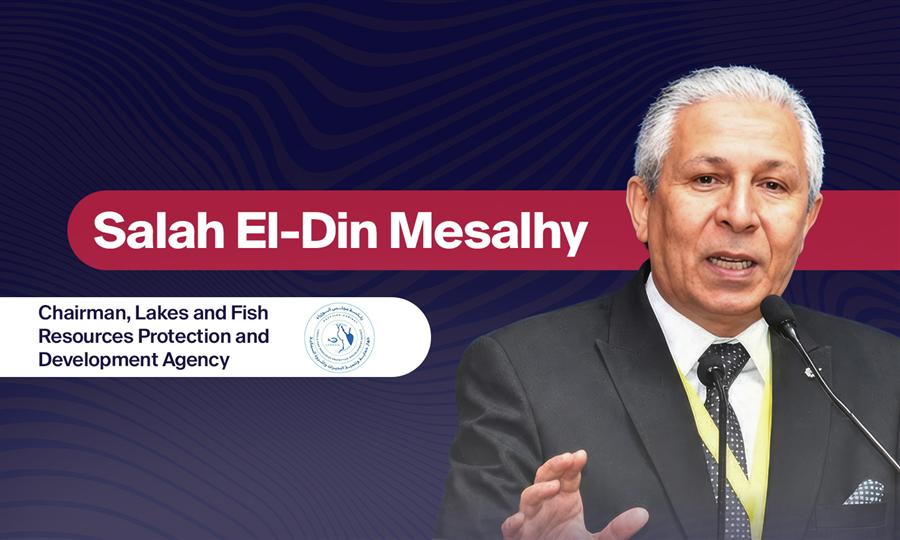
Arab Finance: Egypt’s fisheries and aquaculture sector has strengthened its position as a key contributor to national food security and economic resilience, ranking first in Africa and among the world's top 10 fish producers. According to official data from the Lakes and Fish Resources Protection and Development Agency (LFRPDA), Egypt's annual fish production exceeds 2 million metric tons. Aquaculture accounts for approximately 80% of total output, with sector-wide investments estimated at EGP 99.5 billion, according to the USDA Foreign Agricultural Service.
In this interview, we spoke with Salah El-Din Mesalhy, Chairman of LFRPDA, about the agency's strategic roadmap for increasing sustainable production, supporting small-scale producers, and developing value-added seafood industries.
1-Egypt has successfully achieved advanced levels of self-sufficiency in fish production. What is the current self-sufficiency rate?
Fish is one of the most important sources of animal protein and plays a major role in stabilizing the prices of other protein sources. In light of Egypt's current fish production, the current self-sufficiency rate has reached 92%, with an annual per capita consumption of approximately 20 kilograms (kg).
2-What are the strategic plans to maintain and increase this percentage amid economic challenges?
The Egyptian state is currently working to increase fish production volumes from various sources. The state is expanding aquaculture horizontally through national projects implemented to boost production, or vertically by adopting modern farming methods to increase output per unit of area. In addition, efforts are focused on natural fisheries by developing and upgrading Egyptian lakes and expanding open-water fishing areas.
3-Despite the expansion in aquaculture, Egypt still imports certain types of fish, such as sardines and mackerel. Are there domestic plans to localize the farming of these species and reduce the import bill?
Sardines, mackerel, and other imported fish are cold-water species, and therefore they are not farmed in Egyptian waters. They are imported through the fish import committee in accordance with actual needs and the quantities required for the Egyptian markets.
4- Fish prices fluctuate periodically. What measures does the agency take to stabilize the market, ensure a steady supply, and make fish available to consumers at affordable and sustainable prices through its retail outlets?
Fish is a commodity with unmanaged prices that is subject to supply and demand. Its prices fluctuate depending on the farming and fishing seasons. During the fishing season, large quantities of fish become available, causing prices to drop due to increased supply. Conversely, during the farming period, produced quantities decrease, which leads to higher prices.
5- National aquaculture projects, such as Birket Ghalioun (Ghalioun Lake), East Port Said, and others have marked a qualitative leap. What is the current total volume of aquaculture production compared to open-water fishing?
National projects have contributed to boosting fish production, helping total output from various sources reach 2 million tons, with aquaculture accounting for 79.5% of total production.
6-How does the agency address the environmental challenges associated with aquaculture, particularly maintaining water quality and improving water-use efficiency as semi-intensive and intensive fish farming operations expand?
Fish farms face numerous challenges annually, chief among them being temperature fluctuations. The agency issues and publishes guidelines to help farms manage and overcome these challenges. It also organizes free veterinary convoys to inspect fish farms, monitor their operations, and provide necessary guidance.
7-What technical and financial frameworks does the agency provide to help small-scale farmers modernize operations and improve production quality?
The agency conducts various training courses and workshops to provide adequate support to farmers, as well as to brief them on the latest aquaculture methods. These include workshops on utilizing clean and renewable energy in aquaculture farms to reduce carbon emissions and lower costs, particularly regarding fuel consumption.
8-Following extensive national efforts to dredge, clear, and remove encroachments across Egypt's primary lakes, such as Manzala, Burullus, what measurable impact have these projects had on fish reserves and ecological balance?
In light of the directives of President Abdel Fattah El-Sisi, the agency, in coordination with relevant authorities, has worked to develop and upgrade Egyptian lakes by removing all existing encroachments, as well as clearing out reeds and bulrushes. This has helped increase the water surface area available for open-water fishing in each lake. Additionally, work was carried out to dredge and clear the outlets connecting the lakes to the sea, which enhanced water circulation and allowed natural fry to enter the lakes, ultimately boosting their fish stocks.
9-How were fishermen's rights handled during the lakes development phases, and what mechanisms are in place to legalize fishing boats and regulate activity to prevent stock depletion?
Lake development activities did not disrupt fishing or prevent fishermen from carrying out their work. Fishing continued in the lakes without interruption. To support fishermen, formalize their work, and regularize their status, the authorities reopened license renewals for boats operating in the Nile River and lakes whose licenses had expired more than five years ago. Efforts were also made to issue new fishing licenses for both areas to reach our registered maximum limit.
Furthermore, within the framework of oversight and ensuring the prevention of fish stock depletion, advisory committees were formed for all Egyptian lakes to examine all issues hindering lake development, establish general policies contributing to the preservation of fish stocks, and ensure optimal utilization. The objective of forming these committees is to engage decision-makers, fishermen's, and security authorities in decision-making, presenting problems and finding rapid, practical solutions away from bureaucracy. This also includes studying everything that contributes to lake development and preservation, formulating proposals for the agency to implement, and involving fishermen and their representatives in decision-making to voice their concerns. This contributes to the swift responsiveness of management decisions and amplifies the positive impact of those measures.
This is in addition to the state's support for lake and Nile fishermen and small-scale fishers under the political leadership's focus on providing them with a decent life, improving their living conditions, and increasing their incomes. The state launched the 'Bar Aman' (Safe Land) initiative with a capital exceeding EGP 50 million, through which fishing nets were distributed to boat owners, along with protective suits and boots to shield fishermen from cold weather and water. The agency had also previously launched an initiative to replace and renew small-scale fishermen's boats in cooperation with the Ministry of Social Solidarity as part of the presidential 'Bar Aman' initiative, which finances the replacement of small fishing boats measuring no more than 6 meters that operate in the lakes and the Nile River, provided their owners hold a valid fishing license.
10- Modern trends indicate that true investment lies in fish processing and value addition. What is the agency's vision for transitioning from raw fish to value-added industries, such as fillets, smoked fish, packaging, and wrapping?
The agency places special importance on fish value addition. In coordination with WorldFish, it conducts training workshops for fish traders and sellers to train them on processing various fish products, such as burgers, hawawshi, kofta, and fillets, among others. These sessions have been held in Fayoum and Kafr El-Sheikh governorates, and coordination is currently underway with Sharqia Governorate.
11- Major national fisheries projects bring feed, sorting, and ice facilities under one roof. How does this integration cut production costs and strengthen the competitiveness of Egyptian fish?
National fisheries projects have added significant value to the Egyptian market through their integrated structure—combining feed, packaging, and ice plants alongside fish farms. This integration has helped cut transportation costs between the farms and the various processing facilities, and vice versa, which directly lowers the prices of fresh fish and finished products from these plants.
12-Fish waste represents an untapped resource. Is there a strategy to utilize it in manufacturing fishmeal, fish oil, and organic fertilizers rather than disposing of it?
Utilizing fish waste is extremely important, as it prevents the accumulation of microbial pollutants and outbreaks resulting from dumping waste into the environment or seas. At the same time, it maximizes national investment returns by locally providing agricultural and livestock production inputs. There are specialized factories, particularly in coastal governorates and areas with concentrated fish farms such as Kafr El-Sheikh, Damietta, and Port Said, that collect waste from retail markets as well as freezing and canning plants, recycling it to produce protein concentrates used directly in manufacturing livestock, poultry, and fish feed to reduce the import bill.
13-What standards and requirements does the agency apply to ensure that Egyptian fish and processed fish products comply with international specifications?
The LFRPDA strengthens oversight and traceability to ensure the production of safe, high-quality fish. Within this framework, efforts have focused on establishing good practices and applying international standards across fish farms, contributing to the production of safe, high-quality fish and boosting the competitiveness of Egyptian seafood in both domestic and global markets.
These standards are based on a set of fundamental requirements and veterinary healthcare protocols for fish, spanning from the beginning of the production process to harvest. Foremost among these measures are ensuring water quality, the safety of fry and feed, implementing biosecurity measures to prevent the introduction of pathogens and limit their spread among farms, conducting veterinary monitoring, and ensuring the safe and rational use of veterinary medicines and drugs—all backed by laboratory testing at the agency's ISO 17025-accredited laboratories.
Furthermore, strict adherence to hygiene and disinfection protocols, as well as sound environmental management practices, is maintained inside fish farms. In this regard, the Egyptian Good Agricultural Practices system (EGY-GAP) represents a practical step toward embedding best practices within Egyptian fish farms through integration between the agency, laboratories, scientific research institutions, and all relevant authorities, while leveraging digital transformation to develop registration, evaluation, and accreditation procedures and support the coding and traceability system.
14- How do rising temperatures affect water bodies, and what is the extent of coordination with research centers to develop fry that are resistant to climate change and diseases?
Climate change represents one of the most prominent challenges facing the aquaculture sector, given its potential impact on water temperatures and quality, as well as the heightened risk of disease and epidemic outbreaks. This can affect growth and production rates and poses a threat to investment stability in the fisheries sector.
Accordingly, the agency is keen to coordinate with scientific and research institutions, universities, and specialized centers to study climate impacts and mitigate their repercussions. This is alongside developing biosecurity programs for disease prevention and control, and supporting the production of fish strains characterized by high feed conversion and growth rates, greater disease resistance, and better adaptability to changing environmental conditions.
Through these efforts, the agency aims to support the sustainability of the aquaculture sector, bolster both domestic and global consumer confidence in Egyptian products, and elevate their quality and competitiveness—with a focus on meeting export market requirements, primarily those of the European Union, thereby opening broader horizons for Egyptian fish to access global markets.