Poultry prices in Egypt rose notably during February, largely driven by seasonal demand ahead of Ramadan, when consumption typically accelerates. To contain price pressures, the government announced plans to expand market supply through imports of frozen poultry and parts, to be sold at subsidized prices of EGP 100 per kilogram. Authorities have described the current increase as temporary, attributing it to demand cycles rather than supply shortages.
- Poultry prices reached their highest levels in nearly 10 months. Fresh baladi chicken prices rose from EGP 109 per kilogram in December 2025 to EGP 119 by mid-February 2026. The highest averages were recorded in Beheira at around EGP 137 per kilogram, followed by Ismailia and Sharqia at about EGP 135. The lowest prices were observed in New Valley at approximately EGP 81.
- Fresh white poultry prices also increased from roughly EGP 71 per kilogram in December 2025 to EGP 89 by mid-February 2026. Prices peaked in Damietta, Beheira, and Dakahlia, exceeding EGP 100 per kilogram, whereas New Valley recorded the lowest level at about EGP 68, underscoring wide regional price disparities.
- Frozen poultry prices rose from EGP 122 per kilogram in December 2025 to EGP 128 by mid-February 2026, with extreme variations across governorates. Prices exceeded EGP 190 per kilogram in Matrouh, while New Valley recorded the lowest level at around EGP 83. In parallel, the government announced an agreement to boost imports and supply frozen poultry at EGP 100 per kilogram through consumer outlets.
- Egypt’s poultry production expanded significantly in 2025, with broiler output reaching approximately 1.6 billion birds, up from 1.4 billion in 2024. Growth extended beyond white poultry, as baladi chicken production increased by 12.5% to around 360 million birds, compared to 320 million the previous year, reflecting strong domestic supply capacity.
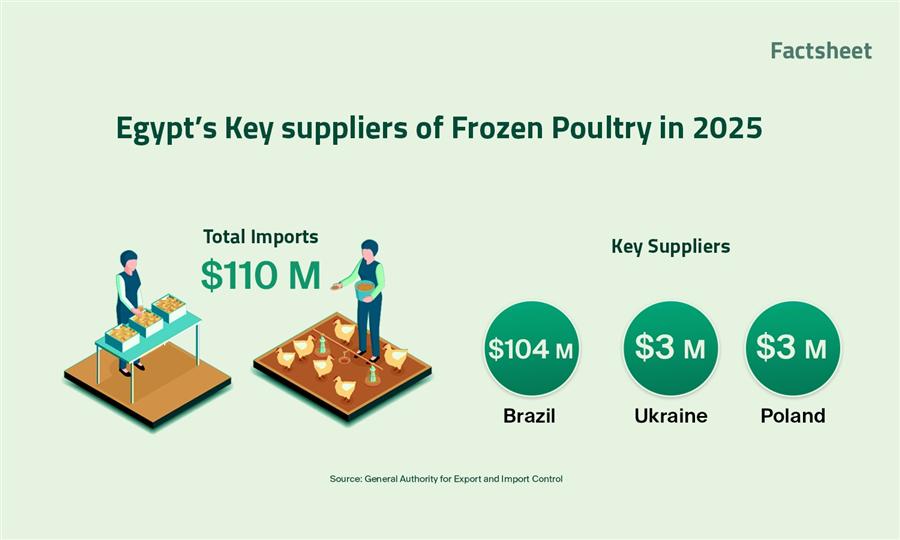
- Despite the release of feed shipments and a relative decline in corn and soybean prices, poultry prices continued to rise, indicating pricing inefficiencies or weak market oversight. In 2025, Egypt imported frozen poultry worth around $110 million, with Brazil accounting for $104 million of total imports, followed by Ukraine and Poland at approximately $3 million each.
By: Amina Hussein
Related News