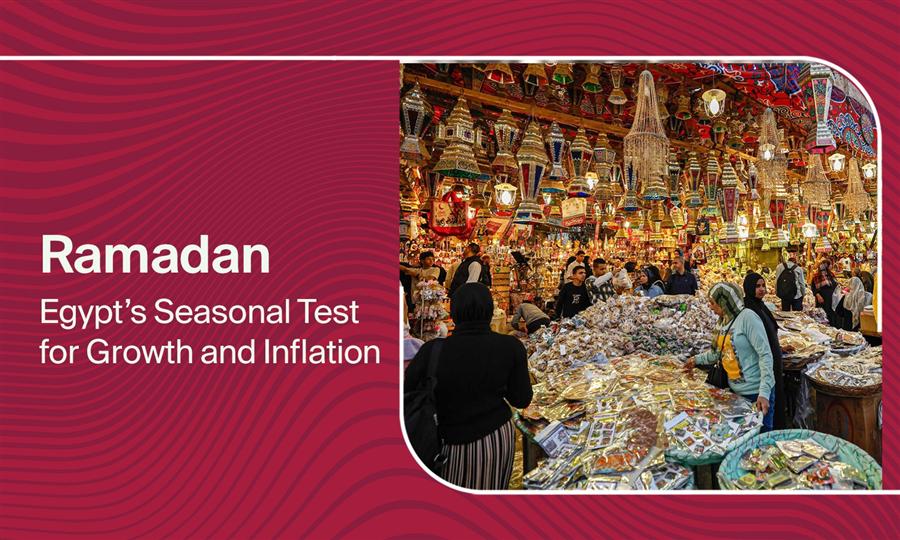
In Egypt, the crescent moon of Ramadan signals more than the start of a spiritual journey; it ignites a seasonal economic engine. The holy month triggers a massive reallocation of capital, shifting billions of Egyptian pounds through the hands of households, retailers, and charitable institutions.
Heightened demand often collides with existing inflationary pressures, testing the resilience of supply chains and prompting government interventions such as subsidies, price controls, and initiatives like the Ahlan Ramadan campaigns.
Seasonal Consumption Surge
Ramadan reliably triggers one of the most pronounced seasonal consumption spikes in Egypt’s economic calendar. As households prepare for daily iftar meals and festive gatherings, demand for food staples, sweets, and celebratory goods rises sharply.
Hazem El-Manoufy, a member of the Foodstuffs Division of the Chambers of Commerce, told the media in December 2025 that Ramadan sees a significant increase in food consumption rates. Market estimates indicate that demand rises by up to 150% compared to normal months, with monthly spending reaching around EGP 100 billion, up from an average of around EGP 55 billion during the rest of the year. This surge is driven by an increase in family gatherings and celebrations, as well as changes in the dietary patterns of more than 85% of Egyptian families.
For markets, the impact is obvious. “Ramadan usually sees a marked increase in sales, as people buy larger quantities of food and essential products in preparation for iftar and suhoor. Demand is higher for certain goods such as dates, juices, rice, sugar, and oils, which increases sales volume compared to other months,” Mohamed, a supermarket owner, tells Arab Finance.
On the household level, the financial shift is equally evident. Basant, a 38-year-old mother, says: “During Ramadan, my household budget changes and is affected by the purchasing power of many Ramadan-specific products and customs.”
Additionally, Adel, a 67-year-old breadwinner, explains: “With the arrival of Ramadan, our families prepare for this holy month due to increasing spending on food. Consequently, a special budget is set aside to manage the increased costs of food, drink, and various religious traditions, which requires advance financial planning.”
He adds that household budgets change due to “higher spending on food, beverages, and Yamish (dried fruits and nuts). These expenses are further driven up by frequent social gatherings to host family and friends for iftar and suhoor. Additionally, lifestyle changes, such as staying up late watching television, lead to higher electricity consumption. Costs related to religious duties also increase, including paying zakat and donating to charities, alongside shifts in shopping patterns towards specific goods,” Adel points out.
For many families, traditions and obligations carry significant financial weight. As Basant notes, “Traditions and obligations play a significant and influential role in the budget due to invitations and visits with family and friends.”
The Discount Dilemma
This social dimension of Ramadan often translates into higher spending on food, hospitality, and gifts. Adel says, “Many families turn to exhibitions like 'Ahlan Ramadan' to benefit from offers and discounts.”
“While these exhibitions are beneficial, they can have downsides, such as encouraging people to buy more than they need just to catch a deal, which ultimately increases spending. Other habits also contribute to budget strain, such as purchasing gifts and preparing for Eid al-Fitr, including buying clothes and desserts,” he explains.
What Adel highlights at the household level mirrors broader structural changes in Egypt’s economic management of Ramadan.
For his part, Ahmed Elwaraky, an economist, explains to Arab Finance: “The Egyptian government has proactively organized large-scale exhibitions prior to Ramadan to supply essential goods at discounted prices. These initiatives aim to mitigate seasonal price increases and protect lower-income household.”
Economist Retaj Asser explains that the very exhibitions families flock to are evolving beyond temporary relief measures: “During Ramadan, temporary price caps are being replaced by logistical depth. The Ahlan Ramadan network is evolving into a permanent public?option supply chain that pressures the private sector to maintain competitive pricing.”
Retailers and Market Dynamics
On the supply side, retailers face their own challenges. Mohamed points out that “some challenges may arise, such as sudden increases in demand, delays in deliveries from suppliers, or price increases for certain goods due to market pressure. Maintaining sufficient stock throughout the month can be difficult sometimes, especially for high-demand goods.”
Yet Ramadan also provides opportunities. He highlights the role of seasonal markets: “Ramadan markets are a big help because they draw in a lot of customers and give small businesses a chance to showcase their products and get more exposure. These markets often make special offers and discounts that encourage people to buy, which helps boost sales and improve income during the holy month.”
Meanwhile, Asser states: “For Egypt’s media, advertising, and retail sectors, Ramadan is the Q4 of the Middle East. It provides liquidity that allows firms to survive leaner months. With the International Monetary Fund (IMF) growth projections for 2026 ranging between 4.7% and 5.3%, Ramadan is a critical engine for meeting national growth targets.”
Elwaraky agrees, stating that “food manufacturing, wholesale and retail trade, sweets, advertising, media, and telecommunications all experience noticeable spikes.”
Additionally, Ramadan intensifies competition in the retail sector. Asser explains that “after years of margin pressures, 2026 sees a massive rise in retailer-owned brands. Major chains are no longer just distributors; they are competitors, reshaping consumption through a loyalty battle that pushes consumers toward house brands over global FMCG giants.”
Hence, Elwaraky highlights that “small and medium-sized enterprises (SMEs), particularly in food production and trade, experience seasonal revenue growth.”
Ramadan as a Velocity Catalyst
The holy month brings both opportunities and challenges for the national economy. Asser says, “Ramadan is the peak season for the social safety net (SSN). Major Egyptian charities report receiving up to 90% of their annual donations during this month. This represents a significant private?sector redistribution of wealth that supports the purchasing power of lower?income brackets, which might otherwise be priced out of the market.”
Moreover, “Ramadan consumption is inelastic. Essential food items are purchased regardless of price, creating a seasonal CPI peak. In 2026, the Central Bank of Egypt’s 7% ±2% inflation target makes Ramadan the ultimate stress test of monetary credibility,” Asser points out.
2026 marks a turning point. Asser describes Ramadan as a laboratory for Egypt’s digital economy. “We are seeing a permanent shift where Ramadan is no longer just a shopping peak, but a testing ground for Egypt’s digital economy,” according to Asser.
She points to the “Midnight Digital Frontier,” where 5G rollouts and dark stores fuel q?commerce between midnight and Suhoor, and the “Private Label Pivot,” where retailers push house brands to protect margins. In her view, Ramadan is best understood not as a stimulus or an inflationary element, but as a “velocity catalyst with high stakes.”
“Ramadan serves as an annual stress test for Egypt’s supply chain resilience, revealing both strengths and vulnerabilities in the system,” Elwaraky said, highlighting that one of the most critical steps to mitigate these vulnerabilities is accurate demand forecasting, which allows for early procurement and stockpiling of strategic commodities ahead of consumption peaks.
Equally vital is strengthening strategic reserves, as “maintaining sufficient buffer stocks of essential goods helps reduce vulnerability to sudden demand spikes.”
Another key takeaway is the need to enhance market monitoring mechanisms. Smart oversight can prevent hoarding, speculative pricing, and supply manipulation while still preserving healthy market signals.
Supporting purchasing power through targeted subsidies or temporary social protection measures ensures that vulnerable households are cushioned during periods of heightened demand, safeguarding social stability alongside economic resilience, according to Elwaraky.
Ramadan in Egypt is far more than a religious observance, it is a recurring economic cycle that tests the resilience of households, retailers, and policymakers alike. Families stretch their budgets to accommodate traditions and hospitality, retailers navigate surging demand and supply chain pressures, and the state intervenes to stabilize prices and ensure access to essentials.
By Sarah Samir