Arab Finance: Egypt’s energy landscape is undergoing a pivotal shift, with the renewable energy and electromechanical contracting (EPC) sectors emerging as primary engines of economic growth. As of early 2026, the renewable energy market is valued at approximately $11.79 billion, with the government targeting a significant increase in the green energy mix to 16% for the 2025/2026 fiscal year, as mentioned in a report by Research and Markets on Egypt’s renewables market.
This transition is supported by a massive EGP 136.3 billion investment plan dedicated to electricity and renewables, aimed at adding 3 gigawatts (GW) of solar capacity and 600 megawatts (MW) of battery storage by the end of 2026, according to Ministry of Planning and Economic Development.
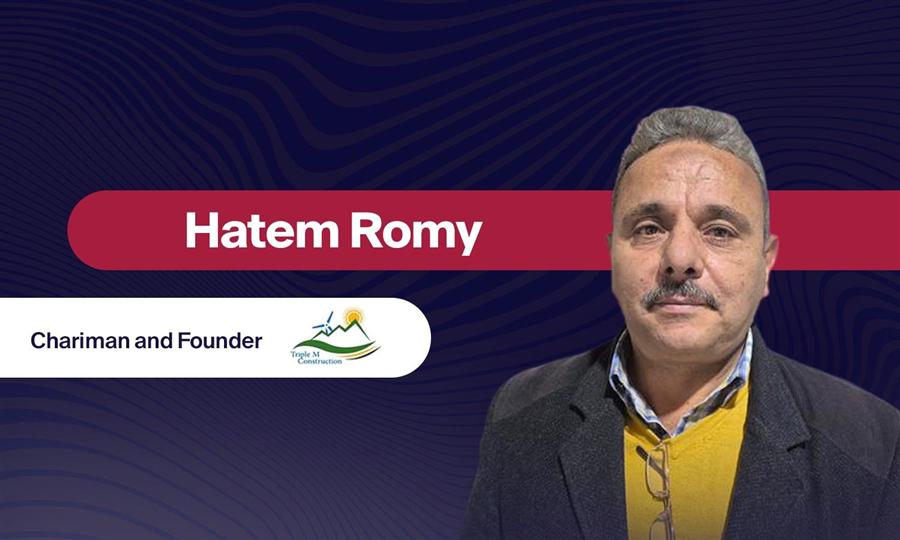
With this massive shift, we sat down with Hatem Romy, Chairman and Founder of Triple M Group, to discuss the reality of Egypt’s energy targets and its move toward becoming a regional green hydrogen hub. A staunch advocate for scientific energy management, Romy explores the necessity of localizing technology and the critical role of private-sector coordination in ensuring national energy security. Beyond the grid, Romy delves into the transformative power of the circular economy, sharing his vision for sustainable desert development through integrated biogas and livestock initiatives that empower Egypt's rural communities.
1-How do you see Egypt’s position on the regional renewable energy map?
Egypt is well-positioned and possesses all necessary components to become a regional hub for green hydrogen production. One of the most important advantages is the presence of major ports like Ain Sokhna and others that can facilitate exporting green hydrogen abroad.
However, green hydrogen production requires green energy sources owned by the government, which makes full coordination between the public and private sectors essential. To ensure national energy security during global crises, projects should involve Egyptian investors or partnerships between foreign investors and Egyptian partners.
A clear example is what happened in Yemen, where a large solar power station was shut down as disputes arose with its owner, who is a foreign investor. This caused major problems for the country.
2-What are the primary challenges facing Egypt’s energy sector?
The high cost of financing from Egyptian banks is a major hurdle. Interest rates for Egyptian investors can reach around 15%, compared to foreign investors who can secure financing from the World Bank at rates of around 1% or 2%. This creates an uneven playing field.
Another challenge is the lack of unified efforts and coordination among different government entities. Some ministries operate in isolation without sufficient coordination with one another.
3-How do you evaluate Egypt’s current energy mix?
Renewable energy can become a waste of public funds if not managed scientifically. The issue lies in the methodology used to deploy energy, the degree of adherence to investment rules, and how the energy mix is structured.
For instance, which is better: producing energy when it is needed, or generating it at a central location and then transmit production? The answer depends on scientific research and careful study of the specific problem being addressed.
Furthermore, while the Ministry of Electricity subsidizes over 50% of costs, public dissatisfaction persists, partly because some officials may hesitate to present the full and accurate data to the minister responsible. Therefore, transparency and data availability are essential for making sound decisions. Without accurate data, neither investors nor officials can make the right decisions.
4-In your opinion, which is better to invest in: solar or wind power?
Egypt has an installed capacity of 62 GW, while peak demand is only 36 GW. This means the country is energy-rich, with roughly double the capacity needed by the Egyptian population. The real question is where to invest. We should explore untapped resources like geothermal energy, which provides 24-hour power without needing storage.
We often import "ready-made" European solutions that do not fit our environment. What works in Germany may not work in Egypt. Therefore, we need local studies to determine grid capacity for solar and wind while integrating them with existing sources like hydropower from the Aswan High Dam. Energy management is a science we must adopt.
A good example of energy management is Saudi Arabia, as it invested heavily in numerous energy storage facilities worth about $7.8 billion, only to later discover that not all of these investments were necessary.
5-What is your take on the state’s 2030 plan to reach a 42% renewable energy in Egypt’s energy mix?
The government’s plan is ambitious and positive. As an investor, my role is to find economic solutions for energy challenges.
For example, 10,000 feddans of agricultural land have been reclaimed in East Oweinat, and an internal network of cables and power transformers was built there at a cost of EGP 800 million. This was not an economic solution, as solar power could have been a far more cost-effective alternative.
6-You mentioned scientific research. How vital is it for economic progress?
Scientific research in Egypt is disconnected from practical reality. Universities must align with professional and industrial sectors to help advance society. As a member of the Energy Committee at the Academy of Scientific Research, I am involved in launching initiatives aimed at connecting scientific research with industry and agriculture in Egypt. This also requires updating university curricula, while giving greater attention to technical education and changing the social stigma surrounding it.
I recently discussed the importance of cooperation between the Ministry of Military Production and Egyptian universities in the field of green hydrogen with the former military production minister. Technologies such as green hydrogen are relatively easy to localize in Egypt, both those that produce green hydrogen and those that convert it into electricity. This is unlike solar cells, which require massive investments, extensive financing, long timelines, and large-scale infrastructure. Achieving this requires cooperation between the government, research institutions, and investors at the same time.
Green hydrogen is a genius solution for energy in the future. China, the world’s leading producer of green hydrogen, already has over 100,000 heavy vehicles running on it.
Another emerging global trend is the move toward using certain plants that produce biofuel and bio-oils, such as jojoba and jatropha, at a minimum rate of 30% in aircraft operations. Airports have been notified that aircraft should use oils derived from these products within the next five years at this specified ratio. Egypt has great potential in this field.
7-What specific obstacles does Egyptian research face?
As a board member at five energy centers at Egyptian universities, I can give a real example of some of the problems facing Egyptian universities. There was a project funded by the US Agency for International Development (USAID) worth $90 million for Mansoura University, Cairo University, Alexandria University, and Aswan University before the measures taken by US President Donald Trump to halt US aid.
Unfortunately, equipment belonging to Mansoura University worth EGP 25 million under the aid has been held at Cairo International Airport for a year and has not been released because customs duties and sales taxes have not been paid. I hope that the Minister of Finance Ahmed Kouchouk will look into this matter in support of scientific research in Egypt.
Our fundamental problem is that we expect universities to develop on their own. Instead, there must be coordination with the agricultural and industrial sectors to identify society’s needs and begin studying and addressing them accordingly. There should be continuous communication between factories and universities.
Many successful international models rely on both academic and professional expertise working together. Although Egypt has thousands of PhD holders, we do not benefit from them sufficiently, and most of their research remains underutilized.
8- How do you view the "brain drain" of Egyptian scientists?
We are proud of our scientists abroad, but we must incentivize them to stay. Egypt is losing its most valuable asset: human capital, which emigrates and often does not return to serve the country. We need to create an environment that encourages them to stay in Egypt and build our industry, agriculture, and mining sectors. To rise economically, we must prioritize research and fight corruption.
Egypt should also work on exporting companies abroad while supporting those already operating there. This could be done through cooperation between the Ministry of Finance and these companies via joint banks, along with facilitation from commercial representatives at the Ministry of Foreign Affairs.
In this way, the remittances of Egyptians working abroad could gradually be transformed into revenues generated by Egyptian companies operating internationally.
9- As the head of a group of companies operating in renewable energy, how do you see this sector’s importance?
Investment in renewable energy is substantial. However, if this energy is not used efficiently and rationally as a resource, such investments could end up wasting public funds. For example, a sudden government decision to remove energy subsidies could severely impact several sectors, including agriculture, which relies heavily on diesel, as well as small and medium-sized industries.
Therefore, the transition toward renewable energy sources that do not rely on conventional fuels must be gradual and accompanied by economically viable solutions.
10- Could you provide an overview of Triple M and the core activities the company is involved in?
Triple M specializes in renewable energy and currently operates in Egypt, Saudi Arabia, Jordan, and the UAE. We are also in the process of launching two additional branches in Oman and Chad. Our "Reef Research Farm" in Egypt is a United Nations (UN) candidate as the first sustainability point in the country that incorporates all forms of sustainable energy.
The farm aims to educate youth on how to develop the desert sustainably using renewable and clean energy. It also introduces them to new ideas for launching projects and developing renewable energy applications. One such application is generating electricity, lighting, and operating heaters and cooking stoves through methane gas produced from animal waste at the research farm.
Through this process, we are working to transform animal waste into a valuable resource within the farm, linking agricultural activity with livestock production. Livestock numbers have declined sharply by about 70% over the past five years due to rising feed prices and insufficient support for farmers and agricultural workers. This issue must be addressed jointly by investors and the government.
11-How do you see linking Egyptian farms to livestock as a way to preserve it?
I will cite an example that illustrates the importance of scientific research in the livestock sector. In Egypt, producing one kilogram of meat requires about 5 kilograms of feed. In Europe, however, 3 kilograms of feed is enough to produce a kilogram of meat. This difference exists because in Europe, they control humidity levels in which the animals live and acidity levels of the water the animals drink.
At Triple M, we have launched an initiative with the Agricultural Bank of Egypt (ABE) aimed at creating productive communities in desert areas. Under this initiative, farmers receive loans to buy two cows and install a biogas unit in desert locations. This approach achieves two goals. First, it links farmers to livestock using animal waste to produce energy. As a result, farmers become more committed to preserving livestock, since the animals produce waste that can be used to generate energy. Farmers will also be motivated to expand and breed more livestock, as it becomes a key factor in the sustainability of their desert-based projects.
The initiative achieves several objectives, including preserving livestock and providing farmers and agricultural workers with a new life in the desert with all kinds of amenities. This includes building houses in the desert at only about 30% of the cost of concrete construction, using the architectural approach of the renowned Egyptian architect Hassan Fathy. This environmentally friendly architecture does not rely on steel or concrete, yet it can support buildings of up to three stories.
This model has already been implemented at the company's 15-acre Reef Research Farm, where we use all types of fish and animal waste to produce methane gas and biofuel to power various equipment, including lighting and other utilities.
Ironically, students from France and other European countries come to our farm to study environmental challenges in Egypt as part of their Master's degrees research. They develop solutions to Egyptian problems and then later sell these solutions back to us, exporting them in the form of imported products.
Hence, we need to focus on scientific research as it is the path to progress for any society. Just as we have real estate developers, we also need agricultural and industrial developers.
12-Finally, what is the key to Egypt’s economic growth?
Egypt was once the world's granary; now we are the largest wheat importer and import about 97% of its edible oils. This is due to the absence of sufficient scientific research and the lack of integration between the government, researchers, and investors.
If these three parties work in an integrated manner, many solutions could be achieved. These include addressing energy and housing issues through the development and cultivation of desert areas, increasing productivity, boosting exports, generating foreign currency inflows, and reducing reliance on imports.