Arab Finance: The MENA region’s food and beverage (F&B) sector—one of the most dynamic hospitality markets globally—is entering an unprecedented era of expansion. The food service market is projected to reach $113.72 billion in 2025, growing at an annual rate of 8.41%, according to Fortune Business Insights. Egypt is emerging as a key frontier, with its market expected to reach $11.83 billion by 2026, according to Mordor Intelligence.
Yet this momentum comes with high stakes. World Bank data shows that food inflation across the region has averaged nearly 29%, forcing operators to confront shrinking margins and accelerating a critical digital realignment.
While front-of-house innovations such as delivery apps and digital reservations have long dominated the conversation, the industry’s survival mandate for 2026 is shifting behind the kitchen door. In an industry where food costs consume up to 35% of revenue, operators are moving from fragmented supply chains to integrated back-of-house (BOH) ecosystems to protect profitability.
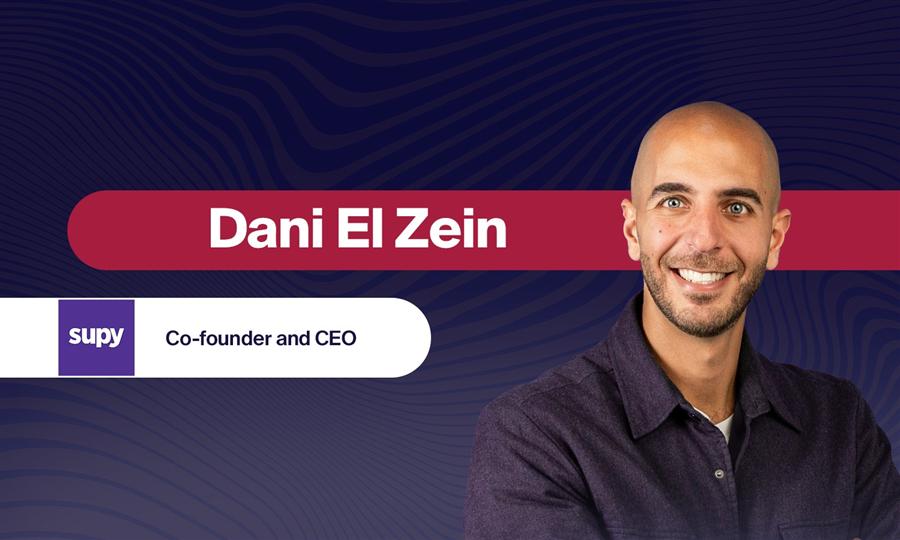
At the forefront of this transformation is Dani El Zein, co-founder and CEO of Supy. The company tripled its revenues in 2025 and expanded across 42 countries, positioning itself as the “co-pilot” for restaurant groups. We sat down with El Zein to discuss how building in the "training ground" of Dubai prepared Supy for global scaling, why the rapidly formalizing Egyptian market is the next frontier for BOH tech, and how the 2026 launch of its AI Insights Hub is introducing "Agentic AI" to the kitchen—turning raw data into autonomous, cost-saving actions that protect the bottom line.
1-Could you provide an overview of Supy's core mission? How exactly does your platform transform the traditional relationship between a restaurant and its supply chain, and what is the primary problem you are solving for global operators?
Our mission is simple: we help restaurants reduce their food costs and improve their gross profit margins.
We focus on the back of house - the forgotten child of restaurant technology and the part that determines whether you make money or not. The industry-built tools for front of house—reservations, delivery apps, point of sale (POS)—but nobody truly solved what happens behind the kitchen door. This is where costs live, and your margins are won or lost.
Supy is a full back-of-house operating system. We handle procurement, inventory management, recipe costing, reporting, and business intelligence. We connect all the data: sales from the POS, purchases from suppliers, stock on hand, recipes—and give operators real—time visibility into what is actually happening to their margins. Not last month, but right now.
Restaurants generate a huge amount of data every day, but nobody has connected it all to give operators the insight they need to act. Most operators find out too late. We make sure they find out in time.
2-Supy tripled its revenues in 2025 while expanding its footprint to 42 countries across six continents. Beyond capital, what specific operational "secret sauce" allowed the company to scale into such diverse markets as Melbourne and Hong Kong simultaneously?
There is no secret sauce—just hard work and a few things we got right.
We were fortunate to be based in Dubai, home to some of the world’s strongest restaurant brands. When these brands expand to London, Melbourne, Hong Kong, or Riyadh, they take Supy with them.
But our global expansion started organically. A restaurant group in Melbourne found us on Google and told us they needed a product like Supy there, too. We realized our software works just as well in that market and doubled down.
The real differentiator between competitors and us is our implementation and support. We have won awards for best implementation, support, onboarding, and training. We are a newcomer competing against players who have been around for over 15 years, so we focus on getting clients live and seeing value fast. Our implementation team is mostly former cost controllers, people who have worked in restaurant operations. They speak the language of the kitchen.
We have invested heavily in integrations. We connect with more than 75 POS systems, ERPs, and accounting platforms—this is critical when entering new markets. You cannot ask a restaurant group to change its POS just to use your inventory system. You have to plug into them.
Finally, culture. We move with urgency. When our tech goes down on a Saturday at 6 am (and it has), the team shows up—No questions asked. That intensity and sense of ownership cannot just be hired; it has to be built into the company’s DNA.
3-You have cited Dubai as the "world's most demanding hospitality market." How has building for the complexity of the UAE's F&B sector served as a blueprint for Supy's global success?
Dubai is the world's most demanding hospitality market: 119 Michelin Guide restaurants and 35 different cuisines in one city. Restaurant groups operate at an enterprise level—multi-brand, multi-concept, multi-country—with some of the world’s most sophisticated operators. They expect the best.
When you build a product for these operators, you are building something to work anywhere. In Dubai, we were competing with Oracle and Microsoft, not just other startups. These are the ERPs large enterprise hospitality groups were using. So, we built features with ERP-level sophistication, but user-friendly, so a kitchen porter could use them on day one.
One simple example: we built customizable stock counting templates, so a chef can count inventory in an order that matches their walk through the storeroom. It sounds simple, but that is a very enterprise-level feature demanded by our Dubai clients. Our London and Melbourne clients were genuinely surprised; their 15-year legacy software did not have it.
Dubai was our training ground. Complex, multi-currency, multi-language, massive diversity of cuisines and supply chains, which forced us to build a product to handle anything. This is how we can scale globally with confidence.
4-Most restaurant tech focuses on the "Front-of-House" (reservations/delivery). Why did Supy bet on the BOH as the primary driver of profitability, and how does this focus protect margins differently than consumer-facing apps?
Around 60% of a restaurant’s total cost is in two buckets: food cost and labour. Food is 25 to 35% of revenue alone. That is where profitability is determined, not at the front door.
During the pandemic, technology flooded front of house: QR codes, delivery platforms, reservations—all required to keep restaurants operating. Back of house has not been meaningfully reimagined in a very long time. Legacy players have essentially been doing the same thing for decades.
I started Supy after experiencing the pain of running my own restaurant. The tools available were either too complex, full ERPs designed for manufacturing, or too basic. Nothing in between. I understood the intricacies of restaurant operations - what happens when you cook a steak, when you waste some, when it expires. All are data points—movements of ingredients, but nobody was capturing them in a way to give operators real, actionable insights.
Front-of-house apps attract customers through the door. But if food costs are 3% higher than they should be across 50 branches, you are bleeding money daily without realizing it. Supy makes sure you know and, more importantly, helps you fix it.
5-In 2026, many restaurant groups are "data rich but insight poor." How does Supy's AI specifically move beyond just showing data to providing predictive actions that prevent issues before they impact the bottom line?
Restaurants sit on mountains of data—sales, purchases, inventory, recipes—but most drown in it. Dashboards show them what happened, but knowing about last week does not save you money this week.
What we are building and launching in 2026 is a powerful intelligence layer, giving restaurant groups real-time visibility, predictive insights, and clear direction on where to act. We call it our AI Insights Hub. The idea is straightforward. We do not just want to show you variances on mushrooms. We want to tell you why, which branch caused it, and what to do about it right now.
AI Sales Forecasting and Predictive Ordering is already live. We take POS sales data, overlay recipes, current stock, and incoming deliveries, and predict exact order requirements and when. We factor in weather, days of the week, and even local events.
But the real shift is moving from AI that explains to AI that acts. We are building a system that detects an anomaly—say, a coffee grinder miscalibration across 170 outlets—automatically flags it, suggests recalibration, and estimates the cost impact if the operator does not act. We are building the restaurant's co-pilot.
6-You have reported reducing food costs by an average of 20%. In an era of rising global inflation and supply chain volatility, can you break down the specific AI-driven workflows that lead to these significant savings?
The 20% average reduction is a real number and comes from a combination of workflows. Real examples are more useful here than abstractions.
One of our most powerful tools is the variance report. It shows, at ingredient and menu item levels, how far actual cost deviates from theoretical cost. A concrete example: a pizza restaurant with 12 outlets was over-portioning mushrooms by c. 5%. You would not see it on the pizza. But over six months and 12 locations, correcting that single variance saved them $50,000 a year.
Or a coffee chain where a single espresso shot is 9 grams. A miscalibrated grinder by just 1 gram—when selling tens of thousands of cups daily—wastes kilos of coffee. That is $200 per outlet, per day, from one calibration issue.
Second, AI-powered invoice processing. We have automated invoice receiving, so supplier invoices are scanned, digitised, matched to purchase orders, and discrepancies flagged. This eliminates thousands of hours of manual work and catches pricing errors otherwise unnoticed.
Third, smart procurement. Our predictive ordering takes sales forecasts, maps them against recipes, checks current stock, analyzes pending deliveries, and tells operators exactly what to order. No over-ordering, no emergency supplier runs.
Fourth, the compounding effect of accurate real-time data. When operators see actual costs of goods sold in real time - not at month-end - they make better decisions every day.
7-Given Egypt's massive and rapidly formalizing F&B sector, one of the largest in the MENA region, what is Supy's current or planned footprint in the country? Are there specific "Egyptian market" complexities you are looking to solve?
While our recent global surge has focused on hubs like London, Melbourne, and Hong Kong, Egypt remains a high-priority landscape where we already maintain an active and growing client base. We are watching the market closely because the "formalization" you mentioned is the exact catalyst for our technology.
Egypt presents a unique set of complexities that Supy is specifically engineered to solve. Supy safeguards Egyptian F&B margins against inflationary volatility, leveraging "Dubai-tested" reporting to reduce food costs by an average of 20%.
The upcoming AI Insights Hub shifts operators toward "Agentic AI," automatically detecting and correcting operational anomalies like over-portioning in real-time.
The platform delivers verifiable, source-level waste tracking to fulfill the rigorous environmental, social, and governance (ESG) and regulatory demands of Egypt’s institutional investors.
As a strategic "co-pilot," Supy provides the critical infrastructure for Egyptian brands to scale regionally with financial discipline and transparency.
8-We are seeing a massive surge in AI adoption across MENA. Where do you see the region's F&B tech landscape in the next three years? Will "Agentic AI" (AI that takes actions, not just gives advice) become the standard for regional kitchens?
We are still early in AI for F&B. There is a lot of excitement and noise, but the real impact is just beginning.
Most AI in our industry is analytical right now, examining data; explaining what happened, perhaps even why. But the next phase, and this is what Supy is building, is agentic AI. AI that does not just provide a recommendation but takes action itself.
Consider the progression. Today, our system might report: "Mushroom variance is high at your downtown branch—likely an over-portioning issue." Soon, the system detects the anomaly, automatically flags the branch manager, triggers retraining protocol for the kitchen team, adjusts the next purchase order, and updates cost projections for that branch, all without the need for human initiation.
Will that be standard across MENA kitchens in three years? For top-tier enterprise groups operating 30, 50, or 100+ branches—yes, absolutely. They are already data-savvy, see the value, and will adopt agentic AI because the return on investment (ROI) is undeniable. For the broader market, adoption will take longer, and that is fine. There is still immense value in simply getting accurate inventory data in the first place.
9-Food waste is a critical global and regional issue. To what extent is Supy leveraging its data to help restaurants meet ESG targets by minimizing waste at the source?
Food waste and food cost are part of the same problem. When Supy reduces variance, prevents over-purchasing, or flags ingredients before they expire, that is waste reduction. Fewer wasted ingredients mean fewer carbon emissions across the supply chain.
What makes Supy different is ingredient-level data on what is being wasted, where, and why. Not estimates, actual tracked data. That is what ESG reporting requires. You cannot report on what you do not measure.
Institutional investors and regulators increasingly demand measurable environmental impact from hospitality. Restaurant groups on Supy can demonstrate month-on-month waste reduction with data that holds up to scrutiny.
10-Following your tripling of revenue in 2025, what are the primary KPIs you are chasing for late 2026? Are we looking at further geographical expansion or a deeper "vertical" integration into the F&B supply chain?
The metric I obsess over is retention—gross and net revenues. If clients are staying, expanding their usage, and referring other restaurant groups to us, then I know we have something that works.
For late 2026, we have several priorities. Most significantly, we are launching our AI Insights Hub, the intelligence layer giving operators real-time visibility, anomaly detection, predictive insights, and clear direction on where to act. It fundamentally changes how clients interact with Supy, moving us from a system of record to a system of intelligence.
We are continuing geographical expansion, but not just flag-planting. We are doubling down in markets with the strongest product-market fit and the largest enterprise opportunities, the UK, Australia, Malaysia, and Hong Kong, while keeping other European and Asian markets firmly on our radar.
And beyond that, we are deepening our ecosystem of integrations. We already connect with over 75 systems, but the more embedded we are in a restaurant's ecosystem—their POS, accounting, suppliers—the more valuable our data becomes and the stickier the platform is.