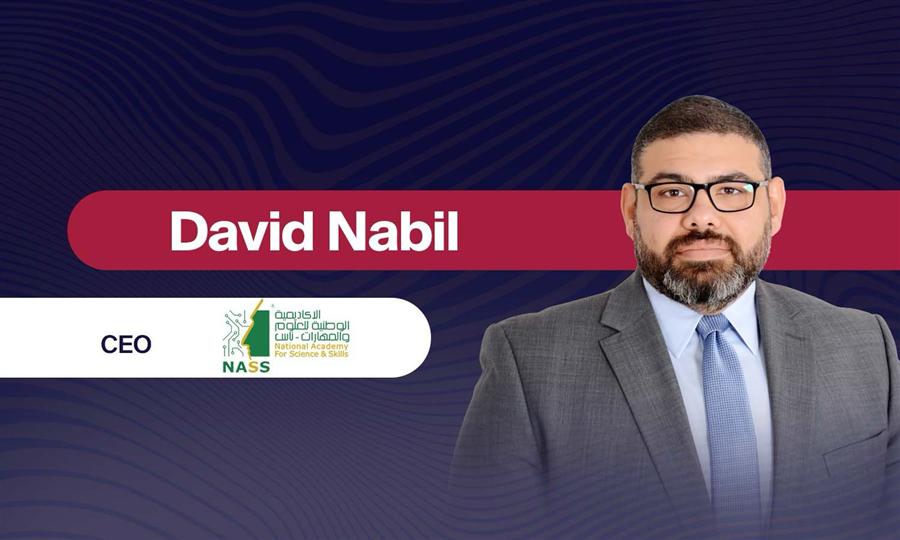
Arab Finance: As Egypt accelerates its transition toward a high-tech industrial hub, the gap between traditional education and market-ready skills has become a critical focal point for private investment. With the government allocating EGP 30.5 billion to the 2025/2026 education investment plan, technical vocational education and training (TVET) is emerging as a high-growth, counter-cyclical asset class, according to a statement by the Ministry of Education.
We sat down with David Nabil, CEO of NASS Academy, to discuss the academy's strategic partnership with Singapore’s ITEES, its expansion into 19 governorates, and how the "CashTech" of human capital is unlocking a demographic dividend for Egypt. From AI-integrated curricula to a revenue growth rate exceeding 200%, Nabil outlines how NASS is rebranding technical professionalism into a globally mobile, prestigious career path.
1-NASS recently signed a tripartite MoU with the Ministry of Education and Singapore’s ITEES. How does the "Global Excellence Model" from Singapore translate to the Egyptian industrial landscape, and what specific KPIs are you using to measure its success?
Since NASS’s inception in 2012 as an affiliate of SAMCRETE Holding, we have focused on developing a globally recognized Egyptian technical education model. This objective shaped our partnership approach to join forces with global leaders, transfer know-how, and tailor to local needs.
Applying ITEES Singapore’s GEMSET model under Egypt’s Ministry of Education will boost global benchmarking, continuous improvement, employability, and economic development outcomes core to our mission.
How does this translate to Egypt? We are not importing a foreign system. We apply GEMSET’s dimensions through four pillars: aligning with Egypt Vision 2030, targeting key sectors (manufacturing, ICT), adopting International Skills Qualification (ISQ) certificates, and building a high-performance ecosystem via infrastructure and teacher training.
We measure success with specific KPIs over 36 months, completing a GEMSET gap analysis, certifying instructors under “Train the Trainer”, achieving high ISQ pass rates, and increasing graduate employment.
We have already turned the tripartite MoU into several partnership agreements – transforming a high-level agreement into on-the-ground results.
2-With the launch of the first Innovo Applied Technology School, you are targeting high-growth sectors like AI and cybersecurity. How does NASS ensure that technical curricula remain agile enough to keep pace with these rapidly evolving technologies?
NASS’s partnership with Innovo Applied Technology School is considered an important milestone for introducing industry-based systems and applications with the integration of AI and cybersecurity. Our approach is built on three pillars of agility, all anchored in our partnership with ITEES and Singapore's proven TVET model.
We ensure that the curriculum remains agile through a modular curriculum design, rather than rigid, multi-year programs. We adopt competency-based units that can be updated independently.
Capitalizing on deep industry partnerships. We do not design curricula in isolation; we enter into partnerships with ITEES, as well as with local and global technology leaders.
Also, technology-enabled delivery. Through NASS’s LMS “NASSNA”. These platforms allow us to update training content rapidly and deploy it across all classrooms simultaneously.
Underpinning all of this is a continuous feedback loop; our instructors receive ongoing training and feedback from our industry partners to ensure that the curriculum does not become outdated. In this way, we build obsolescence detection into the system itself.
The result is not a static curriculum, but a living ecosystem that evolves with the industries it serves.
3-You have strong ties with Siemens and the Engineering Export Council of Egypt (EEC). How do these corporate partnerships influence the "Product-Market Fit" of your graduates for the private sector?
Our 13-year journey with Siemens as a strategic training partner has been a foundational element in delivering graduates with strong product-market fit. By offering Siemens Certification programs in Industrial Automation, we ensure that Egyptian youth train on the most updated, globally leading technology, from PLCs and industrial drives to digital twins and Industry 4.0 systems. This means our graduates are proficient in the exact hardware and software that private sector factories and export-oriented companies use every day.
The EEC is an example of NASS’s partnerships with the industry; the EEC represents member companies that are actively seeking qualified, job-ready personnel. Through our close ties with the Council, we aim to have direct visibility into their skill gaps and hiring needs.
The integration is paramount. NASS sits at the center, translating both into a curriculum that produces graduates who can walk into a factory or an export-oriented company and be productive.
4-The Egyptian government has allocated approximately EGP 30.5 billion to the education investment plan for 2025/2026. From a private equity perspective, what makes technical education a "buy" right now despite the high-inflation environment?
From a private equity perspective, technical education in Egypt today is not just a ‘buy’, it is a defensive, counter-cyclical asset with government-backed tailwinds.
But let me add a broader, macro-level observation. Across the world, from Germany to Japan to the Gulf states, we are seeing a massive labor force gap driven by aging populations and shrinking workforces. The best investment any country can make right now is not in real estate or financial instruments, but in qualifying human capital. Because human capital is the only asset that appreciates while everything else depreciates.
Here in Egypt, we have the opposite problem and the opposite opportunity. We have a young, growing population. Nearly 60% of Egyptians are under 30. That is not a burden; it is a demographic dividend waiting to be unlocked. But the dividend only pays off if we qualify that youth with the skills that global and regional employers actually need. Otherwise, we have numbers without productivity.
That is where the labor mobility dimension becomes critical. Our graduates, holding internationally recognized credentials like Pearson BTEC Level 3, ISQ certificates, and Siemens certifications, can and will compete regionally and globally. That means remittances, foreign currency earnings, and a direct link between Egyptian education and global labor markets.
From a private equity perspective, technical education is a ‘buy’ because government spending de-risks the sector, inflation strengthens pricing power because when household budgets tighten, families prioritize spending with the clearest, fastest return on investment, and a technical diploma that leads to a certified, in-demand job offers exactly that., and the combination of Egypt’s youth bulge and global labor mobility creates a massive, scalable market for employable graduates, which drives predictable, long-term returns.
5-What is NASS Academy’s roadmap for geographic expansion beyond Greater Cairo into industrial governorates?
Our geographic expansion is already well underway. NASS is currently operating in 19 governorates across Egypt, either by managing Applied Technology Schools or implementing other vocational projects with international partners.
Beyond Egypt, we have already delivered educational services in Malawi as a first step toward providing our model across the African continent.
And we are actively working with German partners on both training and labor mobility solutions to connect our graduates to international job markets.
NASS has a national footprint, an African presence, and a European mobility pathway all in motion.
6- How does NASS generate revenues? And what are the best financial figures that reflect NASS’s financial health?
NASS generates revenue through multiple diversified streams. These include direct training services and certification programs, consultation and curriculum development for public and private sector clients, and management fees for the full management service of Applied Technology Schools.
We have sustained a year-on-year revenue growth of over 200% for the past two years, and our net profit margin exceeds 15%, both of which are exceptional benchmarks in the education sector. These numbers reflect strong operational efficiency, recurring demand, and a scalable business model, which is considered a showcase in the technical education field.
7-With your mission to graduate "international caliber" technicians, how much of your strategy is focused on serving the local Egyptian market versus preparing a workforce for regional (MENA) or European labor export?
At NASS, we are not choosing between serving Egypt or the world; the core of our strategy is a dual mandate that fundamentally redefines what a technical graduate can achieve.
Our model has been built on a clear and ambitious vision to create a 'competitive Egypt powered by professionals who are competent, confident, and internationally certified.' This vision inherently requires a workforce that can compete on a global stage.
Therefore, a significant portion of our strategy is dedicated to preparing graduates for international labor markets in the MENA region and Europe. This means embedding international certifications from partners like Pearson BTEC, ITEES Singapore, and Siemens, combined with language and intercultural professional skills tailored to each target market.
However, the most crucial point is that these two goals are not separate tracks; they are mutually reinforcing.
In essence, by preparing our graduates for the most demanding international roles, we are elevating the baseline of skill for the entire Egyptian workforce. This dual focus is the engine for driving Egypt's economic progress, creating a professional labor ecosystem that benefits the entire region.
We're not just training people to leave, we're training them to raise the bar for everyone, wherever they choose to build their future.
8-Historically, technical education in Egypt faced a "social status" challenge compared to traditional universities. How is NASS Academy rebranding "Technical Professionalism" to attract the top tier of Egyptian youth?
Historically, the social status challenge facing technical education in Egypt was never about technical work itself. It was a direct result of the deterioration of the technical education system over decades, outdated facilities, irrelevant curricula, and no clear pathway to good jobs.
We believed someone had to break that loop. At NASS, we set out to introduce a true, decent gateway that provides real, world?class value. That meant three things:
First, a new brand for our facilities – inviting, modern, and designed to make students feel proud, not second-class.
Second, integration of behavioral change and language programs alongside the technical components, because professionalism is not just about skills but about mindset and communication.
Third, setting a visible standard of success. We treated our early graduates as ambassadors, proof that a technical career can be prestigious, high-earning, and globally mobile.
In partnership with the Egyptian Ministry of Education and Technical Education, we propagated this model through the Applied Technology Schools. Parents and learners have shown an appetite over the last years to join, because the value we promised is now real and visible. This is the right way of rebranding technical professionalism through results.
That said, we still see that the whole ecosystem, with all stakeholders involved, has a role to play. The industry needs to increase investment in the human element, and opening pathways for technological higher education and postgraduate studies is very important. This is not just NASS’s responsibility; it is a national effort.
9-As Egypt pivots toward being a Green Hydrogen and Energy hub, how is NASS integrating "Green Skills" and automation into its mechatronics and electrical programs?
Our philosophy is simple: we are ready to launch any new field as soon as industry demand is clear. We are already integrating green skills across all our programs – energy efficiency, renewable systems, sustainable manufacturing – and also in hospitality, agriculture, and supply chain.
We are currently holding several discussions with our network of partners to determine the best form of needed programs.
10-Your website highlights a model that bridges the gap between learning and employment. In a market where 50% of students often fail to meet learning benchmarks, how does NASS guarantee the "Day 1 Readiness" of its students?
The 50% failure rate is not because the skills are lacking. It is because of the human being behind the skills. At NASS, we guarantee ‘Day 1 Readiness’ not by teaching more content, but by transforming mindsets.
Yes, validated technical skills and academic excellence are essential. But what makes someone truly employable is being agile, eager, and professionally self-aware. That is why our core methodology is not just a curriculum; it is a comprehensive transformational program.
Each learner goes on a journey starting with self-awareness, then building the habits, communication skills, and problem-solving mindset that turn a technician into a true key player professional. We measure readiness not only by exams, but by behavior, initiative, and the ability to adapt on the job.
11- In your opinion, what does Egypt need fundamentally in its education system to match the needs of the growing tech realm?
Egypt’s education system needs four fundamental shifts to match the growing tech realm.
First, we need one entity to standardize and recognize for all Technical Education and Vocational Training efforts. That is what we are all looking for, and we believe ETQAAN is the key to closing this gap.
Second, a culture of hands-on mastery, where technical education is not a second choice but a source of pride. This means embedding a ‘craftsmanship’ mindset from an early age, with practical training and full integration between schools and applied sciences.
Third, massive employer partnerships, every technical school should have direct industry partners that co-develop curricula, provide internships, and guarantee that what is taught is what is actually needed.
Fourth, a national lifelong upskilling system where every citizen, regardless of background, has continuous access to future-ready training tied directly to labor market needs and new trends.
What Egypt needs is not just more schools. It needs a national movement for skills, a culture of craftsmanship, and a collective commitment to making technical education truly prestigious. That is how we compete globally.