Arab Finance: Egypt’s non-banking financial services (NBFS) and digital wealth management sectors are undergoing a massive transformation, fueled by rising digital adoption and a strategic shift by savers looking to preserve capital in a challenging economic climate. According to the data from the Central Bank of Egypt (CBE), the nation's financial inclusion rate reached an impressive 77.6% by the end of 2025, illustrating a massive shift toward formal financial mechanisms. Backed by forward-looking initiatives by the Financial Regulatory Authority (FRA) to test and supervise digital-native financial solutions, platforms that digitize traditional saving habits are finding substantial traction.
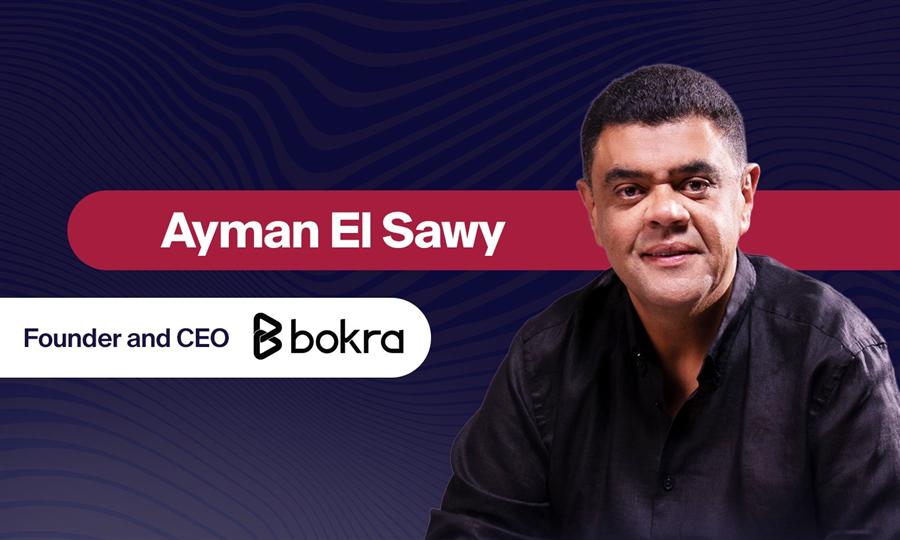
In this interview, we sit down with Ayman El Sawy, Founder and CEO of Bokra, to discuss the company's strategic pivot from a focused goal-based application into a comprehensive, multi-sector investment house. El Sawy breaks down how they are digitizing familiar Egyptian saving practices, why Sharia compliance serves as a trust catalyst for locking in latent household capital, and how their product pipelines are designed to offer retail savers a resilient, asset-backed hedge in unpredictable markets.
1-Since your successful $4.6 million pre-seed round, Bokra has evolved into a diversified fund pipeline. How would you describe Bokra’s evolution in 2026, and how is the company shifting from a "goal-based app" to a comprehensive, multi-sector investment house for the Egyptian market?
When we launched Bokra, the idea was simple: to give everyday savers in Egypt a more accessible, structured, and goal-based way to save and invest. That core vision has not changed, but the platform has grown significantly around it. The philosophy behind our product offering is to digitize traditional Egyptian savings behavior and deliver products that are suited to the Egyptian DNA.
Egyptians already save through familiar habits and concepts, whether through gold, rotating savings groups ‘gameyas’, savings ledgers, fixed-income style products, or long-term family planning. Our role is to take these behaviors and place them within a regulated, digital, and more transparent investment framework.
In 2025, we completed an EGP 3 billion retail sukuk issuance through the platform, which was an important validation that Egyptian retail savers are ready for more structured, Sharia-compliant investment products when they are offered in a simple and trusted way.
In 2026, Bokra is evolving from a goal-based savings app into a broader multi-asset investment platform. Today, we are building products that serve different savings needs across the user’s financial life. Daftar El Tawfeer is designed for short-term, flexible daily savings. Bokra Sukuk offers a more structured, CD-like product with monthly profit distributions. El Shakmagiya, our precious metals fund, brings exposure to 24K gold into a regulated investment framework. The Pension Card is designed for long-term retirement-oriented saving plans.
Later this year, we expect to bring additional funds to market across new asset classes and sectors. Taken together, this reflects the direction Bokra is moving in: the goal-based app was our entry point, but the bigger ambition is to become a comprehensive, multi-asset investment house serving the Egyptian market through regulated, accessible, and culturally relevant financial products.
2-Can you give us details about Shakmagiya Fund? And how does the Fund specifically bridge the gap between "dead capital" kept in a drawer and a regulated, high-yield financial vehicle that offers real returns?
El Shakmagiya is Bokra’s Sharia-compliant precious metals fund, designed to give users exposure to physical 24K gold, 999.9 purity, without the operational burden of buying, storing, securing, or reselling the gold themselves.
Gold has always been part of the Egyptian savings culture. For generations, Egyptian households, especially Egyptian women, have understood the value of gold as a way to preserve wealth, plan for the future, and protect savings long before it became widely discussed as a formal investment asset. The challenge is that much of this wealth is still kept informally, often at home, outside the regulated financial system.
This is where El Shakmagiya comes in. The fund takes a deeply familiar savings behavior and places it within a regulated investment structure. Instead of users physically buying and storing gold, the fund provides exposure to securely vaulted physical gold, managed professionally and held with institutional-grade custody arrangements.
In that sense, El Shakmagiya helps bridge the gap between gold kept in a drawer and gold held as part of a transparent, regulated financial product. The objective is not to change how Egyptians think about saving; it is to modernize the way they access an asset they already trust.
3- The fund is structured to be Sharia-compliant. In the current economic climate, how does this certification act as a "trust catalyst" for both retail savers and institutional investors looking for ethical hedging tools?
Sharia compliance is not a feature we added to broaden our market; it is a reflection of what we believe is simply the right way to structure a product. There is something worth saying here that often gets lost in technical conversations. Sharia-compliant finance is built on genuine economic fundamentals, real assets, real transactions, and real value creation. It prohibits speculation, excessive risk, and extractive structures. In other words, it demands that money serve a productive purpose.
For retail savers, the certification removes one of the most significant psychological barriers to participation. A large segment of Egyptian savers has historically stayed out of formal financial products, not because of lack of interest, but because of legitimate questions around permissibility. When that concern is addressed through a credible, transparent compliance framework, the conversation shifts entirely. It is no longer "Is this allowed?"—It becomes, "How do I get started?" That is a profound unlocking of latent capital.
In the current economic climate, where inflation has eroded purchasing power and trust in conventional instruments has been tested, that certification carries even more weight. People are looking for stability, and they want it in a form they can believe in. That is what we mean when we call it a trust catalyst. It is not marketing language; it is the mechanism.
4- One of the main barriers to gold investment is the difficulty of quick liquidation without losing value (the "spread"). How does the Shakmagiya Fund ensure that investors can exit their positions more efficiently than they could with physical bullion?
Anyone who has tried to sell physical gold in Egypt knows the experience. You go to a dealer, they give you a price well below what the market says your gold is worth, and you either accept it or leave. The process is opaque, slow, and it almost always disadvantages the seller.
El Shakmageya works differently. Savers hold units in a regulated fund, so when you want to exit, you are not negotiating with anyone. You redeem at a price tied to the fund's net asset value, which is based on transparent, market-referenced gold pricing. What you see is what you get.
The process itself is also far simpler. You submit a redemption request through the application, and it is processed within a defined settlement window. No physical transport, no authentication, no back-and-forth.
And unlike physical gold, where you either sell a whole piece or nothing at all, with El Shakmageya you can redeem exactly the amount you need. That kind of flexibility is something physical gold can never offer. The spread does not disappear entirely in any gold vehicle, but in a regulated fund structure, it becomes predictable and transparent. For the everyday savers, that is a very different experience from what they are used to.
5-With several gold investment funds already active in the Egyptian market, what is the specific, unique value proposition of the Shakmageya Fund? Furthermore, given the recent surge in similar vehicles, do you believe the market has reached a saturation point, or is there still significant "white space" for more precious metal instruments?
I want to reframe the questions slightly because El Shakmageya is not really competing with other gold funds. It is competing with the gold sitting in Egyptian homes. That is where our true market is. The billions of pounds worth of gold stored in drawers and jewelry boxes across the country, that is what we are trying to mobilize. The existing funds are largely serving investors who already participate in formal financial markets. We are going after the much larger population.
Our distribution is app-first, which means the barrier to entry is genuinely low: no prior investing experience, no broker, no complex onboarding. We also offer the lowest fee structure, keeping it competitive and transparent, so that cost is never the reason someone hesitates.
When you are asking an Egyptian household to move away from a habit it has trusted for generations, the value exchange must be obvious, and the friction has to be minimal. That includes fees.
The Sharia-compliance dimension reinforces that positioning. It addresses the single biggest reservation that a large segment of our target customers have, and it does so through a credible, certified framework, not just a label.
As for saturation, that is not the reality we see. Egypt has over 100 million people, and informal gold holdings represent one of the largest pools of savings in the region. The formal gold fund market has barely touched that. El Shakmageya is not here to take market share from other funds; it is here to bring an entirely new pool of capital into the formal economy.
6- Beyond gold, how is Bokra preparing its users to navigate a 2026 landscape defined by fluctuating interest rates and regional instability?
We are preparing them by giving them more options, better tools, and clearer information because no single asset class wins in every environment.
Interest rates in Egypt have gone through a significant cycle. When rates were high, fixed-income instruments were the obvious choice for capital preservation. As that cycle turns, people who were parked entirely in deposits or treasury instruments will need to think differently. Our job is to make sure they have somewhere productive to go.
That is exactly what our sukuk issuance in 2025 was about. We brought a Sharia-compliant fixed income instrument to retail savers who previously had no access to that market. Sukuk gave our users a way to generate stable, predictable returns backed by real assets and real economic activity, not just interest on paper.
In a volatile rate environment, that kind of instrument is genuinely valuable. It is structured on sound fundamentals, and it is accessible through the app without any of the complexity that typically surrounds fixed income investing.
Building on that, the gold fund addresses inflation and currency concerns. The upcoming venture funds give exposure to a sector with strong domestic growth drivers. Together, they give our users the ability to spread their exposure across different asset classes and return drivers because in an environment this uncertain, concentration is a real risk.
Regional instability is harder to hedge against directly. But a diversified, regulated, Sharia-compliant portfolio built on real assets is about as resilient a position as a retail saver in this market can hold. That is what we are building toward, and the sukuk was the proof point that we can deliver it.
7- Can you walk us through Bokra’s other funds, especially in the real estate and healthcare sectors?
These are three funds we are genuinely excited about, not just for their return potential, but for what they represent in terms of where Egyptian capital can go.
The real estate fund focuses specifically on underdeveloped cities like Banha and Asyut. While most institutional capital continues to chase developed areas, we see real opportunities in cities with strong population bases and growing infrastructure that have been consistently overlooked. Beyond the returns, the social dimension is equally important: bringing organized investment into these communities creates jobs and builds long-term local value.
The health-tech fund targets the intersection of two powerful realities: a structurally underfunded healthcare system and a rapidly evolving technology landscape. This is a sector with strong domestic growth drivers and real room to scale.
The manufacturing fund is where the story becomes particularly compelling. Egypt is at an industrial inflection point. Global supply chains are being restructured, and Egypt's geography, labor force, and improving logistics infrastructure position it well to capture that shift.
All funds are built on real assets and real economic activity.
8- The Egyptian non-banking financial services (NBFS) sector is undergoing a massive digital transformation. Do you believe the Egyptian investor is finally ready to decouple from traditional banking and fully embrace digital, asset-backed wealth management?
I would not frame it as decoupling because that suggests a clean break, and that is not how behavioral change works. What I would say is that the Egyptian investor is ready to expand beyond traditional banking in a way they were not five years ago.
The shift is real, and it is being driven by a combination of factors that have converged at the same time. Inflation has eroded the real returns on bank deposits. The devaluation cycle has made people rethink where their savings are held. Meanwhile, a generation of younger Egyptians has grown up with a phone in their hand and a natural comfort with digital services. Those three forces together have created an opening that did not exist before.
But trust is still the central variable. Egyptians do not abandon familiar institutions easily, and they should not have to. What we are seeing is not a rejection of banks; it is a growing appetite for complementary options. People want to keep their salary account where it is and still have access to a gold fund, a sukuk, or a diversified portfolio. The question is no longer "instead of the bank”; it is "in addition to the bank."
So yes, the readiness is there. But the responsibility is on platforms like Bokra to meet that readiness with products that are transparent, regulated, and worthy of the trust being extended.
9- What are Bokra’s plans for the rest of 2026?
2026 is an execution year for Bokra. The groundwork has been laid: our application is live, our EGP 3 billion sukuk issuance has been completed, El Shakmagiya is now on the market, and the focus for the rest of the year is on delivering what we have committed to.
Our immediate priority is bringing the next wave of regulated investment products to market. We currently have three funds in the pipeline: a real estate fund and two multi-series venture debt/capital funds. Each one is at a different stage of structuring and regulatory preparation, but our target is to make them accessible before the end of the year.
On the platform side, we are investing in the user experience to make the investment journey simpler, faster, and more informative. Financial literacy is also a major focus for us. We do not want users to simply hold products; we want them to understand what they are saving in, why it matters, and how it fits within their broader financial goals.
We are also focused on growing our savers’ community, both in size and in depth of engagement. For us, success is not only about bringing more users onto the platform, but about helping them become active, informed users who are gradually building real portfolios over time.
Overall, the plan for the rest of 2026 is to execute with discipline: expand Bokra’s product ecosystem, grow AUM responsibly, deepen user trust, and continue positioning Bokra as a regulated, accessible, and culturally relevant investment platform for the Egyptian market.