Following the previous two parts of the 2025 recap, this last part reviews the global economic scene performance during 2025, focusing on the performance of strategic commodities, including crude oil, natural gas, and precious metals.
- In 2025, global oil prices trended downward as supply growth outpaced demand. West Texas Intermediate (WTI) crude peaked in the low $70s in January before sliding to about $56 per barrel by December, while Brent crude eased from the mid-$70s to around $63 by year-end. Oversupply from US shale production, OPEC+ output increases, and weak demand growth curbed prices despite periodic geopolitical spikes. As a result, markets ended the year generally weaker, with analysts widely citing falling inventories and surplus concerns as core drivers of this slide.
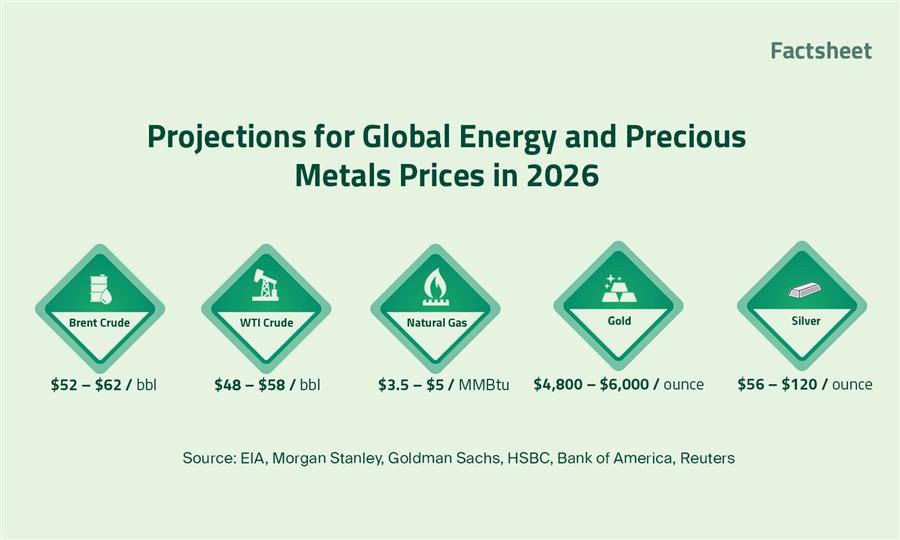
- For 2026, major entities expect continued price pressure with varying ranges. The US Energy Information Administration (EIA) projects average Brent prices to be around $55 per barrel and WTI near $51–52. J.P. Morgan forecasts Brent at roughly $58 and WTI at $54. Meanwhile, Goldman Sachs expects Brent and WTI prices to average $56 and $52, respectively, amid surplus risks. Some polls and forecasts from sources such as Reuters and Morgan Stanley place Brent in the $55-65 range, although downside scenarios persist if inventories remain high.
- In 2025, natural gas prices climbed from the historic lows recorded in 2024, averaging around $4.1–$4.2 per million British thermal units (MMBtu) as demand rebounded and inventories tightened on a year-on-year basis. Seasonal weather swings and strong liquefied natural gas (LNG) trading helped sustain price volatility. For 2026, global natural gas prices are projected to be moderate to higher than recent lows, with expected volatility. The EIA forecasts spot prices to average around $3.5 per MMBtu, while institutions like Morgan Stanley predict a potential surge above $5 per MMBtu.
- In 2025, both gold and silver surged strongly. Gold climbed from roughly $2,650 per ounce in January to record levels above $4,500 per ounce by December, driven by safe-haven demand amid geopolitical tensions and monetary uncertainty. Silver outpaced gold, rising from about $30 per ounce in January to nearly $70–$77 per ounce by year-end, reflecting both investment flows and booming industrial demand, especially in green energy and technology sectors.
- Forecasts for 2026 vary but remain bullish. Goldman Sachs raised its year-end 2026 gold forecast to about $5,400 per ounce, with central bank buying and investors hedging as key drivers. Other analysts see gold in the $4,800–$6,000 range. Silver projections range widely, with some models forecasting $56–$120 per ounce. Strong industrial demand and supply deficits underpin upside, while broader sentiment and analyst surveys see silver continuing to outperform gold due to robust demand fundamentals.
By: Amina Hussein
Related News