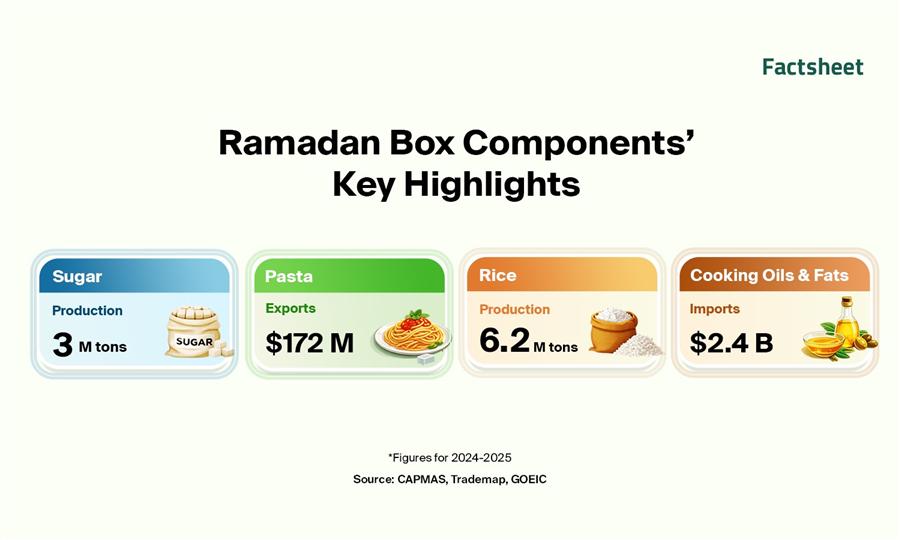
Ramadan in Egypt is marked by organized charitable giving, with households, businesses, and civil society preparing food boxes and bags for low-income families. These packages typically include sugar, pasta, rice, and cooking oil and ghee, reflecting core items in the national diet. Distribution expands in the weeks preceding the holy month to ensure stable access to basic staples.
In this factsheet, we review the latest available data on the production, consumption, trade flows, and market trends of the main components of the Ramadan box.
- Egypt’s sugar production increased from 2.5 million tons in 2024 to around 3 million tons in 2025, while domestic consumption exceeds 3.4 million tons annually. The rise in output was driven by the expansion of cultivated areas, with sugar beet reaching about 750,000 feddans and sugarcane around 310,000 feddans. A three-month ban on refined sugar imports, ending in February 2026, reduced import value from nearly $1 billion in 2024 to $647 million in 2025.
- Egypt is a rapidly expanding pasta producer with a growing export base. Pasta and related product exports reached $172 million in 2025, up from $156 million in 2024, reflecting annual growth of around 10%. Egypt ranks 20th among the world’s largest pasta exporters, holding a 1% global market share. Regionally, it ranks second among Arab countries after Saudi Arabia.
- In 2024, the cultivated rice area reached approximately 1.3 million feddans, generating a production of 6.2 million tons. Per capita supply stood at about 37.7 kilograms annually, underscoring rice’s role as a staple commodity. Domestic production largely meets local demand, with trade flows adjusted periodically to maintain price stability and adequate supply levels. In 2025, rice imports amounted to nearly $130 million, marking an annual increase of 33%.
- Egypt relies heavily on imports to meet domestic demand for edible oils and fats. Per capita consumption ranges between 10 and 13 kilograms annually, while local production covers only 2–10% of total demand due to climatic and environmental constraints limiting oilseed cultivation. As a result, imports reached $2.4 billion in 2025, accounting for around 3% of Egypt’s total non-petroleum import bill, highlighting structural dependence on external supply.
By: Amina Hussein
Related News