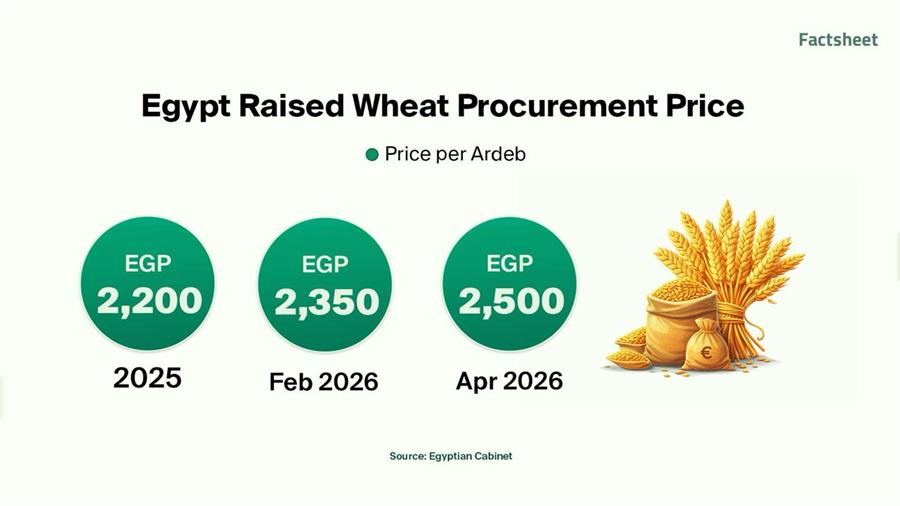
Egypt has long been recognized as an agricultural country, with farming forming a central pillar of its economy and food system for centuries. However, successive global shocks have disrupted supply chains and increased production costs, contributing to periods of food insecurity. Rising global oil prices, in particular, have driven up local fuel costs, placing pressure on agricultural inputs and leading to notable increases in crop prices. For instance, the Egyptian government raised the procurement price for wheat to EGP 2,500 per ardeb to reduce reliance on imports.
In this factsheet, we examine the sector’s economic significance and assess its capacity to meet domestic demand.
- The agriculture sector generated a gross domestic product (GDP) of EGP 3 trillion in fiscal year (FY) 2024/25, with a modest 2.76% year-on-year (YoY) growth. Agricultural activities made a relatively considerable contribution to the country’s GDP in FY2024/25, accounting for around 17.2% of GDP.
- According to recent data published by the Central Agency for Public Mobilization and Statistics (CAPMS), the average daily wage rate in agricultural activities reached EGP 196 at the end of 2025. The sector employs around 20% of total Egyptian labor. The employment rate is higher among females, accounting for 25.4%, while males represent 18.7%.
- In FY2024/25, the contribution of agriculture to public investments increased to 4.2%, compared to 4.1% during the same period a year earlier.
- Foreign investments in agricultural activities are relatively small compared to other sectors, as they hit $101.3 million in FY 2024/25, representing only 0.4% of total foreign direct investment (FDI) inflows to Egypt.
- During the agricultural season 2024, the total cultivated area in Egypt reached 16.9 million feddans. Around 73% of this area was cultivated with crops, including wheat, rice, and maize. Wheat represented 26% of the total cropped area.
- In 2025, agricultural exports hit $4.8 billion, representing 9.5% of Egypt’s non-oil exports and recording a 2% YoY growth rate. Citrus, potatoes, and grapes were the top exported agricultural commodities, with exports valued at $480 million, $498 million, and $346 million, respectively.
By: Amina Hussein
Related News