Happy Eid El Adha to all. As one of the most significant celebrations for Muslim communities worldwide, Eid El Adha carries unique traditions and a special spirit. During this occasion, Muslims perform the ritual sacrifice of livestock, including cattle, sheep, goats, buffaloes, and camels, with the meat distributed among family members, neighbors, and those in need.
In this factsheet, we present an overview of Egypt’s livestock sector and its main components, along with key statistics on fresh meat production and consumption. Grab a plate of fattah and enjoy the read!
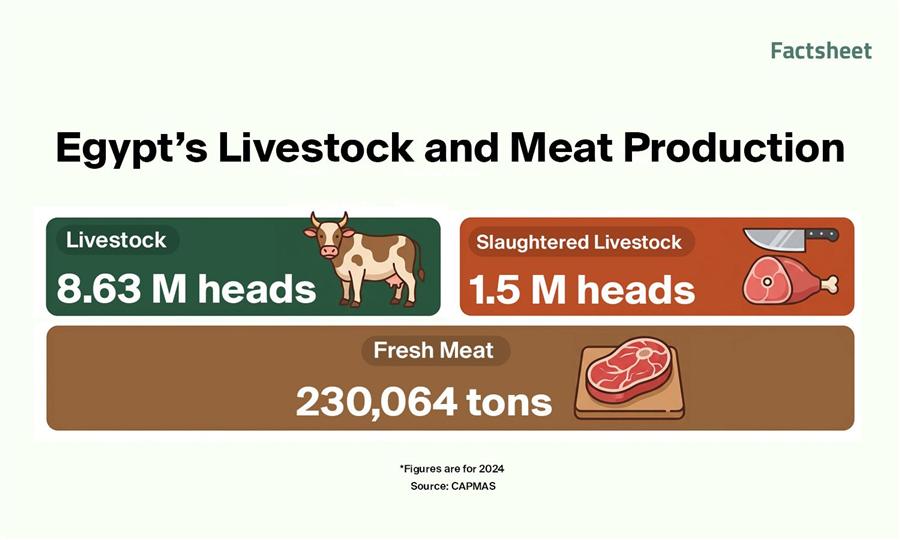
- In 2024, Egypt’s livestock, including cattle, buffalo, sheep, goats, and camels, increased by 13.2% year-on-year (YoY) to 8.63 million heads compared to 7.6 million heads in 2023.
- Egypt’s livestock structure included 3.15 million cattle, 2.12 million sheep, 1.53 million buffaloes, 1.1 million goats, and 189,995 camels.
- In 2024, Beheira, Sharkia, and Minya emerged as Egypt’s leading governorates in terms of livestock population. Beheira held the top position with 545,924 heads, followed by Sharkia with 366,768 heads, and Minya with 230,697 heads.
- In 2024, the total number of slaughtered livestock in Egypt declined to 1.52 million head, down from 4.2 million in 2023—an overall decrease of 63.8%. Of the total slaughtered animals, cattle accounted for 47%, buffalo for 4%, sheep and goats collectively for 30%, while camels represented 4%. Notably, Egypt has 495 public slaughterhouses.
- A notable decline was recorded in Egypt’s fresh meat production, which totaled 230,064 tons in 2024—down 65% from 650,000 tons in 2023. Beef accounted for 65% of the total output, followed by buffalo meat at 23%, sheep and goats at 5%, and camel meat at 6.8%.
- The average per capita consumption of red meat in Egypt reached 8 kilograms in 2024. The total domestic consumption recorded 1.06 million tons. This indicates a self-sufficiency rate of 55.4%. Hence, Egypt bridges this consumption gap through importing livestock and frozen meat.
- Egypt’s imports of livestock hit $232.2 million. This amount placed Egypt among the top Muslim countries importing livestock in 2025. The key supplying markets were Colombia, Brazil, and Czech. The meat imports, on the other hand, recorded $1.37 billion coming mainly from India, Brazil, and the US.
By: Amina Hussein
Related News