Egypt’s economy recorded improved performance in fiscal year (FY) 2025/26, supported by stronger economic growth, declining inflation, improved fiscal balances, and higher foreign investment inflows. Net international reserves also increased, while the balance of payments (BoP) shifted from a deficit to a surplus. However, the widening current account deficit, driven by a significant increase in merchandise imports, remained a key external challenge. Looking ahead, local and international institutions expect continued economic growth in FY2026/27, although forecasts differ regarding growth momentum, inflationary pressures, fiscal performance, and external balances.
In this Factsheet, we review the performance of the Egyptian economy during the past year and explore forecasts for the ongoing year.
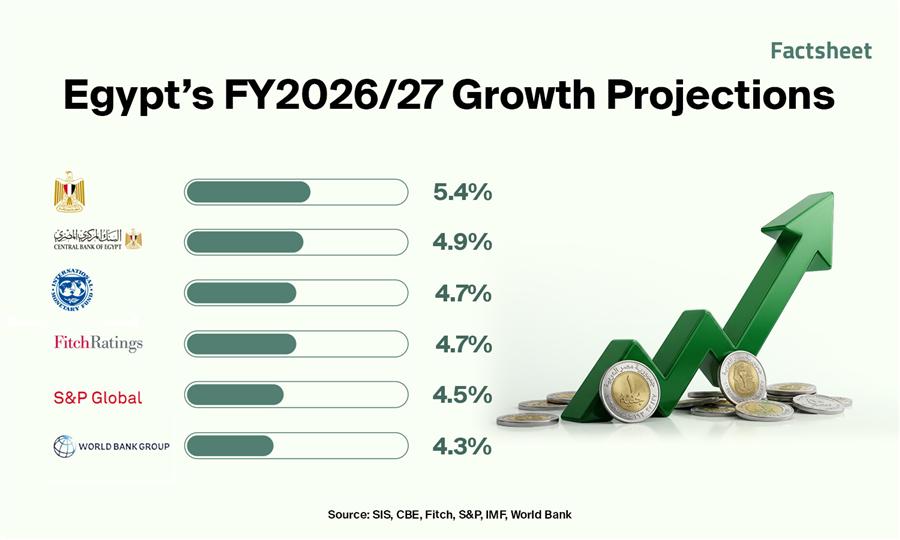
- Egypt’s gross domestic product (GDP) growth rate increased to 5.1% in FY2025/26, compared with 4.4% in FY2024/25. For FY2026/27, projections range from 4.3% by the World Bank to 4.9% by the Central Bank of Egypt (CBE), while the International Monetary Fund (IMF) and Fitch both forecast 4.7%, and S&P Global expects 4.5%. The government’s growth target is 5.4%, exceeding all institutional forecasts and reflecting expectations of continued economic expansion.
- Egypt’s inflation rate declined to 11.6% in FY2025/26, from 19.9% in the previous fiscal year. For FY2026/27, forecasts indicate renewed inflationary pressures, with estimates ranging from 12.3% by Fitch to 14.8% by the IMF. S&P Global and the World Bank project inflation rates of 12.9% and 14.2%, respectively, while the CBE expects inflation to range between 15.2% and 17.8%. These projections suggest that inflation will remain elevated, despite the substantial decline recorded in FY2025/26.
- Egypt’s budget deficit narrowed to 5.8% of GDP in FY2025/26, compared with 7.22% in FY2024/25, while the primary surplus increased to 4.9% of GDP, from 3.52%. For FY2026/27, Fitch projects that the budget deficit will remain at 5.8% of GDP, whereas the World Bank expects it to widen to 6.5%. Government debt projections also vary, with S&P estimating total government debt at 89% of GDP and the World Bank forecasting 76.3%.
- Net international reserves increased to $55.07 billion in FY2025/26, from $48.7 billion a year earlier. Net foreign direct investment inflows rose to $18 billion, compared with $12.2 billion, while the BoP recorded a $2.8 billion surplus, reversing the $2.1 billion deficit in FY2024/25. However, the current account deficit widened to $22.5 billion, from $15.4 billion, amid merchandise imports exceeding $100 billion. For FY2026/27, current account deficit forecasts range from below 3.5% of GDP in Fitch’s projections to 5% in S&P’s projections, with the IMF and World Bank projecting 4.5% and 4.2%, respectively.
By: Amina Hussein
Related News