Africa’s economic integration continued to deepen in 2025, with intra-African trade expanding alongside growing investment flows across the continent. Against this backdrop, Egypt maintained a prominent position in Africa’s trade and investment landscape, ranking among the continent’s leading contributors to intra-African trade and exporters to African markets. Egypt also remained Africa’s largest recipient of foreign direct investment (FDI).
In this Factsheet, we provide a comprehensive overview of Egypt’s remarkable economic contribution to the African continent in 2025.
- Africa’s intra-African trade expanded by 5.5% in 2025 to approximately $213.8 billion. Egypt ranked 6th among the continent’s top contributors to intra-African trade, accounting for 4.35% of total intra-African trade, equivalent to $9.31 billion. Egypt’s position followed South Africa, the Democratic Republic of Congo, Côte d’Ivoire, Uganda, and Morocco. Despite a 2.93% decline from $9.59 billion in 2024, Egypt remained one of Africa’s largest trading economies.
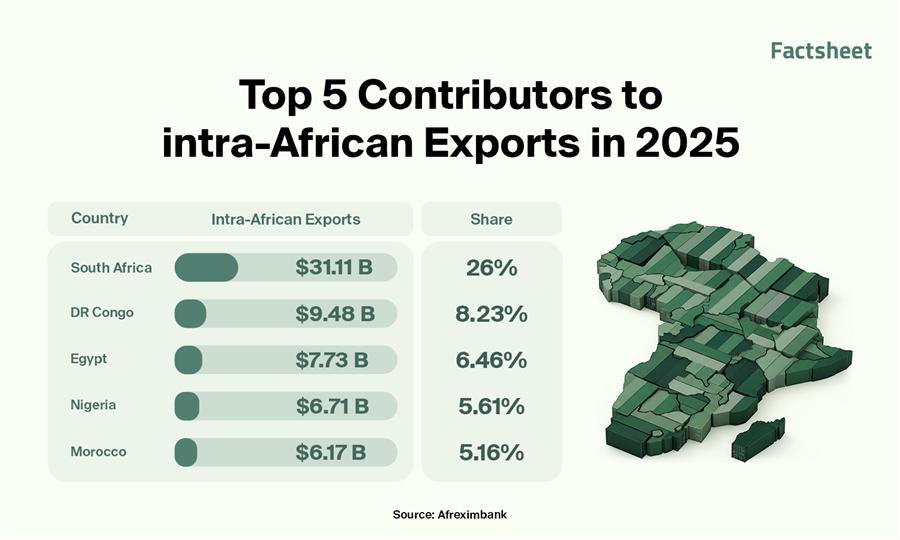
- Egypt maintained a strong position as a supplier to African markets in 2025, with intra-African exports reaching $7.73 billion, compared with $7.6 billion in 2024, representing 1.82% growth. The country accounted for 6.46% of total African exports to African destinations, ranking among the continent’s leading intra-African exporters. Egypt’s export performance was supported primarily by manufactured and processed products, including cement and construction materials, plastics, fertilizers, chemicals, and processed food products.
- Egypt’s intra-African imports declined from $1.99 billion in 2024 to $1.57 billion in 2025, a decrease of 21.1%. Nevertheless, African markets remained an important source of raw materials, agricultural commodities, and intermediate inputs for the Egyptian economy. Key imports included copper and copper products, fuel and mineral oils, coffee, tea, and other agricultural commodities. The resulting trade balance reached approximately $6.16 billion in Egypt’s favor in 2025.
- Egypt’s trade relations with Africa remained geographically diversified in 2025, extending beyond North African markets into East and West Africa. Its principal export destinations included Algeria, Libya, Morocco, Sudan, and Tunisia, while the country also expanded its commercial footprint in markets such as Kenya. At the same time, Côte d’Ivoire identified Egypt among its key African suppliers.
- Egypt ranked first in Africa in FDI inflows in 2025, attracting approximately $15.5 billion and remaining the continent’s largest FDI recipient for the fourth consecutive year. Africa as a whole received around $70 billion in FDI, making Egypt’s inflows equivalent to roughly 22% of the continent’s total. Although Egypt’s 2025 inflows were substantially below the exceptional $46.6 billion recorded in 2024, they continued to place the country ahead of Guinea at $7.8 billion, Mozambique at $5.7 billion, and Nigeria at $4 billion.
By: Amina Hussein
Related News