Egypt has continued to expand its urban areas and increase housing supply to meet rising demand and accommodate population growth. Several housing programs have contributed to these efforts, including the Social Housing Project, which targets one million units; Sakan Misr for middle-income households; the Modern Character Project for middle-income housing; the Middle-Income Housing Axis; and the Upper-Middle-Income Housing Axis. In fiscal year (FY) 2024/25, the real estate, building, and construction sectors generated EGP 3 trillion, equivalent to 17.5% of Egypt’s gross domestic product (GDP), underscoring their substantial role in economic activity.
This factsheet highlights developments in housing construction across different sectors in FY2024/25.
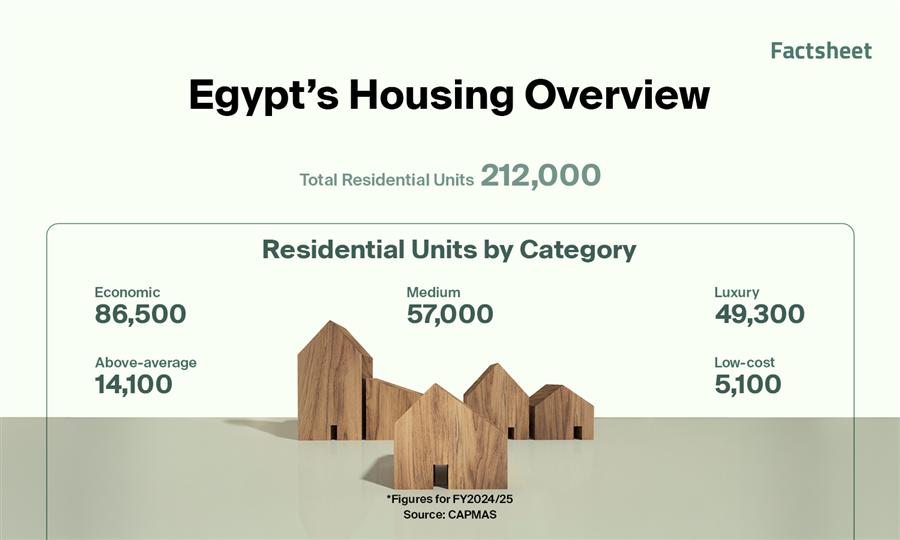
- In FY2024/25, Egypt implemented 212,000 residential units, compared with 158,900 units in FY2023/24, marking a 33.5% year-on-year (YoY) increase. At the same time, investments in the housing sector reached EGP 245.3 billion, up from EGP 152 billion in FY2023/24, representing a 61.4% annual increase.
- Economic housing accounted for the largest share of implemented residential units in FY2024/25, with 86,500 units, representing 40.8% of the total. Medium housing followed with 57,000 units, or 26.9%, while luxury housing reached 49,300 units, equivalent to 23.2%. Above-average housing accounted for 14,100 units, or 6.7%, and low-cost housing totaled 5,100 units, representing 2.4%.
- Government, public, and public business sector entities implemented 104,800 residential units in FY2024/25, a 27% YoY growth and accounting for 49.4% of total completed units. Economic housing dominated this segment, with 68,500 units, representing 65.4% of the sector’s total. Medium housing followed with 13,800 units, or 13.2%, while luxury housing reached 13,500 units, or 12.8%. Above-average housing stood at 9,031 units, representing 8.6%.
- Cairo recorded the highest number of residential units implemented by the government, public, and public business sectors, with 47,600 units, representing 45.4% of the sector’s total. Giza followed with 20,700 units, accounting for 19.8%. At the other end of the distribution, North and South Sinai recorded a combined 20 units, equivalent to 0.02%.
- The private sector implemented 107,2000 residential units in FY2024/25, representing 50.6% of the national total, compared with 76,200 units in FY2023/24. Medium housing represented the largest category, with 43,200 units, or 40.3% of private-sector completions. Luxury housing followed with 35,800 units, or 33.4%, while economic housing accounted for 18,000 units, representing 16.8%. Above-average housing accounted for 5,100 units, or 4.7%, and low-cost housing recorded 5,128 units, equivalent to 4.8% of private-sector completions.
- Cairo also led private-sector residential development, with 31,700 units, representing 29.6% of the sector’s total, followed by Giza with 24,600 units, or 22.9%. Gharbia recorded the lowest private-sector output, with only 7 units, equivalent to 0.007% of the total. The private sector led the position in FY 2024/25, accounting for 6% of all implemented units.
By: Amina Hussein
Related News