Over the past few years, the Egyptian economy has encountered a series of challenges that have weighed on its overall performance. These pressures, largely stemming from ongoing regional conflicts and external economic uncertainties, persisted during the first half (H1) of 2026 and continued to affect the performance of major economic indicators.
This factsheet reviews the latest developments in Egypt’s key monetary indicators, including inflation, exchange rate movements, interest rate trends, and other related variables, to provide a clearer understanding of the country’s current economic conditions.
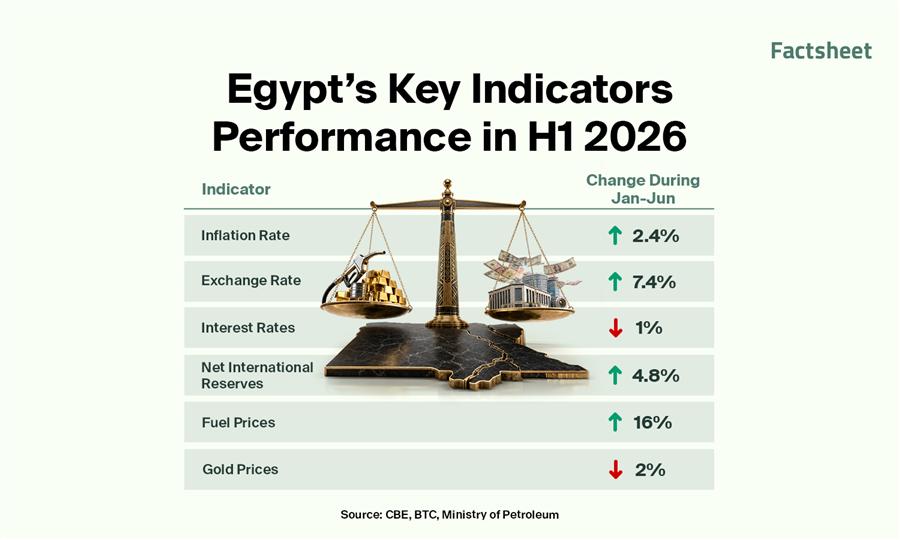
- During H1 2026, the Central Bank of Egypt’s (CBE) Monetary Policy Committee (MPC) cut interest rates once at its first meeting of the year in February by 1% and kept them unchanged in the next three meetings. The overnight deposit rate, overnight lending rate, main operation rate, and discount rate reached 19%, 20%, 19.5%, and 19.5%, respectively.
- Egypt started the year with an annual headline inflation rate of 11.9% in January. The inflation rate increased in the following months to reach a peak of 15.2% in March. Notably, the inflation rate then gradually declined over the following three months to reach 14.3% by the end of H1 2026.
- The USD-EGP exchange rate recorded an average of EGP 50.5 during the first six months of the year. Pressures resulting from the regional war caused foreign investors to pull hot money out of the country, which negatively affected the exchange rates. The exchange rate rose by 7.4%, as the USD appreciated from EGP 47.3 in January to EGP 50.8 in June.
- Net international reserves (NIR) increased from $52.6 billion in January to $55.1 billion in June, recording an overall growth rate of 4.8%. Despite the growth recorded in the first two months of the year, gold reserves, a key component of Egypt’s NIR, dropped by 8.1% during H1 2026.
- Due to regional uncertainty, disruptions to global maritime routes, and the resulting energy crisis, the Egyptian government increased prices for all fuel types by EGP 3 per liter in March. This increase represents an average growth of 16% across all fuel prices.
- Gold started the year with an average price of EGP 6,277 per gram of 21-karat gold. The price surged to a peak of EGP 7,180 in March amid the outbreak of the regional war in late February. However, the price declined to EGP 6,168 in June. This represented a 2% decline since the beginning of the year.
By: Amina Hussein
Related News