The Egyptian government has been actively working to streamline investment procedures and foster a more investor-friendly business environment. Recently, it introduced new investment and taxation measures aimed at facilitating business operations and enhancing the ease of doing business in Egypt. As a result, private investment reached its highest level in five years during fiscal year (FY) 2024/25, accounting for 47.5% of total executed investments, and was targeted to reach 63% in the recently ended FY2025/26. The government aims to further increase the share of private investment to more than 70% by 2030.
In this factsheet, we provide a comprehensive analysis of investment inflows into the Egyptian economy during the first six months of 2026, covering the number of newly established companies and their segmentation, as well as the sources of capital inflows and sectoral categorization.
- The total number of new companies in Egypt increased by 19.9% to 26,525 in January-June 2026 from 22,131 in the same period a year earlier.
- The services sector had the lion’s share of new companies, with 16,597 companies, representing 62.57% of the total. The construction sector came in second with a share of 12.36%, followed by the industrial sector, which represented 11.52% of the total new companies.
- The number of non-Egyptian companies increased by 31.3% to 5,441 during the first six months of 2026, with Syrian companies topping the list with 2,290 companies, representing a share of 42.09%. Chinese and Saudi companies came in second and third, with shares of 6.56% and 6.12%, respectively.
- Capital inflows from new company formations dropped to $2.56 billion in January-June 2026, compared to $3.56 billion in the same period a year earlier, representing a 28.15% year-on-year (YoY) decline. The decrease was driven by lower inflows into the industrial, agriculture, information technology, and construction sectors.
- Construction companies attracted $812.17 million in capital inflows, accounting for 31.79% of total inflows. Notably, the sector’s capital inflows were 26% lower than in January-June 2025. Meanwhile, the services and industrial sectors received $781.6 million and $357.1 million in capital, respectively.
- Majority of capital inflows came from Egyptian companies, contributing $2.24 billion, or 87.75% of total inflows in the first six months of 2026. Non-Arab foreign companies generated capital inflows of $128 million (5%), while Arab capital inflows totaled $185 million (7.24%).
- Egyptian investors mainly focus on services, construction, and manufacturing, while non-Arab foreign investors tend to invest in manufacturing, finance, and construction, and Arabs invest in manufacturing and construction.
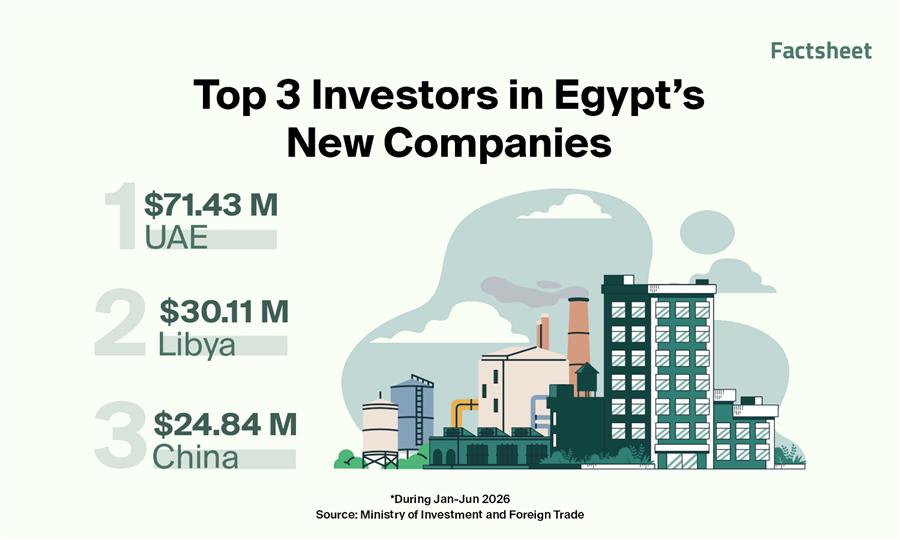
- In January-June 2026, capital inflows from the UAE reached $71.43 million, representing 22.85% of total foreign inflows from new companies in Egypt. Libya came in second, with inflows of $30.11 million, followed by China in third place, with inflows of $24.8 million.
By: Amina Hussein
Related News