As the new academic year approaches in Egypt, families, students, and educators prepare for the familiar rhythm of “back to school.” With an 11% increase in public budget allocations for the education sector in fiscal year (FY) 2026/27, the government aims to expand the Egyptian-Japanese Schools project through adding 100 schools to the project and upgrading infrastructure by building and renovating 13,000 new classrooms, increasing the efficiency of 1,600 schools, and rehabilitating 1,000 technical schools in cooperation with the private sector.
In this Factsheet, we will highlight statistics on pre-university education infrastructure, focusing on schools and classrooms during the most recent academic year 2025-2026.
- In 2025-2026, the total number of schools in Egypt reached 62,690, compared to 62,056 in 2024-2025, reflecting a modest yet important growth rate of 1%.
- Public schools in 2025-2026 amounted to 52,676, representing the majority at 84% of the total, while private schools stood at 10,023, accounting for 16%.
- The distribution of schools in 2025-2026 shows that rural areas hosted 35,099 schools (56%), whereas urban areas had 27,591 schools (44%), showing a clear rural majority.
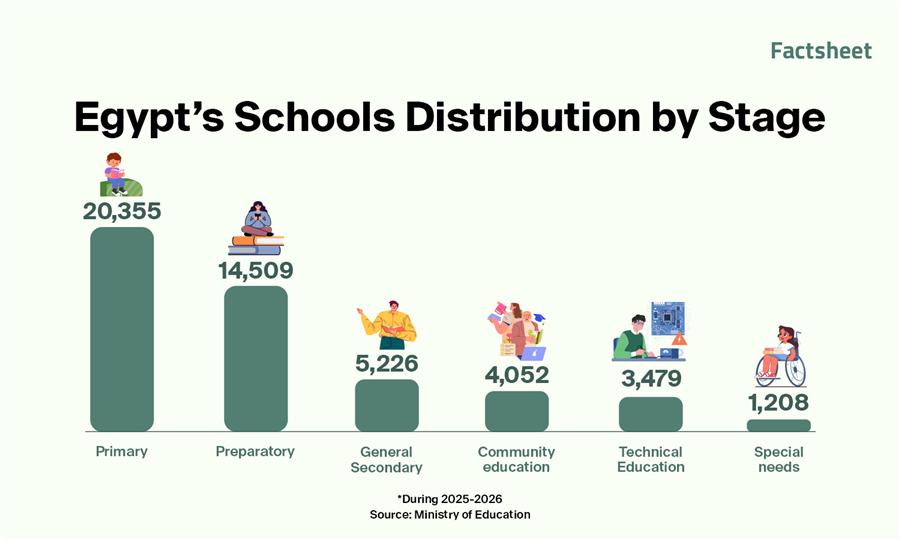
- In 2025-2026, the education system included 20,355 primary schools, 14,509 preparatory schools, 4,052 community education schools, and 1,208 institutions dedicated to students with special needs.
- At the secondary level during 2025-2026, general secondary schools (Thanaweya Amma) totaled 5,226, while technical education schools, covering industrial, agricultural, commercial, and hospitality programs, reached 3,479.
- Among governorates in 2025-2026, Cairo ranked first with 6,292 schools (10% of the total), followed by Sharqia with 4,896 (7.8%), and Giza with 4,506 (7.2%), reflecting the concentration of schools in more heavily populated areas.
- Turning to classrooms, the total number of classes across Egypt in 2025-2026 reached 677,182, compared to 672,852 in 2024-2025, marking a slight growth rate of 0.6%.
- Public schools in 2025-2026 hosted 592,186 classes, representing 87.4% of the total, while private schools accounted for 84,996 classes, or 12.6%.
- The distribution of classes in 2025-2026 reveals that rural areas had 334,189 classes (49.3% of the total), while urban areas were nearly balanced with 342,993 classes (50.7%).
- Finally, the average number of students per class improved, declining from 38.4 in 2024-2025 to 38.1 in 2025-2026, signaling progress toward reducing classroom overcrowding.
By: Amina Hussein
Related News