By the end of 2025, the Ministry of Finance introduced a package of tax facilitation measures aimed at easing pressures on taxpayers, broadening the tax base, streamlining procedures, enhancing the quality of tax services, and resolving outstanding cases and long-standing disputes. This was followed by a second package comprising 33 measures introduced at the beginning of 2026.
In this Factsheet, we provide a brief on the second package of tax facilitation measures and shed light on the tax revenue structure in Egypt during the first half (H1) of the fiscal year (FY) 2025/26.
- The second package of tax facilitation measures is designed to support investment and strengthen trust between the state and taxpayers. It follows an extensive dialogue with the tax community, reflecting a more inclusive approach to involving the private sector in shaping economic policies.
- The package introduces a set of incentives, including concessional financing for new taxpayers, simplified procedures for resolving tax disputes, and the establishment of a “white list” that grants additional benefits to compliant taxpayers. It also seeks to improve corporate liquidity through faster value-added tax (VAT) refunds and the introduction of a settlement system that allows offsetting tax liabilities against government dues.
- On the legislative front, the measures aim to eliminate double taxation on dividend distributions and streamline the tax treatment of debts to reduce administrative complexity. To support capital markets, the system will shift to a stamp duty on stock exchange transactions instead of capital gains tax, which is expected to enhance market attractiveness. The package also includes expanded digital services, such as electronic platforms, specialized service centers, and applications to facilitate tax payments.
- In H1 FY2025/26, Egypt’s public revenues hit EGP 1.38 trillion, of which 87%, or EGP 1.2 trillion, came from tax revenues. Tax revenues witnessed a remarkable year-on-year (YoY) growth rate of 32%.
- Tax revenues notably increased across key categories, led by income tax revenues, which rose by 47% to EGP 380.1 billion. VAT revenues also grew by 23.9% to EGP 516.5 billion, driven mainly by higher collections from goods (up to EGP 281.8 billion) and services (up to EGP 71 billion).
- Revenues from property taxes increased by EGP 51 billion (30.5%) to EGP 218.1 billion during H1 FY2025/26, compared to EGP 167.2 billion a year earlier. Customs revenues rose by 10.9% to EGP 69.5 billion, while revenues from other taxes reached EGP 12.8 billion.
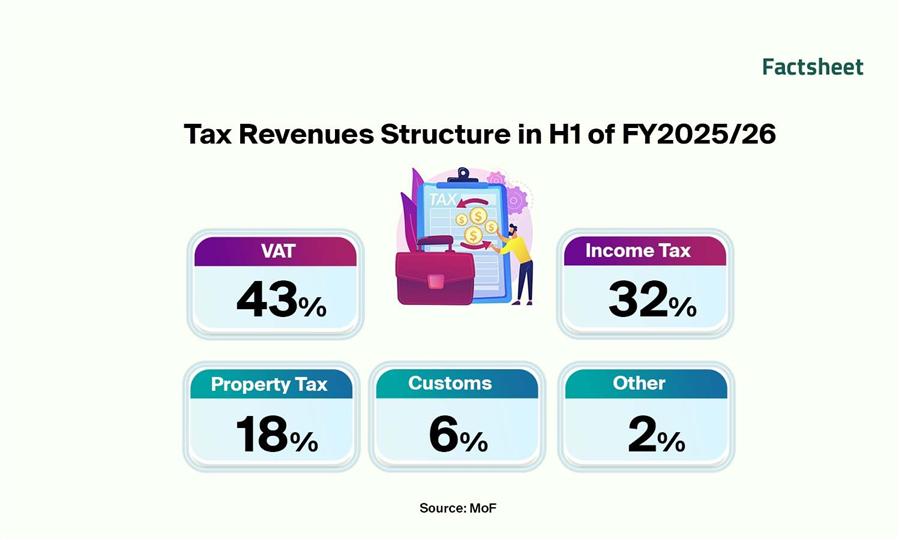
- Tax revenues are primarily driven by VAT, which accounts for 43% of the total, followed by income tax at 32% and property taxes at 18%, while customs contribute 6% and other taxes account for 2%.
By: Amina Hussein
Related News