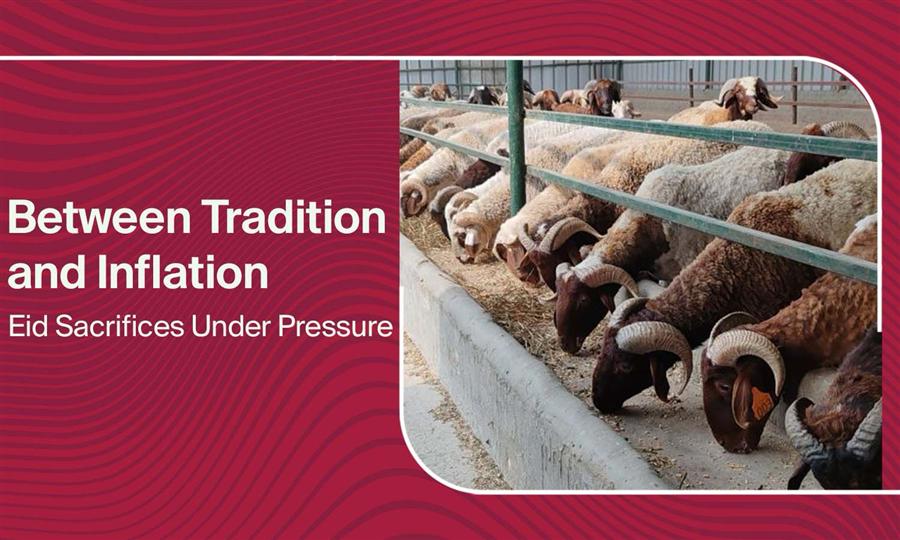
Every Eid El-Adha, Egypt’s livestock markets are a crucible of religious tradition, economic strain, and policy experimentation. Demand for sacrificial animals is colliding with structural weaknesses in the meat supply chain, leading to volatile prices and parallel market realities. In response, households react with adaptive strategies such as collective sacrifices, subsidized frozen meat, and institutionalized charity Sukuk.
Meanwhile, the state buffers supply through imports, subsidies, and price caps. But these short-term relief measures often create unintended distortions, demonstrating the fine line between preserving cultural practices, protecting vulnerable consumers, and maintaining long-term market health.
State Interventions and the Supply Buffer
To contain the volatile holiday market, the Ministry of Agriculture and Land Reclamation rolled out extensive preparations for the season, including the provision of 15,000 head of livestock at discounted prices alongside food commodity discounts of up to 25%.
This domestic push was reinforced by a significant state-led import campaign executed from the start of the year through the end of April. The government expanded its inventory with foreign supplies totaling 158,876 head of live calves, sheep, and camels, in addition to 100,781 tons of frozen meat and 65,432 tons of liver, kidneys, and hearts.
The objective of these large-scale inflows is to boost aggregate supply across government outlets, the private sector, and open markets in an attempt to ensure price stability and meet the growing needs of citizens during the high-demand season.
Parallel Pricing and Market Realities
Despite these major supply injections, a clear pricing mismatch has emerged between official government thresholds and the open marketplace, resulting in a distinct parallel pricing structure.
The ministry set official live-weight prices at EGP 190 per kilogram for cows, EGP 160 for buffalo, EGP 220 for sheep, EGP 240 for goats, and EGP 200 for camels. However, the open marketplace tells a different story.
Khaled, a 40-year-old livestock merchant, points out that the actual live-weight price of cows in the market is around EGP 225 per kilogram. Khaled adds that “government-subsidized livestock have only a limited impact on the market as they do not meet the overall demands.”
From the consumer perspective, these interventions provide a necessary safety net, yet they fall short of systemic stabilization. Mohamed, a 76-year-old breadwinner, notes that “while government-provided sacrificial options have partially eased purchasing burdens, overall prices remain much higher than the financial capacity of the majority of citizens.”
He adds that because the supply of sacrificial animals cannot keep pace with national demand, retail prices stay highly volatile and fluctuate unpredictably from one day to the next as the Day of Arafah approaches.
Collective Cost-Sharing and Institutional Sukuk
Faced with steep retail prices, Egyptian households are increasingly turning to collective cost-sharing mechanisms. “Group sacrifices offer a highly practical alternative because splitting a single sacrifice among seven individuals drastically lowers individual costs,” Mohamed notes.
Concurrently, institutional options like charity sacrifice sukuk have grown in prominence, though they reveal severe market distortions. The price of a cow Suk climbed by roughly 11.1% this season, rising to EGP 13,000 from EGP 11,700 in the previous season. In contrast, the sukuk offered by the Ministry of Endowments remained stable at EGP 9,500 for local meat and EGP 7,000 for imported meat.
While convenient, these institutionalized sukuk alter traditional supply chains. Khaled explains that “sacrifice sukuk systematically pull physical livestock out of local markets, reducing immediate spot supply and inadvertently driving prices upward, even for non-participating consumers. This localized scarcity forces families to purchase meat nearly three weeks in advance of the butcher’s holiday leave just to ensure they can secure meat to celebrate together.”
Furthermore, some consumers remain culturally and logistically hesitant. Mohamed points out that sacrifice Sukuk present non-financial friction, as buyers cannot inspect the live animal with their own eyes or witness the slaughter process firsthand.
Market Distortions and Long-Term Sustainability
From an analytical standpoint, blunt market interventions frequently trigger unintended economic blowback. Economist Mohamed Hosny warns that rigid price caps can severely discourage local livestock producers. “Price caps can force local livestock producers to sell in unofficial markets or even reduce the quality of meat by not investing in veterinary care,” he says.
However, Hosny notes that “price caps can be done in a way that does not discourage livestock production. They can target low-income households or make caps for a short period of time, such as during Eid. This way, local producers will not be disincentivized.”
Commenting on the viability of the sacrifice sukuk model, Hosny says that “charity sacrifice sukuk can be suitable because they improve market efficiency, reduce waste, and are easier to track. They also save consumers time and eliminate the need to transport livestock. However, they cannot replace large livestock markets that require proper infrastructure, cold chains to preserve meat, and strong insurance for livestock producers. In the short run, they may work, but in the long run, they are not sustainable.”
To balance immediate consumer relief with structural market health, Hosny outlines several critical policy recommendations. Subsidies should strictly target low-income consumers, so local producers can continue selling at market prices to maintain profitability. These interventions must be confined to specific holiday periods like Eid to prevent long-term production disincentives. Additionally, the state should improve price transparency by publishing updated prices through an online database so consumers know a fair price, while simultaneously investing in cold-storage infrastructure to reduce spoilage and maintain a reliable buffer supply when market demand is low.
The evidence suggests that Egypt’s subsidized livestock quotas, heavy reliance on imports, and specialized charity sukuk offer vital short-term financial breathing room for vulnerable households. At the same time, they fuel a multi-tiered parallel pricing market and drain the open spot market of physical inventory. The policy framework must move away from general price suppressions towards highly targeted consumer aid and strong cold storage logistics, to prevent long-term distortions and discourage producers.
By Sarah Samir