Arab Finance: The Information and Communications Technology (ICT) sector has firmly established itself as a cornerstone of Egypt's modern economy. Driven by strong government support and a rapidly expanding, highly skilled young workforce, the sector has consistently been the fastest-growing, outpacing all other economic activities.
This momentum is clearly reflected in its contribution to the national output, with ICT accounting for approximately 5.8% of gross domestic product (GDP) in fiscal year (FY) 2023/2024, according to the Ministry of Communications and Information Technology. Egypt’s strategic focus on digital exports has yielded significant results, with digital exports soaring to over $6.2 billion in 2023.
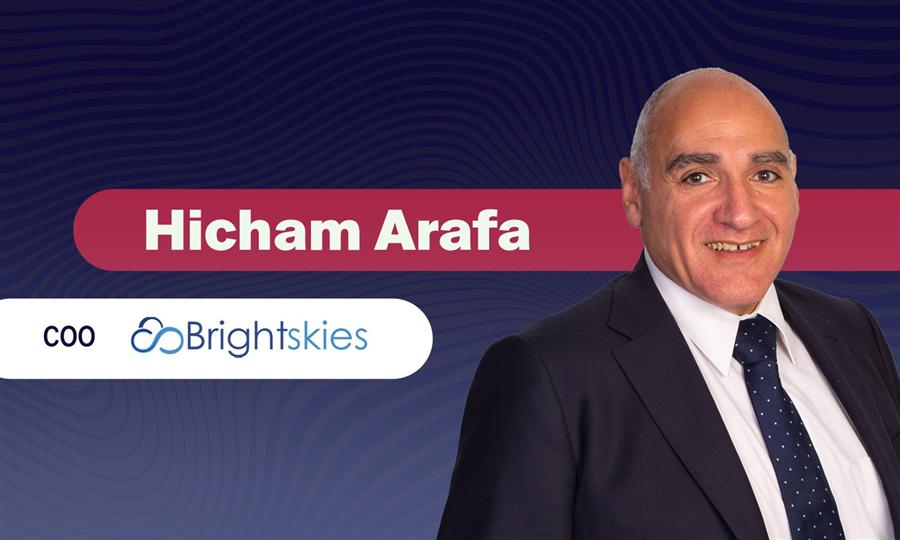
Against this backdrop of exponential growth and national ambition, we sit down with Hicham Arafa, COO of Brightskies, to discuss how the company is moving beyond traditional service outsourcing to become a global leader in proprietary IP, particularly in the advanced fields of electric vehicle (EV) and autonomous driving technology.
1-What is the core purpose and mission of Brightskies, and how does it differentiate itself in the competitive technology sector?
Brightskies started as a technology services company, but its core mission has always been to deliver innovative, high-value engineering to global clients.
Over the past seven years, the company has invested heavily in research and development (R&D) and built product-focused spin-offs in autonomous driving and electrification, which clearly differentiates us from pure service providers.
2-What are Brightskies’ main competitive advantages in delivering digital transformation and technology solutions?
We differentiate ourselves by combining strong engineering services with our own intellectual property (IP) in areas such as self-driving technologies and electric powertrains.
Brightskies has established two spin-offs, Bright Drive, dedicated to autonomous driving, and Bright EV, focused on electric powertrains and battery systems. This positions the group as both a services and products player.
3-Could you elaborate on the key services and solutions Brightskies offers, particularly in automotive, embedded systems, and cloud computing?
Bright Drive has developed and piloted self?driving solutions globally, including a recently demonstrated autonomous bus in Graz, Austria. This has been built with an Austrian partner and powered by our stack across perception, localization, path planning, and other self-driving domains.
Meanwhile, Bright EV focuses on electric powertrains and has already started manufacturing power batteries for light-mobility applications.
4-How has Brightskies’ financial performance evolved in recent years, and what are the key factors behind its growth?
Over the past eight years, Brightskies has recorded average year?on?year (YoY) growth of around 25–30%, which is quite strong for our segment. This performance reflects Egypt’s growing attractiveness as an engineering services hub as well as the cost efficiency and quality we deliver to our international customers.
5-Brightskies has partnered with ITIDA and academic institutions like Alexandria University. How critical are these partnerships to your innovation and market reach?
Collaboration with ITIDA and the wider government ecosystem is central to our innovation story. ITIDA’s Industry Academia Fund financed the development of our first Bright EV bus battery prototype.
Beyond funding, we work with ITIDA on export support and talent development. We also engage closely with Alexandria University, Ain Shams University, Cairo University, ITI, and NTI on specialized tracks such as embedded cybersecurity, systems engineering, motor control, and hardware design.
6-How does Brightskies position itself regarding Egypt’s broader digital transformation initiatives and government policies promoting ICT?
Government entities such as the Ministry of ICT and ITIDA have put in place strong infrastructure, incentives, and talent programs to grow Egypt as an offshoring and engineering hub.
Brightskies is deeply integrated into this ecosystem, translating policy and infrastructure into real products, exportable services, and high?quality jobs, especially in advanced domains like automotive software, AI, and electrification.
7-What makes Egypt’s ICT sector attractive for investment, and how do you see it evolving in the near future?
People are Egypt’s biggest asset. The country has world?class engineers with strong problem?solving abilities and what we like to call “Egyptian street smarts,” which help them overcome obstacles and deliver results.
With the right investment in human capital and job creation, this talent pool can continue to underpin Egypt’s position as a competitive global ICT and engineering hub.
8-You work extensively on human capital development in Egypt. What has been the outcome of this work for Brightskies?
Brightskies grew from just one or two employees at inception to about 30 people in its first five years. It has expanded then to around 450 employees over the last eight years. This shows how critical talent development is to our business model.
Ensuring both the quantity and quality of engineers is essential to maintaining our competitiveness on price and service quality, and to keeping Egypt attractive versus other offshoring destinations.
9-The ICT sector is a major contributor to Egypt’s GDP. From your point of view, what drives this sector’s growth?
The sector’s growth is driven by a combination of strong talent, supportive infrastructure, and dedicated technology parks such as Smart Village and Silicon Waha that provide conducive environments for innovation.
In parallel, institutions like ITI, NTI, universities, and the ministries of ICT and Higher Education ensure a steady pipeline of skilled professionals. The priority now is to attract more global customers to leverage this setup.
10-What key industry trends do you see shaping the technology and outsourcing sector in Egypt over the next few years?
Key technologies such as machine learning, AI, data science, and cybersecurity are already reshaping demand. Egypt is actively building capabilities in these areas across its talent base.
At Brightskies, this also means expanding beyond Cairo into other governorates to tap into strong local engineering talent that can support future growth.
11-How does Brightskies plan to stay competitive and expand within Egypt?
We currently operate three development centers in Alexandria, Cairo, and Asyut, our newest and smallest site. A key priority is to scale R&D capacity in Asyut and to expand our manufacturing footprint in Borg El Arab, where our first factory is ramping up from low?volume production.
12-You mentioned manufacturing activities. What exactly do you manufacture in Egypt, and how do you source raw materials?
Through Bright EV, we manufacture power batteries for light mobility, including solutions for golf carts, two?wheelers, three?wheelers, and swappable battery packs. We are also moving into energy?storage batteries for commercial, industrial, and household use.
Our differentiator is that these products are designed and engineered by Brightskies, rather than produced under foreign license or assembled from imported designs, making them genuinely developed in Egypt.
13-Brightskies now operates in Egypt, Germany, the UAE, and Saudi Arabia. How does working across these markets influence your business strategy and operations?
We run three development centers and one manufacturing site in Egypt, complemented by a front-office in Germany, two offices in Saudi Arabia, and one in the UAE, eight sites in total.
Our model is to keep engineering back offices in Egypt for scale and cost efficiency, while placing front?line engineers close to customers abroad to improve communication and service delivery.
14-What are the main differences between the needs of the Egyptian market and those of the international markets you serve?
Our portfolio is largely export?oriented, with about 95% of our business coming from international clients in areas such as high?performance computing, enterprise solutions, and automotive embedded systems.
Since most OEMs and Tier?1 suppliers in these domains are outside Egypt, our local projects remain a small share of total activity.
15-Finally, what message would you like to share with young Egyptian engineers and professionals in your field?
Having worked with many nationalities, I am convinced that Egyptian engineers are truly world?class. They should recognize the value they bring, have self?confidence, and believe in their ability to deliver globally competitive work. The quality of engineering talent coming out of Egypt is already at an international level.