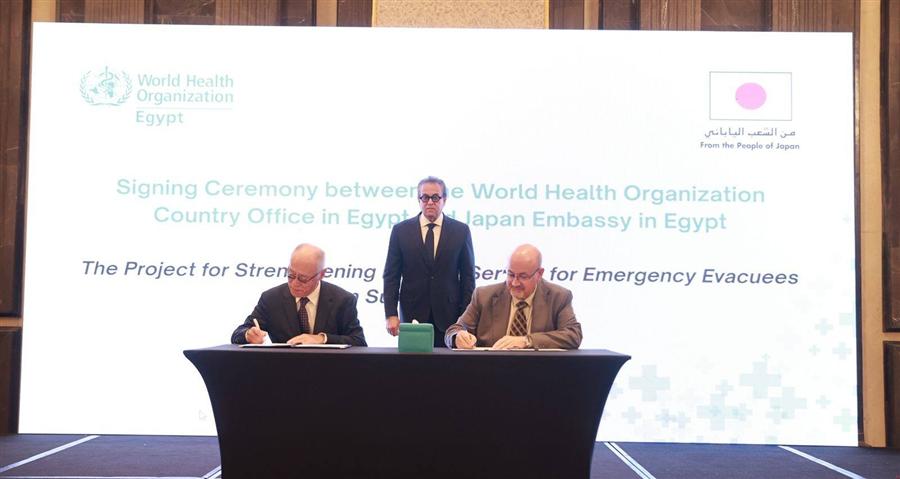
Arab Finance: Egypt’s Ministry of Health and Population has signed a $3.38 million cooperation agreement with the World Health Organization (WHO) and Japan to launch a project aimed at strengthening emergency medical services, according to a statement issued by the ministry.
The agreement was signed in the presence of Minister of Health and Population Khaled Abdel Ghaffar, Japanese Ambassador to Egypt Fumio Iwai, United Nations Resident Coordinator in Egypt Elena Panova, and WHO Representative in Egypt Nima Abid.
Abdel Ghaffar said Egypt was among the first countries to respond to the humanitarian crisis in the Gaza Strip, receiving Palestinians in need of medical care, including thousands of cases requiring complex interventions and delicate surgeries.
He added that Egypt has provided more than 90,000 comprehensive medical examinations through the Rafah land crossing since the start of the crisis.
He explained that the project is built around three main pillars: securing vital equipment and medical supplies for hospitals involved in the emergency response plan, training medical teams on critical care protocols, and enhancing the readiness of hospitals in border governorates to deliver high-quality medical services to the injured and displaced.
The minister expressed his appreciation to the Japanese government and the WHO, noting that the partnership reflects “shared international responsibility,” particularly given the financial and logistical burden Egypt continues to bear by providing free medical care to Palestinians, which he said requires sustained international support.
Moreover, Abdel Ghaffar said Egypt’s healthcare system has mobilized extensive resources since the beginning of the crisis, including equipping 170 hospitals across 24 governorates, allocating more than 13,000 inpatient beds and nearly 2,000 intensive care beds, and deploying around 63,000 medical personnel, including doctors and nurses.
He also reaffirmed that Egypt will continue to serve as a safe haven and a key supporter of humanitarian causes in the region, calling on the international community to follow Japan’s example by providing technical and material support to host countries to help safeguard the stability of their healthcare systems during regional crises.
For his part, Abed praised Egypt’s solidarity efforts, describing the agreement as a reflection of a shared commitment to the values of solidarity and partnership.
He added that Japan was among the first partners to respond to the urgent humanitarian appeal.
Ambassador Iwai also commended Egypt’s role in delivering healthcare to Palestinians and other vulnerable groups, noting that the support comes at a critical time with the resumption of medical evacuations through the Rafah crossing.
He added that the agreement expands the scope of beneficiaries to include Palestinians and Sudanese patients.