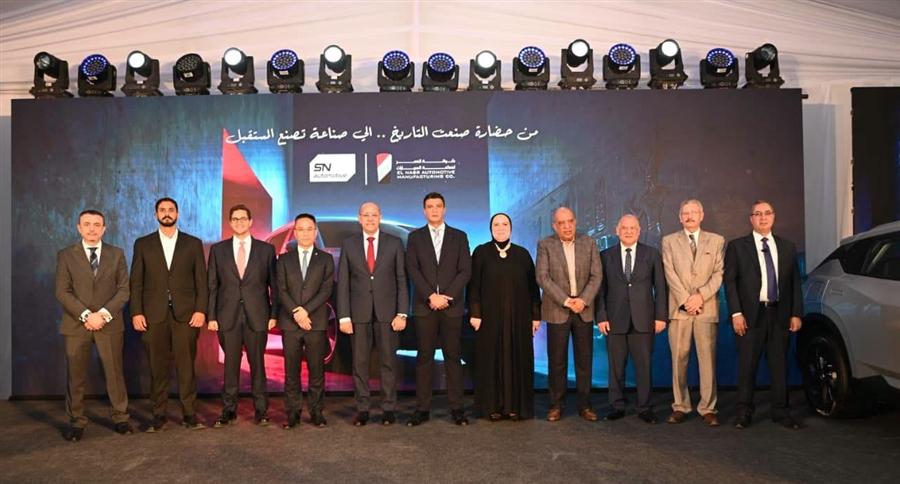
Arab Finance: Egypt-based automaker El Nasr Automotive Manufacturing Company has started producing China's Dongfeng MAGE EV model as Egypt’s first locally produced electric vehicle (EV), with local components reaching 45%, according to a joint statement from the Ministry of Industry and the Ministry of Electricity and Renewable Energy.
Production is being carried out under SN Automotive, Dongfeng’s local agent in Egypt, in partnership with Egyptian conglomerate Al Safy Group.
Attended by Minister of Industry Khaled Hashem and Minister of Electricity Mahmoud Esmat, the launch supports a broader strategy to strengthen domestic industrial capabilities, localize automotive technology, and improve Egypt’s competitiveness.
Hashem said the project builds on the company’s longstanding role in Egypt’s automotive industry, drawing on its production assets and accumulated expertise through partnerships with private investors and international companies.
He noted that the ministry has identified automotive manufacturing as a priority for integration into global supply chains, with an emphasis on increasing local value-added and developing capabilities that support economic growth and sustainable development.
The next phase will focus on raising the share of locally manufactured components and expanding production of industrial inputs, Hashem said, adding that the objective is to build an integrated automotive industry that meets domestic demand while increasing exports to regional and international markets, advancing Egypt’s ambitions to become a manufacturing and export hub.
To support these goals, the Automotive Industry Development Program (AIDP) provides manufacturers with incentives tied to local value-added, production and investment expansion, and compliance with environmental standards.
The ministry is coordinating with relevant authorities to further develop the AIDP and strengthen incentives for automotive component manufacturers. Hashem added that these efforts aim to encourage international companies to source from Egyptian suppliers, facilitate technology transfer, and deepen domestic manufacturing.
Esmat, meanwhile, attributed the start of EV production to sustained support from the political leadership for localizing vehicle manufacturing technology. He outlined development efforts encompassing workforce training, improved employee performance, and higher output through partnerships with Egyptian and foreign private-sector companies.
At El Nasr Automotive, those efforts have included upgrading assembly lines, paint booths, welding stations, and production jigs, alongside rehabilitating existing facilities and adding EV production lines.
Esmat highlighted the company’s production of environmentally friendly buses with more than 60% local content that meet the latest European emissions standards, as well as minibuses. He said the addition of EV manufacturing advances the company’s revival and aligns with Egypt’s automotive localization plans and the global transition toward clean energy and environmentally friendly transport.