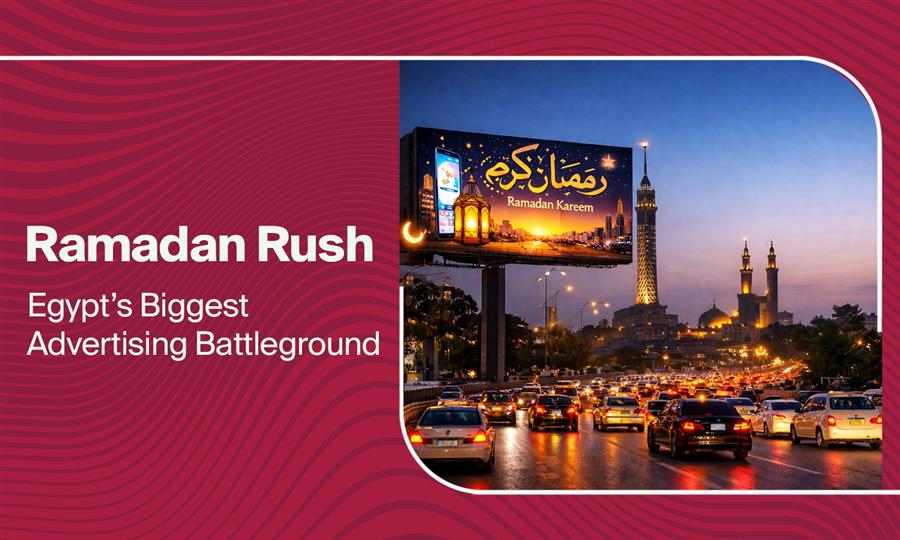
In Egypt, the holy month of Ramadan is defined by more than just spiritual reflection and family gatherings; it is the undisputed Super Bowl of the advertising industry. When the lunar calendar turns, so do the gears of the nation’s economy, as companies scramble to reallocate resources and consumers inundate stores in a surge of purchases that define brands for the year across the region.
From the sprawling digital billboards of New Cairo to viral short-form videos on TikTok, the Egyptian market becomes a high-stakes platform where tradition and heritage collide with modern digital strategy.
Peak Season for Purchasing and Advertising
Industry experts consistently highlight Ramadan as one of the most commercially significant seasons for Egyptian advertisers. According to Roaa Gelshany, a social media strategist and digital advertising expert, “During Ramadan, advertising budgets significantly increase compared to the rest of the year. It is considered the peak season for brands across multiple industries, especially fast-moving consumer goods (FMCGs), telecom, food and beverage, and e-commerce.”
Brands reallocate larger portions of their annual budgets specifically for Ramadan campaigns because consumer engagement, media consumption, and purchase intent are at their highest during this month, Gelshany notes. Ipsos data confirms this surge: 75% of Egyptian consumers prefer in-store shopping during Ramadan, and three in five shoppers say advertisements influence their purchasing decisions.
Ramadan advertising generates direct revenue for agencies and media outlets while indirectly fueling consumer spending and strengthening brand equity. Ipsos identifies five consumer personas during Ramadan, with the “Content Explorer” (35%), a digitally engaged audience, being the largest. This persona underscores the growing importance of digital-first strategies.
Television remains central, with prime-time slots commanding premium rates, but digital platforms are now equally dominant. Younger audiences, in particular, are shifting toward social media and short-form video, making Ramadan a hybrid media season where traditional and digital channels intersect.
The impact of Ramadan advertising is not limited to industry metrics; it directly shapes household purchasing decisions. Ahmed, a 36-year-old breadwinner, says: “I prefer social media ads to other forms as I can skip ads anytime. I also purchase many items influenced by social media ads, and I even search for specific ads on social media when I am planning to buy certain products.”
On the other hand, Jumana, a 33-year-old housewife and mother, shares: “Personally, I purchase many things influenced by Ramadan advertisements. I prefer TV ads over billboard ads and social media, as I watch a lot of TV shows during Ramadan.”
Market Dynamics
Competition among major brands intensifies during Ramadan. High-production campaigns driven by emotional storytelling dominate the scene, as companies aim to create memorable content that resonates culturally and spiritually.
Gelshany notes that brands are adapting by increasing investment in social media ads, collaborating with influencers and content creators, producing vertical, mobile-first content, and leveraging interactive formats like polls, live sessions, and short-form videos.
Mahmoud Nabil, a senior brand manager, highlights the season’s unique consumer behavior: “There are very few seasons when consumers exhibit reckless purchasing behavior, as people are aware of specific commitments, such as buying the whole month’s groceries. These high-purchasing seasons include Ramadan and the back-to-school season. Accordingly, advertisements increase during these seasons.”
He explains that while everyday groceries maintain steady advertising throughout the year, sectors like telecom, real estate, and luxury goods intensify their campaigns during Ramadan to capitalize on heightened consumer intent.
The Role of Traditional vs. Digital Media
Billboards remain a fixture of Ramadan advertising, especially in high-traffic urban areas. Gelshany emphasizes that outdoor ads are evolving. “We are more likely to see integrated campaigns where billboards support digital storytelling rather than operate as standalone channels. The future is not about replacing traditional media, but about strategic integration.”
In 2025, Egypt’s out-of-home (OOH) advertising market saw a significant surge, with investments climbing 60% year over year to reach EGP 12.7 billion. According to data from AdMazad, physical inventory grew at a more moderate pace of 9%, totaling 900 new billboards, primarily located in New Cairo and Sheikh Zayed. Notably, 115 of these new additions were digital out-of-home (DOOH) screens, reflecting a deliberate but steady transition toward digitized advertising formats.
Meanwhile, the digital vs. satellite gap is steadily narrowing. DICM data shows that streaming now captures 44% of all eyeballs across MENA, APAC, and Africa. Although traditional TV still holds a 56% edge, the real story is in the timing. Younger viewers are ditching the remote for late-night scrolling and streaming on YouTube and TikTok, cementing digital's role as the new prime-time destination.
Nabil adds that while billboards are effective for broad visibility, digital platforms offer trackable metrics and precision targeting. “Unlike the static nature of outdoor advertising, digital influence is defined by its traceability. Digital is not just an ad; it is a data stream, allowing us to track engagement in real time.”
“While billboards serve as a useful secondary touchpoint, they are rarely sufficient in isolation. We cannot only release billboard ads; we must further activate PR campaigns and launch digital ads. Thus, traditional media remains a valuable complementary asset, but digital is the only channel capable of driving a complete, standalone conversion cycle,” he notes.
To achieve this, digital advertisements have to be catchy to consumers, as per Nabil. He further highlighted that his team’s recent campaign attracted four million views on social media within a short period, underscoring the importance of capturing attention within the first few seconds.
“In social media ads, we need to attract consumers within the first three to four seconds, as people’s attention span is not like before. Billboard ads must also grab attention at first glance or present a compelling offer to attract consumers,” Nabil explains
Meanwhile, Gelshany says, “We are seeing a shift toward performance-driven marketing, where brands demand measurable ROI. Digital campaigns offer detailed analytics, targeting precision, and flexibility, making them increasingly attractive.”
Ramadan in Egypt is more than just a time for serious introspection, it is the paramount playing field between brands, agencies, and media. What starts out as a month of spirituality turns into an all-out commercial crescendo where consumer appeal, cultural tradition, and high-tech digital marketing meet.
Television and billboards remain the backbone of visibility, but social media and streaming services have reshaped the rules of engagement, demanding immediacy, creativity, and quantifiable impact.
By Sarah Samir