With Ramadan now underway, Muslims around the world, including Egyptians, are observing cherished traditions, particularly those centered around food. Dates hold a special place at Iftar, as they are traditionally the first food consumed to break the fast.
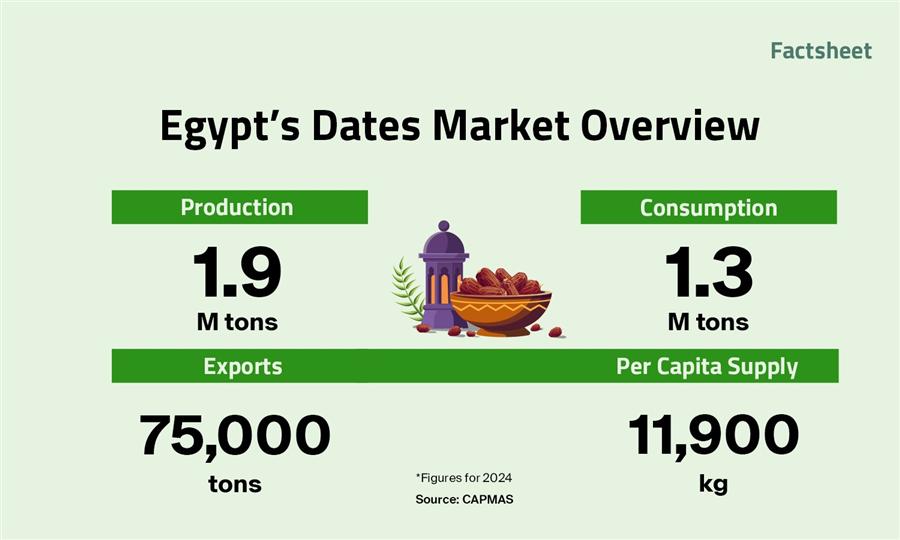
Egypt stands as the world’s largest producer of dates, benefiting from its favorable climate conditions, especially in the Nile Valley and the oases of Upper Egypt.
This factsheet provides a comprehensive overview of Egypt’s date market, highlighting the country’s leading global position as both a producer and an exporter.
- The market encompasses a broad portfolio of date varieties, notably Siwa, Zaghloul, and Barhi. These varieties cater to diverse consumer demands across both local and international markets. Egypt’s geographic position also facilitates efficient access to principal export destinations in the Middle East, Europe, and other international markets.
- The total cultivated area of date palms in Egypt remarkably increased by 40% year-on-year (YoY) to 259,785 feddan in 2024. This represents around 1.5% of Egypt’s total cultivated area. The number of cultivated palms hit 16.9 million.
- In 2024, Egypt’s production of dates increased by 12% YoY to 9 million tons, from 1.7 million, according to the latest statistics.
- Giza led governorates in terms of date production, with a share of 13.7% of total date production, followed by Aswan in second spot at 5% and Sharqia at around 11.5%.
- Egypt’s global share of date production reached 19.5%, securing its position as the largest producer in the world. Production is directed mainly to the local market, with only 2.2%
- In 2025, Egypt’s date exports grew significantly by 38% YoY to $147 million, compared to $106 million in 2024. Date exports represented around 2.1% of Egypt’s total food exports.
- Egyptian dates were exported to 98 global markets, mainly in the Middle East region. Morocco alone imported $70 million worth of dates, representing 49% of Egypt’s total exports. Türkiye came in second place, with a 21% share, followed by Indonesia at 3%.
- In February 2024, Egypt launched a comprehensive strategy to develop a sustainable date palm sector for the period 2024–2029. The strategy aims to raise annual exports of fresh and processed dates to $250 million within five years, with an extended objective of reaching $500 million over the following decade. It also seeks to cut post-harvest losses of fresh dates by 15% and reduce supply chain costs by 20%.
By: Amina Hussein
Related News