Arab Finance: Egypt's economy is stepping into a promising "stability-driven growth phase" in 2026, moving beyond the heavy lifting of structural reforms into a time of smarter capital use and clear sector strategies. With currency issues now stabilized, the real edge for investors is not chasing new laws anymore; it is all about fast execution, smooth regulatory teamwork, and deals that banks love to fund. In this setup, lawyers’ role is no longer just about compliance, but about creating the transactional certainty required to attract global institutional capital.
At the forefront of this legal evolution is Tahoun Law Firm, a powerhouse that has been instrumental in shaping the frameworks for some of the region’s most complex public-private partnerships (PPP) and cross-border deals.
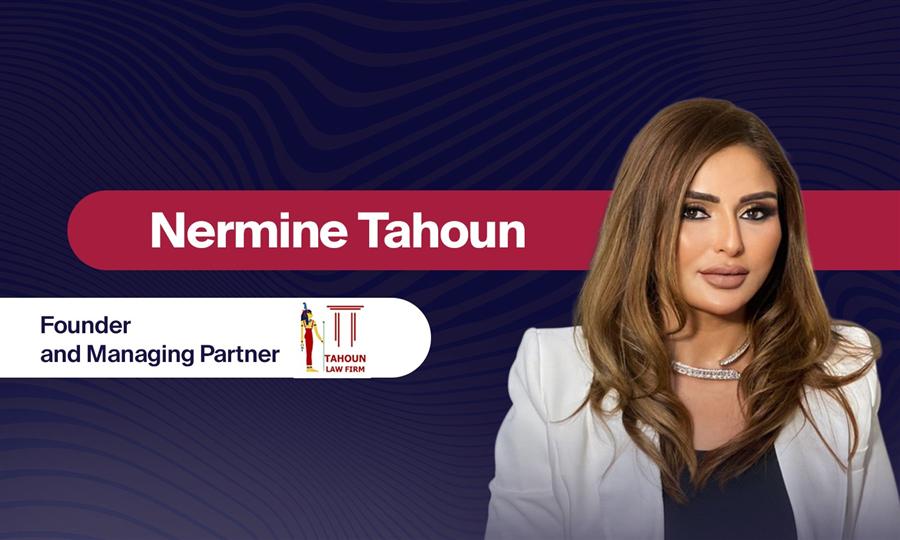
In this exclusive interview, Nermine Tahoun, Founder and Managing Partner of Tahoun Law Firm, shares her insights on why Egypt must adopt a three-day standard for company incorporation, how special economic zones can be repositioned for high-value tech, and her primary advice for international investors: "Enter Egypt through structure, not speed".
1-How has your firm’s strategy evolved from providing traditional litigation to becoming a strategic partner for multinational corporations?
By 2026, Egypt is entering a decisive economic phase — one that regional and international investors typically view as the most strategic point of market entry. Following currency normalization, monetary tightening, and structural fiscal adjustments, Egypt is now transitioning into a stability-driven growth cycle, where legal predictability, capital discipline, and sectoral clarity are becoming the defining investment drivers.
From my perspective, Egypt’s competitive advantage today does not lie in introducing entirely new legislation. Instead, it lies in optimizing execution speed, regulatory coordination, and transaction bankability across the investment landscape.
2-In your recent analysis comparing Egyptian and Gulf special economic zones (SEZs), you noted that business setup can take up to 120 days in Egypt compared to just three days in the UAE. From a legal standpoint, what specific bureaucratic bottlenecks must be removed to close this gap?
In my view, company registration in Egypt should not exceed three days. The legal framework and digital infrastructure already exist to support this timeline. Delays beyond that are largely procedural rather than legislative.
The main bottlenecks include:
If Egypt consolidates incorporation, tax registration, social insurance enrollment, and licensing into a single enforceable digital platform, it can realistically match top regional benchmarks. In today’s global investment environment, speed of entry is no longer a competitive edge; it is a baseline requirement.
3-Having played a pivotal role in drafting Egypt’s PPP law and its contractual models, what legislative refinements are currently needed to further encourage private sector participation in national infrastructure?
Egypt’s PPP framework is structurally strong and aligned with international standards. The current priority is not to redesign the legal architecture, but to strengthen transaction-level certainty.
Key areas for enhancement include:
Global infrastructure capital is currently prioritizing markets that combine legal stability with execution speed and revenue predictability. Egypt is well-positioned to deliver both if procedural bottlenecks are addressed.
4-How can Egypt’s legal framework and incentive packages be restructured to attract more high-value, specialized technology investments?
Only 7% of licenses in Egypt’s SEZs are for high-tech industries, compared to 63% for light industries. Egypt’s economic zones have historically attracted light manufacturing. The next phase must focus on attracting high-value, specialized technology sectors.
To achieve this, Egypt must move from general incentives toward sector-designed regulatory ecosystems.
Priority reforms should include:
Technology investors typically prioritize regulatory predictability and IP protection over tax incentives alone.
5-Regarding the Central Bank of Egypt’s (CBE) recent interest rate cuts in 2025, how do you foresee this shift affecting the "appetite" of private sector companies for new credit and expansion, particularly in the manufacturing and tourism sectors?
The CBE’s interest rate cuts in 2025 are expected to gradually reactivate private sector credit expansion, though the impact will vary by sector.
Manufacturing expansion is expected to grow steadily, particularly among export-driven producers. However, access to foreign inputs and foreign exchange stability remain as critical as financing costs.
Tourism historically reacts faster to monetary easing cycles. Lower borrowing costs directly support hotel construction, renovation financing, and hospitality asset acquisitions.
The next credit growth phase is likely to be driven initially by mid-sized private sector companies, followed by large corporate expansion once macro stability is fully consolidated.
6-As an expert in mergers & acquisitions (M&A), which sectors of the Egyptian economy do you believe currently offer the most stable, high-return opportunities for foreign investors following the stabilization of the exchange market?
Following foreign exchange stabilization, several sectors currently present strong risk-adjusted returns:
Historically, the most resilient investments in Egypt are those aligned with population growth, export capacity, or sovereign-backed demand structures.
7-Your firm works closely with international giants. How does this international collaboration help align Egyptian legal practices with global standards for institutional investors?
Collaboration with international law firms and advisory institutions enables practical alignment between Egyptian and global legal standards.
This includes:
For institutional investors, transaction familiarity significantly reduces market entry friction.
8- What is your primary piece of advice for an international investor considering a major stake in Egypt for the first time in 2026?
My core advice is clear: Enter Egypt through structure, not speed.
Successful investors typically:
Egypt today represents a structural growth story rather than a short-term opportunistic market. Historically, investors who enter during stabilization phases, with disciplined structuring and long-term strategy, achieve the strongest returns.