Egypt’s financial sector is undergoing a historic transformation, reshaping how citizens and businesses interact with money. Over the past decade, deliberate policies by the Central Bank of Egypt (CBE) and other institutions have driven remarkable progress in financial inclusion, reducing reliance on cash and expanding access to digital financial services.
Yet, cash dependency and the informal economy remain persistent challenges. To address this, the CBE has intensified efforts to accelerate the transition toward a less-cash society, in line with Egypt Vision 2030 goals.
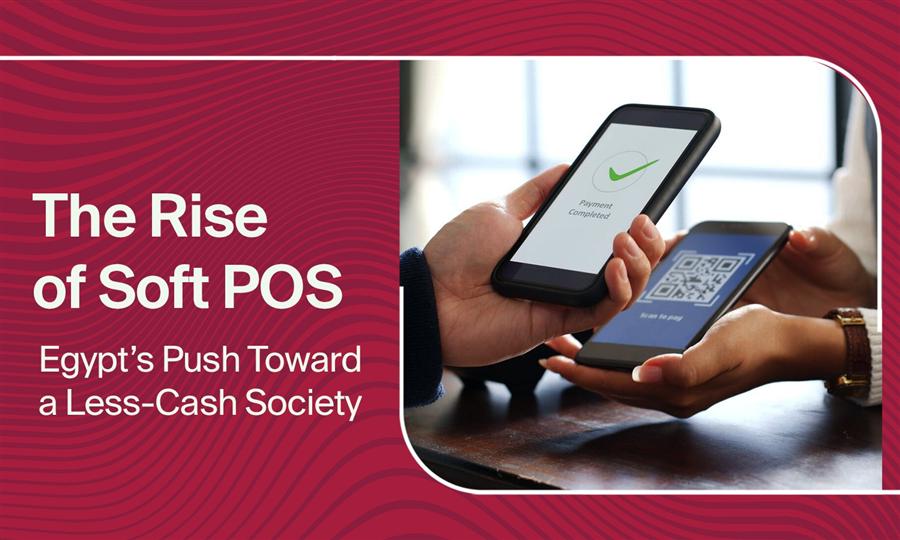
A landmark step in this strategy is the launch of soft electronic points-of-sale (POS) technology, which enables merchants to transform smartphones and tablets into secure payment terminals capable of accepting contactless card transactions.
A Path Towards Financial Transformation
Over the past decade, Egypt has undergone a profound shift in its financial landscape, with deliberate policies driving financial inclusion and reducing reliance on cash. By June 2025, the CBE reported that 76.3% of citizens aged 15 and above—around 53.8 million people—were financially included through bank accounts, Egypt Post, mobile wallets, or prepaid cards, marking a 214% increase since 2016. This progress has been especially notable among women, whose financial inclusion rose from 19.1% to 70.0%, and youth, who reached 54.4%.
At the same time, mobile wallets have emerged as a cornerstone of Egypt’s digital payment ecosystem. Nationwide, 46.3 million wallets executed 718 million transactions worth EGP 943 billion in the second quarter (Q2) 2025 alone. This underscores their growing role in everyday financial activity and bridges gaps where traditional banking access remains limited, according to the National Telecom Regulatory Authority (NTRA).
To further boost financial inclusion and ensure facilitated transactions, the CBE has been intensifying efforts to accelerate the transition toward a less-cash society. A landmark step in this strategy was the launch of contactless electronic payment acceptance via smart devices, enabled through Soft POS applications. This innovation allows merchants to transform smartphones and tablets into secure payment terminals that accept contactless cards using internationally accredited PIN entry standards.
Following a successful pilot phase by the CBE—which previously capped transaction limits at EGP 600—the official launch marks a significant step in the central bank's ongoing mission to modernize payment services and bolster the nation's digital financial infrastructure.
Transforming Smart Devices into Payment Terminals
By lowering barriers to electronic acceptance, the initiative directly supports Egypt Vision 2030 goals of enhancing financial inclusion, fostering transparency, and reshaping the payment ecosystem to align with global digital trends. The new service transforms smart devices into electronic POS, enabling merchants to accept various contactless card payments.
Mohamed Abbas, a senior manager at a fintech company, explains that “this technology aligns with the state’s move toward financial inclusion and reduced cash dependency, while supporting local payment methods such as Meeza cards and contactless payments.”
“It also provides high flexibility for mobile merchants, delivery services, and temporary events, offering a simpler and faster user experience for both merchants and customers. This makes it more suitable for the reality of the Egyptian market compared to traditional POS systems,” Abbas adds.
By simply downloading a Soft POS application, merchants can securely capture card PINs directly on their device screens through an internationally certified process. “The ease of activation and rapid deployment make Soft POS an ideal solution in an environment requiring flexible and fast solutions without logistical complexities or hardware maintenance,” Abbas points out.
In terms of security, Abbas clarifies that “international certifications and secure PIN-entry protocols work to build trust between merchants and consumers by providing a unified framework for security and compliance. This framework ensures the protection of payment data and reduces the risk of fraud.
“When a merchant adheres to globally recognized standards—such as the Payment Card Industry Data Security Standard (PCI DSS)—it reassures the consumer that their financial information is being handled in accordance with international best practices.”
Lowering Barriers to Digital Payments
The introduction of Soft POS technology in Egypt carries profound economic implications, particularly for small merchants and the vast informal sector. Mohamed Abdel Fattah, Economist and Director of Market Access and Government Affairs at M&P, explains, “Soft POS can make a real difference in Egypt’s push to bring informal businesses closer to the formal financial system, mainly because it tackles the everyday realities these businesses face.”
Traditional POS machines have long been a barrier due to their cost, paperwork, and perceived complexity, leaving many small vendors and street businesses reliant on cash. By enabling merchants to accept digital payments through devices they already own, Soft POS lowers these barriers and opens the door for thousands of cash-only businesses to transition into electronic transactions without feeling overwhelmed.
Abbas reinforces this point, noting that “Soft POS technology is particularly suitable for the Egyptian market, as it offers a practical and economical alternative to traditional POS systems. It eliminates the need for expensive dedicated hardware, relying instead solely on an NFC-enabled smartphone—a device already owned by most merchants in Egypt.”
This reduction in upfront investment is especially critical for micro-enterprises, which represent a large share of Egypt’s economy. The simplicity of activation and setup further accelerates adoption, allowing merchants to bypass lengthy procedures and begin accepting payments almost instantly.
Beyond cost savings, the shift to digital transactions creates new opportunities for financial integration. Abdel Fattah highlights that “once transactions start happening digitally, something important happens: businesses begin to leave a digital footprint. Even small, everyday transactions create a basic transaction history.”
“Over time, this helps informal merchants become visible to banks and fintech companies, making it easier for them to access services like micro-loans, working capital, or digital wallets—services that were previously out of reach simply because there was no data,” he says.
The flexibility of Soft POS also aligns with the realities of Egypt’s small business sector. Abbas explains that enabling mobile phones and tablets to function as payment terminals is particularly advantageous for merchants operating in mobile or non-fixed locations, such as delivery services or seasonal vendors. “Turning mobile phones and tablets into payment terminals removes many of the obstacles that small and micro businesses deal with every day. It fits the way small businesses actually operate.”
This adaptability allows vendors to accept payments wherever their customers are, reducing dependence on fixed infrastructure and expanding their market reach.
Moreover, the digitalization of payments fosters better business management. Abdel Fattah observes, “Once a phone becomes a payment tool, it often becomes much more than that. It can help track sales, manage customers, and understand cash flows.” These incremental improvements enable businesses to organize themselves more effectively, grow sustainably, and gradually transition toward more formalized operations.
The launch of Soft POS technology by the CBE marks a pivotal milestone in the country’s ongoing financial transformation. Building on years of progress in financial inclusion and digitalization, this innovation directly addresses the structural barriers that have long kept small merchants and informal businesses reliant on cash.
By leveraging devices already in widespread use, Soft POS reduces costs, simplifies adoption, and provides the flexibility needed for Egypt’s diverse business landscape.
By Sarah Samir