Arab Finance: Middle East and North Africa’s (MENA) digital advertising market is expanding rapidly as businesses shift more of their customer acquisition and commerce activity online. The region’s digital ad spending reached $8.19 billion in 2025, up 17.8% year on year, according to IAB MENA, making MENA the fastest-growing digital advertising market globally and placing it among EMEA’s top five advertising markets by spend. Egypt recorded the region’s highest growth rate, with digital ad spend rising 23.1% during the year, while social advertising grew 19.3% and social video grew 23.6%.
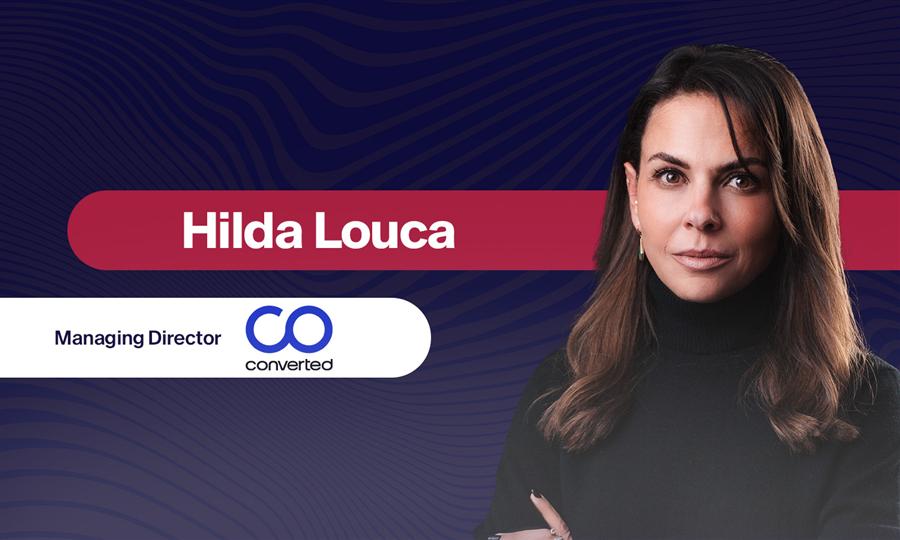
Against this backdrop, Converted is seeking to address the fragmentation across advertising, payments, and e-commerce by integrating these functions into a single infrastructure layer. In this interview, Managing Director Hilda Louca discusses the company’s AI-driven approach, its acquisition of MITCHA, opportunities for Egyptian businesses, regional market differences, SME adoption of AI, and Converted’s plans to expand across MENA.
1-What is the market gap Converted addresses in the digital advertising and e-commerce ecosystem across emerging markets?
Converted is a MENA-focused AdTech and commerce infrastructure company. We were founded to solve a very specific problem. Businesses in the region were forced to stitch together disconnected tools: one platform for advertising, another for payments, another for order management, with no single system that could see the full customer journey from the first ad impression to a completed, paid order. That fragmentation makes it nearly impossible to know which advertising spend is driving revenue, not just clicks.
Converted brings advertising and payments together into one platform, allowing merchants to see and act on the entire funnel in one place. Today, we serve thousands of paying merchants across Egypt, Saudi Arabia, and the UAE.
2-How does Converted’s integrated model change the way businesses manage customer acquisition and measure marketing performance?
The whole industry already looks past clicks to full-funnel performance, so that part is not new. Every serious advertiser already tracks the entire funnel, not just clicks. What is different about Converted's model is the depth of the data behind it. Because ad spend, payments, and order data all sit on one system, we have been able to train our AI directly on real consumer behavior, not just campaign-level signals, but on how people actually shop, pay, and reorder.
That enables us to target more precisely and measure performance more accurately than tools that only work off ad-platform data. It also changes what a merchant has to do day to day. Because the system can see order-level results in near real time, it can reallocate budget toward what is actually converting and keep optimizing automatically, instead of needing a media buyer to check a dashboard every day.
3-AI is rapidly changing digital advertising, from content creation and targeting to campaign optimization and customer conversion. Where do you see AI creating the greatest tangible value for businesses today, and what aspects of marketing remain difficult to automate?
The true power of AI is not just automation—it is continuous, always-on optimization that never sleeps. A campaign can be tested, adjusted, and re-optimized at 3 a.m. without human interference, saving a huge amount of time and compounding into results that manual workflows cannot replicate.
More than any single feature, that is what AI actually gives a business today. It takes care of the repetitive, around-the-clock work and frees people to focus on what matters. That is exactly the idea behind what we have built at Converted: a largely automated funnel where ad spend, creative selection, targeting, and checkout operate continuously with minimal manual intervention, so a merchant can fund the platform and let it work around the clock.
4-Converted recently acquired Egyptian fashion-commerce platform MITCHA. What strategic capabilities or market access does MITCHA bring to Converted, and how will the acquisition strengthen the company's presence in Egypt and the wider MENA region?
As the founder and former head of MITCHA—then Egypt’s largest fashion e-commerce platform—I joined Converted as a partner and Managing Director following the acquisition. Beyond our core e-commerce expertise, MITCHA brought a critical strategic asset: a deeply engaged, high-trust consumer audience reliant on the brand for curated shopping recommendations.
As we phased out the standalone marketplace, that active community transitioned directly into a primary acquisition engine for Converted. It serves as a tangible proof-of-concept for Converted’s founding thesis: in this region, long-term efficiency is not driven by cold ad spend, but by building and maintaining authentic, high-trust consumer relationships.
5-What opportunities do you see for Egyptian businesses to use AI and data-driven marketing to scale domestically and expand into regional markets?
Egyptian businesses have a real opportunity to compete with much larger regional players by using the same data-driven tools that used to be exclusive to companies with big in-house marketing teams. AI-powered targeting and creative testing allow a small brand to run dozens of experiments a day, something that once required a full media-buying team.
Domestically, that means smarter spending against competitive Egyptian ad prices. Regionally, it means a brand that gets its acquisition economics right at home can expand into Saudi Arabia or the UAE without rebuilding its marketing function from scratch, because the infrastructure and learnings travel with it.
6-How do differences in consumer behavior, digital maturity, advertising costs, and e-commerce infrastructure across Egypt, Saudi Arabia, and the UAE influence your regional strategy?
The three markets operate as distinctly different ecosystems. The UAE and Saudi Arabia have higher digital maturity, higher advertising costs, and consumers who are used to fast delivery and a wide range of payment options.
Egypt has a much larger population, lower average order values, a historically higher reliance on cash on delivery, and price sensitivity that changes how you have to structure offers.
Our strategy is to keep one underlying infrastructure, the same engine everywhere, but enable each market's playbook to adapt: different creative strategies, different payment mixes, and different pacing for ad spend. What does not change is the principle that acquisition has to be measured all the way to a paid order, in every market.
7-MENA's e-commerce and digital advertising markets remain fragmented, with businesses often relying on separate platforms. Do you see this fragmentation as a challenge or an opportunity for companies such as Converted?
It is the opportunity that Converted was built around. Fragmentation exists because advertising, payments, order management, and customer acquisition have historically been handled by specialized vendors in the region, leaving merchants as the integrator, manually reconciling data across systems that were never designed to communicate with each other.
We saw that as a chance to build the connective layer ourselves: a single platform where ad spend, creative, targeting, and checkout are automated end-to-end, and a merchant's only real job is to fund the platform. Fragmentation is painful for merchants, but it is exactly the kind of structural gap that rewards a company willing to do the unglamorous integration work underneath.
8-As businesses across MENA accelerate their digital transformation, what are the biggest barriers preventing SMEs from adopting AI-powered commerce and marketing tools, and what needs to change to make these technologies more accessible?
The biggest barrier is not awareness. Most SME owners know that AI tools exist. Rather, it is more a combination of cost, complexity, and trust. Many of these tools are priced and designed for larger companies with dedicated marketing or data teams, which most SMEs do not have. There is also a trust gap: handing ad spend decisions to an automated system feels risky if you do not have visibility into what it is doing or why.
What needs to change is really twofold. Tools need to be affordable and usable by a non-technical business owner, not just accessible to enterprises, and providers need to be transparent about what the AI is optimizing for, so trust is earned rather than assumed. Access to financing for ad spend itself is also a real constraint that we are actively working on.
9-Looking ahead over the next three to five years, what is your vision for Converted's role in MENA's digital economy, and which markets, technologies, or partnerships will be most important to achieving that ambition?
Over the next three to five years, we want Converted to be the default infrastructure layer that MENA merchants build their commerce operations on top of, not just in Egypt, Saudi Arabia, and the UAE, but also as we expand further into North Africa and the wider region.
Technologically, we are pushing further into automation across the entire funnel, and into embedded financing for advertising itself, so access to capital is no longer what stands between a good product and a business that can afford to market it.
In terms of partnerships, the priority is deepening relationships with the payment and logistics providers that each new market depends on, because the hardest part of regional expansion is never the ad technology. It is the local rails underneath it.