Arab Finance: Egypt’s non-banking financial services (NBFS) sector plays a pivotal role in driving financial inclusion, yet micro, small, and medium enterprises (MSMEs) continue to face structural hurdles in accessing tailored capital. As macroeconomic pressures and inflation reshape the local market, expanding productive financing for industrial and agricultural ventures, rather than traditional commercial loans, has become essential to boosting domestic growth and resilience.
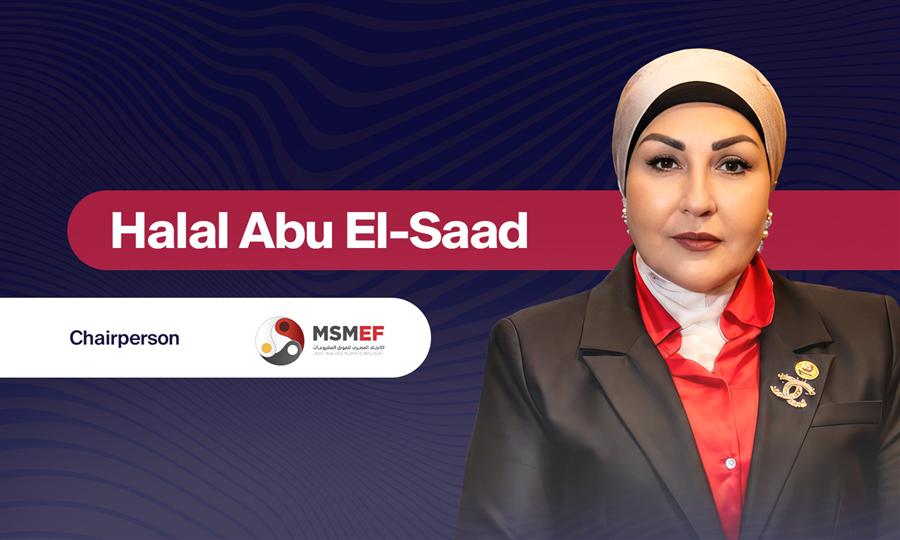
In an exclusive interview with Arab Finance, Hala Abu El-Saad, Chairperson of the Egyptian Federation for Financing Medium, Small, and Micro Enterprises (MSMEF), discusses the federation's strategy to expand its reach to 10 million beneficiaries, the regulatory push to discipline the market alongside the Financial Regulatory Authority (FRA), and upcoming financial innovations designed to empower young entrepreneurs and micro-exporters across Egypt.
1-What role does the MSMEF play in supporting youth and entrepreneurs?
First of all, the federation brings together all microfinance institutions (MFIs), companies, and non-governmental organizations (NGOs) operating in the MSME finance sector. We have nearly 500 member institutions nationwide, spanning all governorates. This is a vital sector within Egyptian society, and it enjoys special attention from President Abdel Fattah El-Sisi, as financing this segment contributes to creating innovative job opportunities, which in turn enhances income levels and standards of living.
The federation was established pursuant to Law No. 141 of 2014. It is worth noting that the FRA plays a robust role in regulating and overseeing these institutions and companies to ensure we reach our targeted beneficiaries across villages, centers, rural areas, and various cities.
The federation aims to develop the microfinance industry in Egypt by providing technical support to all our members. Total beneficiaries currently stand at 4.1 million clients, down from 4.7 million in 2022 due to geopolitical and regional conditions affecting the region. However, the federation’s long-term strategy aims to expand our active client base to 10 million beneficiaries.
The industry currently employs over 55,000 professionals, and we are targeting an increase in employment opportunities within the microfinance sector to reach 100,000 jobs in the coming period.
2-How do you view the challenge facing local financing institutions and companies regarding financing commercial ventures with high capital turnover rates versus productive industrial activities with lower turnover rates?
Indeed, this is a major challenge. However, our primary goal is to channel financing into productive projects, as they carry lower overall risk profiles and help create a balance across the productive and commercial sectors. Looking at Egypt’s microfinance industry, we see a continuous drive to innovate financial products tailored to all segments and cultural backgrounds of society. Ultimately, this translates into healthy loan portfolios for financing institutions capable of absorbing various economic shocks.
During our recent meeting with the CEOs of microfinance companies, we discussed holding an upcoming meeting with officials from the Central Bank of Egypt (CBE) and the Micro, Small, and Medium Enterprise Development Agency (MSMEDA). The goal is to explore introducing dedicated financial products for our members featuring favorable terms, tailored to the culture of beneficiaries and market dynamics.
We are also currently studying a new financial product, which we will announce soon, tailored specifically for micro-exporters. Egypt is a vast market with ample space for diverse financial products; it possesses immense human capital and represents a promising market. What is needed now is to enhance financial literacy across certain social segments in a way that matches their cultures and needs. Our role is to reach these groups to serve the national economy, foster growth, and alleviate poverty.
3-How do you evaluate the equitable geographic distribution of financing across Egypt?
We are in the process of establishing a dedicated Research and Development (R&D) Center under the federation. Its objective will be to roll out new financial products by conducting localized market research tailored to the nature of each governorate. The financial culture in Upper Egypt differs from that of the Delta or major metropolitan cities; every community has a unique approach to financing.
4-What is your view on the role of tax incentives in encouraging and supporting small and medium enterprises (SMEs)?
Tax incentives play a crucial role in supporting MSMEs. Ahmed Kouchouk, Minister of Finance, is doing exceptional work in raising tax awareness and reassuring manufacturers and producers outside the formal sector, encouraging them to join the tax system and integrate into the formal economy.
5-How do you see inflation affecting the cost of capital and default rates among certain beneficiaries?
Risks and default rates among beneficiaries have risen noticeably in recent periods due to elevated inflation rates and regional geopolitical conditions, which naturally impact microfinance portfolios in Egypt.
One of the key drivers behind rising default rates relates to service providers themselves—namely, loan officers. They are the backbone of Egypt's non-banking financial sector. These professionals, especially recent graduates, require high-caliber training in financial inclusion principles and non-banking financial literacy. The federation plans to focus heavily on training this cadre in the coming period to produce highly qualified financial officers.
6- What is your perspective on the importance of credit scoring for prospective borrowers to help mitigate default rates?
We recently held a meeting with the Egyptian Credit Bureau (iScore), one of our core strategic partners, to better evaluate clients' credit histories and analyze their repayment behavior, providing a comprehensive picture of each client's creditworthiness.
We have observed some negative practices stemming from unqualified loan officers within the non-banking financial sector. Working in coordination with the FRA, we have taken active steps to strengthen market discipline through several mechanisms, including purging the market of non-banking financial entities that are unqualified to operate in the industry.
After exhausting all administrative procedures to bring these entities into regulatory compliance, over 400 inactive microfinance entities and shell companies were delisted. On the flip side, the federation has trained, qualified, and upgraded 44 Category 'C' NGOs, enabling them to reach the higher Category 'B' tier.
7-Which international models or best practices can Egypt leverage in the non-banking financial sector?
We look at Tunisia as a notable model, particularly for its effective agricultural finance products. Morocco also offers one of the most distinguished models in the region. International experiences can be adapted and "Egyptianized" to suit our local culture and specific credit tiers.
In this context, we are preparing to organize a major international conference—held in Egypt for the first time—in cooperation with the global organizations CERISE + SPTF. Titled "Protect & Empower Finance," the conference will take place from September 28 to 30, 2026, bringing together over 200 global microfinance experts to discuss the future of the industry.
8-How do you view competition between traditional banks and non-banking financial institutions (NBFIs)?
There is strong synergy between the banking and non-banking sectors; both serve to empower the Egyptian economy.
9-How do you assess the credit discipline and repayment commitment of youth and female borrowers?
Women are among the most disciplined borrowers in our credit portfolio and exhibit the lowest risk profiles; as a result of this strong credit track record, their loan applications are often processed faster.
However, moving forward, we plan to expand our support for both women and youth. We need specialized programs tailored to entrepreneurs, startups, and young people, supported by dedicated financial products.
10-How does the federation specifically support entrepreneurs?
The federation plays an active role in supporting youth and entrepreneurs by reshaping the financing ecosystem in Egypt to prioritize productive ventures, both agricultural and industrial, rather than focusing solely on commercial and service activities.
Data from the FRA indicates that commercial and service activities currently account for the largest share of funding. Therefore, our strategic objective is to rebalance the financing structure so that the industrial and agricultural sectors become the primary beneficiaries, thereby driving economic growth and increasing their contribution to Egypt's GDP.
Additionally, we support entrepreneurship through our member financing companies and Category 'A' NGOs (the top-tier microfinance providers), many of which have a strong development focus. Recently, in collaboration with the Ministry of Investment, we stepped up support for micro-exporters. We will soon visit Port Said Governorate to study and launch dedicated financial products for micro-exporters there.
11-Finally, how do you summarize the key challenges facing the microfinance industry in Egypt today?
The primary challenges stem from geopolitical shifts in the region and the resulting surge in inflation rates. Additionally, we face negative public perceptions regarding financing in some quarters, alongside bad-actor groups on social media advocating non-repayment—a trend we are actively working to address