Arab Finance: As Egypt's business landscape continues to adapt to changing workplace patterns, rising real estate costs, and the growing demand for greater operational flexibility, flexible workspaces are becoming an increasingly important component of the country's commercial real estate market. Egypt's expanding business hubs, new urban developments, and growing role as a gateway to Africa are creating new opportunities for flexible office providers.
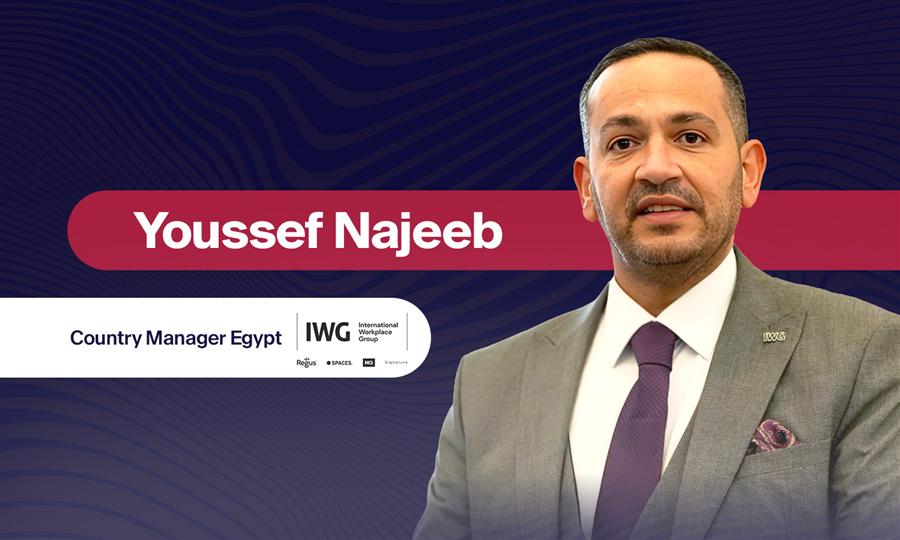
Against this backdrop, International Workplace Group (IWG) is accelerating its expansion in Egypt, targeting 150 flexible workspaces by 2030 after identifying the country as one of its fastest-growing markets for two consecutive years. In an exclusive interview with Arab Finance, Youssef Najeeb, Country Manager Egypt at IWG, discusses the company's capital-light expansion strategy, its growing partnerships with Egyptian developers and investors, the decentralization of office demand, and how flexible workspaces can help businesses navigate rising costs while supporting Egypt's emergence as a regional business hub.
1-What is the core business of IWG? And what range of services and brands does it provide in Egypt and globally?
International Workplace Group (IWG) is the world's largest provider of flexible workspaces. The company helps millions of people and businesses work more productively by offering a range of workspace solutions, including co-working spaces, private offices, meeting rooms, event spaces, and virtual workspaces.
In Egypt and globally, IWG provides its services through a multi-brand strategy designed to appeal to different market segments. The primary brands include Regus for a traditional corporate environment, Spaces for creative and collaborative communities, HQ for practical and cost-effective solutions, and Signature for high-end, premium locations. All these services are supported by and accessible via the digital IWG app.
2-You mentioned Egypt being IWG’s fastest-growing market for two years running, with a target of 150 centers by 2030. What specific factors in the Egyptian market drove this rapid growth, and why is Egypt a strategic priority for IWG?
IWG’s rapid growth in Egypt is largely driven by our capital-light partnership model and the shift toward remote and flexible working as an efficient solution to traditional operational hurdles and a differentiator to attract top talent. Local challenges, such as long commutes, which can reach up to three hours a day in major cities like Greater Cairo and Alexandria, make working closer to home a top priority for office workers.
Egypt is a strategic priority for IWG because it is continuously strengthening its position as a business hub for Africa and the Arab-speaking region, offering unmatched benefits of cost-efficiency and a highly skilled workforce that are sought after regionally.
Favorable economic forecasts and an open regulatory market continue to attract multinational companies, making Egypt an ideal environment for IWG's target of operating 50 centers by the end of 2026 and 150 flexible workspaces by 2030.
3-IWG is expanding through a capital-light partnership model that grew franchise and managed-fee income by 70% globally. How does that model work in Egypt?
IWG's capital-light model has grown managed-fee and franchise income by 70% globally. In Egypt, this model operates by partnering with local real estate investors and property owners who deeply understand the market and recognize the rising demand for flexible working solutions by large corporates and start-ups alike.
Local Egyptian partners handle the logistics, municipality requirements, and upfront capital and setup costs, while IWG provides its world-class design, operational expertise, and integration into its huge global network. This model is highly attractive to landlords because it allows them to transform vacant or conventional real estate into thriving, commercially successful work environments, while maximizing returns on their property portfolios without managing the daily operations.
4-What are your recent projects and partnerships in Egypt?
IWG has been actively expanding its footprint across multiple Egyptian hubs. A recent major milestone is a partnership agreement with ElTarek Group to establish new centres in Cairo and Alexandria.
Additionally, IWG is opening its largest Regus centre in Egypt at District 5 in New Cairo, spanning 1,580 square meters. IWG is also developing what will be its largest flexible workspace globally at "The Ark" in New Cairo.
To address the demand for decentralized workspaces, IWG has signed deals for five new centres in the New Capital and is rapidly expanding into coastal and suburban towns like El Gouna, the North Coast, Hurghada, and New Damietta, with plans to expand into three more cities soon.
5-How do you validate your $11,000 per-employee cost savings for Egyptian clients, and what return on investment (ROI) timelines do they see?
The $11,000 in annual savings per employee is based on global research done with industry professionals and academic experts and reflects the great efficiencies gained from adopting a flexible working model.
For Egyptian companies, the ROI is immediate because the flexible workspace model eliminates the need for expensive, long-term commercial leases, utility management, and upfront investments in office furniture. By utilizing IWG's spaces, businesses can turn fixed capital expenditures (capex) into operational expenses (opex). Since clients can seamlessly scale their office footprint up or down based on their current needs, companies can reduce their overall real estate costs by up to 55%.
6-How is IWG working with developers to support that decentralization and related infrastructure needs?
IWG is supporting decentralization by actively opening centers away from crowded city centers, focusing instead on suburban communities, coastal cities, and large new developments like the New Capital. IWG’s primary approach is to form strategic partnerships with private real estate developers and investors.
While the majority of alliances are private, IWG also engages in discussions with the government on specific projects. This expansion is supported by Egypt's economic development plans, which strongly encourage private sector collaboration.
7-What digital tools and analytics does IWG deploy in Egypt to manage occupancy, member experience, and corporate needs?
Technology is foundational to IWG's operations, as we continuously invest in developing the technology platforms, systems, and distribution channels that support our partners’ work needs.
In Egypt, corporate clients and individual members use the centralized IWG app, which grants them instant access to booking workspaces, meeting rooms, and digital services across the global network.
Furthermore, IWG is increasingly integrating artificial intelligence (AI) to improve its operations, drive business efficiency, and enhance data reporting and occupancy tracking across its platforms.
8-With rising competition from local workspace operators, what differentiates IWG in Egypt, and how do you protect market share?
IWG’s primary differentiator is its unparalleled global scale. An IWG membership grants local Egyptian businesses instant access to a network of over 6,000 signed locations in more than 120 countries, including 34 centers in Egypt, an advantage that local operators cannot replicate.
In addition, IWG’s multi-brand strategy (Regus, Spaces, HQ, and Signature) allows the company to cater to various budgets and aesthetic preferences, unlike competitors that rely on a single brand.
Finally, IWG's significant global investments in scalable, cutting-edge technology and IT infrastructure, as well as in sales and marketing capabilities, outmatch those of competitors on both local and global scales.
9-Looking ahead to 2027–2030, what are the biggest risks and opportunities you see for IWG’s expansion in Egypt, and what metrics will you use to decide whether to accelerate, pause, or change course?
The primary risks to all businesses regionally in the current period involve macroeconomic instability, inflation, rising interest rates, and geopolitical uncertainty. However, IWG views this landscape as an opportunity where "uncertainty is the new certainty", as businesses are increasingly seeking flexibility that allows them to navigate volatile situations.
We are witnessing companies opting away from rigid, long-term real estate liabilities and toward IWG's flexible, asset-light solutions. Significant opportunities exist in Egypt due to its booming urbanization, its role as a gateway to Africa, and a growing demand for outsourcing solutions.
To steer this growth toward the goal of 150 centers by 2030, IWG relies on rigorous metrics such as Revenue Per Available Room (RevPAR), overall network occupancy, and the growth of recurring management fee income driven by its capital-light partnerships.