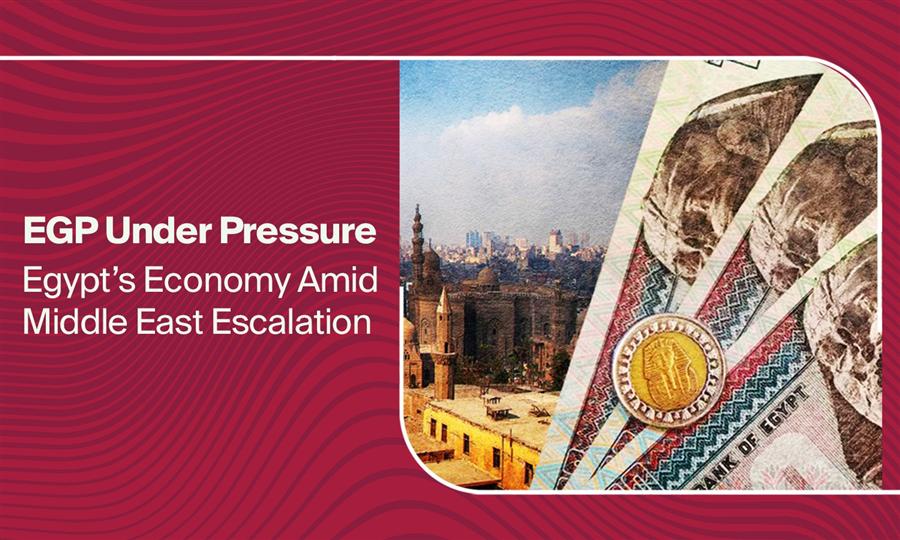
Egypt is once again dealing with the economic fallout from the unrest in the Middle East as regional conflict intensified in late February 2026. Fears of instability across the Middle East have been rekindled by escalating tensions between the US and Iran, punctuated by recent military strikes involving both Washington and Tel Aviv.
The protracted conflict is amplifying economic spillovers, with the Egyptian Pound (EGP) bearing the immediate brunt, even though Egypt faces few direct security threats. Therefore, the government's adherence to structural reforms under its commitments to the International Monetary Fund (IMF), along with the banking sector's role as a stabilizing buffer, will be essential to preserving confidence and stabilizing expectations.
Immediate Impacts on the EGP
While Egypt faces minimal direct security threats from the conflict, the prolonged nature of the war is amplifying economic spillovers that could grow more severe over time. The most visible casualty of the current escalation has been the exchange rate. Within the first 48 hours after hostilities broke out in late February 2026, the Egyptian Pound shed over EGP 1.80, rapidly sliding past 50 per $1, marking its weakest level since July 2025, according to Fitch Solutions.
This comes as the Central Bank of Egypt (CBE) allowed the currency to absorb external shocks rather than burn through reserves. The move mirrors earlier episodes. During the Israel–Iran escalations in early 2024, the EGP weakened from 49.8 to 50.74 in the parallel market as risk premiums surged. During the 12-day US-Iran war in June 2025, the EGP exceeded 50 per $1, as per the CBE data.
Prime Minister Mostafa Madbouly stated at a press conference on March 4th that Egypt decided, within the framework of its economic reform program, to adopt a flexible exchange rate. This means the currency price reflects supply and demand.
In this context, he emphasized that the state possesses sufficient reserves and faces no dollar crisis whatsoever, noting that the CBE is acting with full flexibility to meet market requirements.
A flexible exchange rate acts as a shock absorber for the economy in times of global crisis. Samer Beshir, a former banking expert, financial consultant, and independent external auditor for global corporations, tells Arab Finance: “A flexible exchange rate allows the currency to adjust naturally to external pressures, such as fluctuations in commodity prices, trade imbalances, or capital flows. This reduces the direct impact of global shocks on domestic markets and lessens the need to rely on reserves to defend a fixed rate.”
“For ordinary citizens and businesses, it helps stabilize prices, maintain competitiveness, and ensure continued access to credit and essential goods. Overall, it strengthens economic resilience and allows the economy to navigate uncertainty more effectively,” Beshir adds.
Fatma Elhamalawy, Associate Professor of Economics at the Institute of National Planning, tells Arab Finance: "Compliance and liquidity challenges affect foreign exchange market operations through two main channels during periods of conflict.”
“First, tighter transfer controls and enhanced banking oversight may slow the flow of foreign currency through official channels and increase transaction costs. Second, heightened precautionary demand for US dollars, combined with rising risk premia and potential portfolio outflows, puts pressure on banking system liquidity," she explains.
Elhamalawy also points to Egypt’s 2022–2023 experience, when shortages and widening imbalances expanded the parallel market prior to the adoption of a flexible regime. Recent policy signals show that authorities remain attentive to external pressures, allowing greater exchange-rate flexibility to preserve external balance and limit the risk of sudden outflows of “hot money” amid regional uncertainty.
Madbouly pointed out that monitoring global markets showed fluctuations in currency prices due to recent regional events over the past two days, with the dollar strengthening against several major global currencies—an expected outcome during times of war.
"The most important thing is that we have secured our resource needs, and we fully guarantee the continued regularity of the foreign exchange market within the Egyptian state," he said, adding that the state will maintain the supply-and-demand approach in the coming period.
Speaking in a personal capacity, Asser Badrawy, the Executive Deputy General Manager and Area Manager at Suez Canal Bank, notes: "Egypt’s ability to stabilize the currency under IMF commitments largely depends on maintaining exchange rate flexibility while strengthening foreign currency inflows through structural reforms.”
“Enhancing export competitiveness, attracting sustainable foreign direct investment (FDI), and supporting remittance flows remain key pillars. Additionally, prudent monetary policy and disciplined fiscal management are essential to anchor expectations and reduce speculative pressures," Badrawy explains.
Key Economic Channels
The Egyptian economy is facing significant challenges as a result of the ongoing Iranian conflict in the Middle East, which has increased pressure on many of Egypt's sources of foreign revenue. At least $1.8 billion in foreign investment flowed out of Egyptian debt instruments between February 15th and 26th, according to Fitch Solutions.
Net outflows are projected to persist in the near term, intensifying downward pressure on the currency. March 2026 represents a critical juncture, as Egypt faces a yearly peak of $18.0 billion in maturing short-term domestic debt. Given that foreign investors hold nearly 20% of the T-bill stock, there is a significant risk of capital flight should they choose not to roll over these positions.
“Investors are likely to become more cautious about Egypt if the regional conflict continues or escalates, even in the absence of immediate tangible effects,” Elhamalawy explains. “Heightened geopolitical uncertainty typically leads investors to reassess risk exposure in emerging markets, particularly those geographically and economically linked to the conflict zone.”
She notes that Egypt’s reliance on portfolio flows, Suez Canal revenues, tourism receipts, and remittances makes investor confidence closely tied to regional stability. “Historical precedent reinforces this expectation. During the regional turmoil that followed the Arab Spring in 2011, Egypt experienced large capital outflows and a sharp decline in its international reserves, although part of the shock was due to wider regional instability rather than purely domestic economic factors.”
“This episode suggests that if current geopolitical tensions intensify or endure, a similar precautionary pattern of portfolio reallocation and risk hedging could emerge, potentially preceding any observable deterioration in economic indicators,” Elhamalawy adds.
Egypt’s external balance remains highly sensitive to regional stability. A sustained conflict would likely trigger a multi-front economic hit, driving up oil prices while simultaneously eroding the country's main sources of hard currency: Suez Canal transit fees, tourism, and GCC-based remittances, as highlighted by Fitch Solutions.
In this regard, Badrawy notes, “Suez Canal revenues represent a significant source of hard currency inflows. Any sustained disruption directly affects Egypt’s balance of payments and foreign currency availability. Reduced canal receipts may tighten FX liquidity in the banking system, potentially increasing demand pressures.”
He adds, “However, the overall macroeconomic impact depends on the duration of disruptions and the availability of alternative inflow sources such as tourism, remittances, and external financing.”
Additonally, Elhamalawy underscores the vulnerability of Egypt’s foreign-exchange inflows to disruptions in global trade routes. The rerouting of global trade away from the Red Sea and the Suez Canal could reduce Egypt’s FX inflows in the short to medium term, although permanence depends on the duration of instability and long-term shipping behavior.
She recalls that canal revenues fell sharply from $10.25 billion in 2023 to about $4 billion in 2024 after traffic dropped by nearly half. “However, historical experience suggests that such effects are unlikely to be permanent.”
“During previous disruptions, including the closure of the Suez Canal between 1967 and 1975, global shipping temporarily shifted to alternative routes but returned once the canal reopened and security conditions improved. As the canal remains the shortest and most cost-efficient route between Europe and Asia, most assessments expect traffic, and associated FX inflows, to recover once regional stability is restored,” she notes.
The Banking Sector as a Strategic Buffer
While the geopolitical climate presents severe headwinds, Egypt’s financial architecture is designed with built-in shock absorbers to prevent a full economic derailment. The resilience of the Egyptian Pound is closely tied to the strength of its banking institutions.
According to Badrawy, “The Egyptian banking sector plays a critical stabilizing role by maintaining FX liquidity management, facilitating trade finance, and supporting key importing sectors.”
“Strong capitalization, regulatory oversight, and diversified foreign currency funding sources enhance the sector’s ability to absorb external shocks and maintain market confidence during periods of volatility,” he explains.
When markets face external stress, the internal movement of capital becomes a vital defense mechanism. Beshir emphasizes that interbank activity is essential during periods of market stress because it allows banks to efficiently share foreign currency liquidity. “This prevents sharp, panic-driven fluctuations, narrows bid-ask spreads, and reinforces confidence in the financial system. For everyday citizens, it translates into more stable prices for imported goods, better access to foreign currency, and reduced risk of sudden financial shocks affecting household budgets.”
Beshir further adds that authorities may intervene or adjust interest rates when market volatility rises sharply, inflation pressures intensify, or financial conditions become disorderly.
“Raising rates can help contain inflation and maintain overall stability, while lowering rates reduces borrowing costs, encourages investment, stimulates consumer spending, and supports businesses,” he notes.
He adds that “transparency is essential during geopolitical or economic stress, as clear communication anchors expectations, limits speculation, and reassures households and businesses, helping prevent panic and maintain trust in the financial system.”
Egypt now finds itself at a familiar but challenging economic crossroads as it negotiates the choppy geopolitical waters of early 2026. The recent depreciation of the EGP is a clear reminder of the nation's vulnerability to regional volatility. However, unlike earlier crises, the current approach, which is based on structural IMF-backed reforms and exchange rate flexibility, offers a stronger framework for absorbing external shocks without depleting crucial reserves.
By Sarah Samir