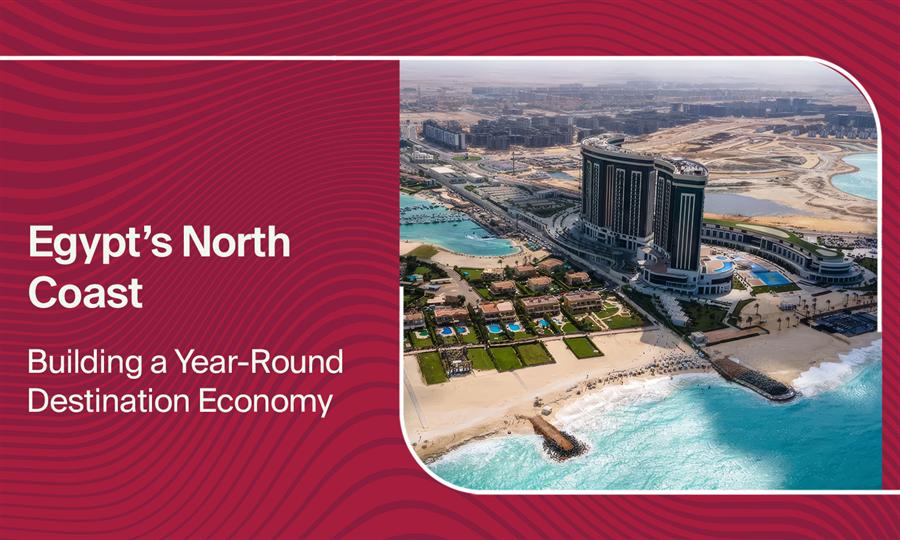
Egypt’s North Coast is entering a new phase of development in which tourism, urban expansion, and private-sector innovation are increasingly tied together. Rather than being shaped by isolated projects or seasonal activity, the region is evolving into a more integrated investment landscape where New Alamein, Yalla Sahel, and other coastal developments can reinforce one another through shared infrastructure, unified destination branding, and complementary services. This shift is not only about attracting visitors but also about building a year-round economic model that improves efficiency, strengthens investor confidence, and creates long-term value for the wider coastal economy.
North Coast Transformation
Egypt’s North Coast is emerging as a focal point for ambitious development, where urban expansion and tourism innovation converge. At the heart of this transformation lies New Alamein, a flagship fourth-generation city designed to attract global investors, diversify the national economy, and extend growth beyond the confines of seasonal tourism.
“New Alamein can be considered a fourth-generation city because it integrates smart technologies, digital infrastructure, sustainable urban planning, clean energy solutions, and advanced public services within a comprehensive development model,” Ahmed Samir AbdelAziz, Head of the Digital & Sustainable Business Economics Department, AASTMT, tells Arab Finance.
“This transforms the North Coast from a seasonal tourism destination into a year-round economic hub that attracts investment, supports innovation, creates employment opportunities, and contributes to achieving Egypt Vision 2030 through sustainable economic development,” Samir adds.
Alongside New Alamein, the private-sector initiative Yalla Sahel is championing sustainable tourism, cultural engagement, and local entrepreneurship. The initiative’s website serves as a central marketplace for verified chalets and luxury villas in Ras El Hekma, Sidi Abdel Rahman, Marassi, and New Alamein, while its TELLR digital concierge app enhances visitor experiences with real-time information on events, hospitality, and local activities.
According to Mohamed Roshdy, CEO of Bokoo Travel, “The North Coast is no longer just a regional, single-season summer resort; it is transforming into a world-class, year-round sustainable tourist destination when its full potential is properly leveraged.”
Integration is key, he emphasizes, saying: “Tourists are not just looking for a hotel room. They are looking for a complete ecosystem, transportation and flights, accommodation, dining and nightlife, and seamless logistics.”
Integration Vs. Fragmentation
Despite their shared geography and overlapping investor interests, New Alamein and Yalla Sahel face a critical choice: pursue fragmented competition or embrace integrated investment strategies.
AbdelAziz warns, “The North Coast cannot reach its full economic potential if real estate, tourism, and infrastructure investments continue to be planned in isolation. Smart city development requires an integrated approach in which infrastructure, tourism, real estate, ICT, and public services are planned together through strong public-private partnerships.”
Roshdy shares a similar view, noting that “fragmentation leads developers and operators to work in silos, creating service bottlenecks and driving up operational costs.”
“Integration, on the other hand, enables us to offer end-to-end curated packages (All-Inclusive Experiences), driving year-round traffic and ensuring smoother operations that benefit all stakeholders, ” Roshdy adds.
He also highlights the geographic advantage of clustering developments around El Alamein Airport and modern highways, which allows agencies to design rich itineraries while lowering customer acquisition and logistics costs.
“Complementary positioning means filling the operational gaps left by major players rather than competing head-to-head. Translating this into a compelling investment pitch requires focusing on actionable metrics and commercial logic,” Roshdy explains.
In practice, this means converting services into monetizable packages. Instead of saying, "We provide complementary travel services to resorts," the pitch becomes, "We capture off-peak capacity by pairing vacant hotel inventory with curated experiential programs and MICE events, boosting occupancy during low seasons," according to Roshdy.
Therefore, showing synergistic cost reduction through figures that demonstrate how integration between services and partner venues reduces overhead and secures steady arrivals through pre-contracted volume.
The model must show clear return on investment (ROI) and unit economics. “This complementary stance yields a stable market share and higher profit margins, as clients purchase a comprehensive, hassle-free solution from a single provider,” Roshdy says.
Transparent Governance as Investor Anchor
Transparent governance frameworks are central to sustaining investor confidence and ensuring the long-term success of public-private partnerships (PPPs).
“Transparent PPP frameworks reduce investor risk by establishing clear governance structures, well-defined roles and responsibilities, fair risk allocation, and accountability,” AbdelAziz notes. “They also enhance transparency in decision-making, improve monitoring and evaluation, facilitate knowledge exchange, and encourage long-term collaboration between the public and private sectors.”
This emphasis on governance aligns with Egypt’s broader economic reform agenda, ensuring that coastal development is not only ambitious but also resilient against geopolitical and climate-related shocks.
In this regard, Ahmed Shalaby, CEO of Tatweer Misr, affirmed during an interview with TV host Amr Adib that the future of coastal development in Egypt no longer relies on seasonal projects, but rather on the creation of integrated year-round destinations.
Moreover, Shalaby explained that such destinations, combining residential, hospitality, entertainment, retail, services, and international marinas, represent a new economic model whose impact extends beyond real estate into tourism, hospitality, employment, and maritime transport.
This holistic model strengthens coastal development’s role in supporting the national economy, generating sustainable jobs, and maximizing the benefits of Egypt’s natural coastal resources.
Egypt’s North Coast is best understood not as a set of competing projects, but as a connected development ecosystem with the potential to reshape how tourism, real estate, and infrastructure work together.
If New Alamein provides the urban backbone and Yalla Sahel channels visitor demand through culture, services, and curated experiences, the real opportunity lies in linking them through coordination rather than fragmentation. That model can lower costs, improve occupancy, strengthen investor confidence, and turn the coast into a durable year-round destination.
By Sarah Samir