Food subsidies remain a central pillar of Egypt’s social protection framework, supporting millions of low-income households through subsidized bread and ration card programs. In fiscal year (FY) 2026/27, the government is expected to initiate a gradual transition from the current in-kind subsidy system to a cash-based model as part of broader efforts to improve targeting efficiency and reduce leakages within the existing framework. According to government statements, the reform will not entail a reduction in subsidy allocations; rather, beneficiaries will be categorized into different support tiers, enabling a larger share of assistance to be directed to the most vulnerable segments of the population.
In this factsheet, we analyze the anticipated development of food subsidies in Egypt for the next FY.
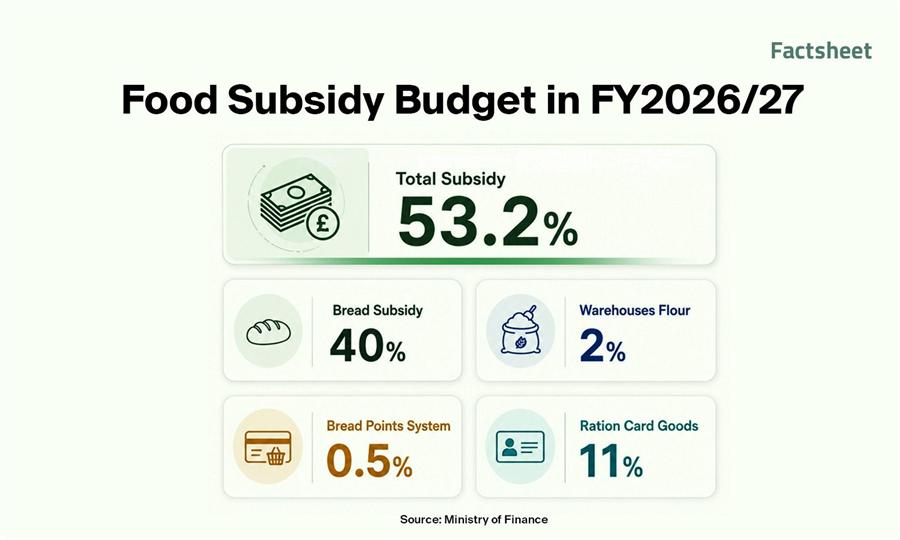
- Within the FY 2026/27 budget, total commodity subsidies are estimated at approximately EGP 334.4 billion, accounting for 40.2% of total subsidy expenditures. Food subsidies represent the largest component of commodity support, with allocations of EGP 178.3 billion, equivalent to 53.3% of total commodity subsidies and 21.4% of overall subsidy spending.
- The draft state budget for FY 2026/27 allocates approximately EGP 178.3 billion to food subsidy programs, compared with around EGP 160 billion in FY 2025/26. The increase reflects the government's continued commitment to maintaining food security and supporting vulnerable households amid persistent pressures on food markets and supply chains.
- The food subsidy allocation is distributed across several components, including approximately EGP 133.8 billion for subsidized bread, EGP 6.7 billion for flour supplied to warehouses, EGP 1.8 billion for the bread points system, and nearly EGP 36 billion for ration card subsidies.
- Budget estimates are based on the provision of approximately 8.6 million tons of wheat during FY 2026/27. Of this quantity, around 8.04 million tons are expected to be utilized to produce nearly 116.4 billion subsidized bread loaves, while approximately 560,000 tons will be allocated to strengthen strategic wheat reserves and support stock management requirements.
- The subsidy system is expected to benefit approximately 60.8 million citizens through the ration card program. Monthly support allocations are set at EGP 50 per person for the first four household members and EGP 25 for each additional member, while budget assumptions also incorporate a bread withdrawal rate of 84.2% and the continued implementation of the bread points mechanism for unused bread entitlements.
- To encourage domestic production and strengthen procurement from local farmers, the government has increased the wheat procurement price for the 2026 season to EGP 2,200 per ardeb, compared with EGP 2,000 per ardeb in the previous season.
By: Amina Hussein
Related News