World Population Day is observed globally every year on July 11th to raise awareness about pressing demographic issues, such as family planning, poverty, gender equality, maternal health, and human rights. Egypt is one of the most populous countries in the world, with its population representing the nation’s most valuable resource and a vital driver of development. According to the latest statistics, Egypt’s population has surpassed 109 million people.
In this Factsheet, we will celebrate this day by exploring the structure and key features of the Egyptian population.
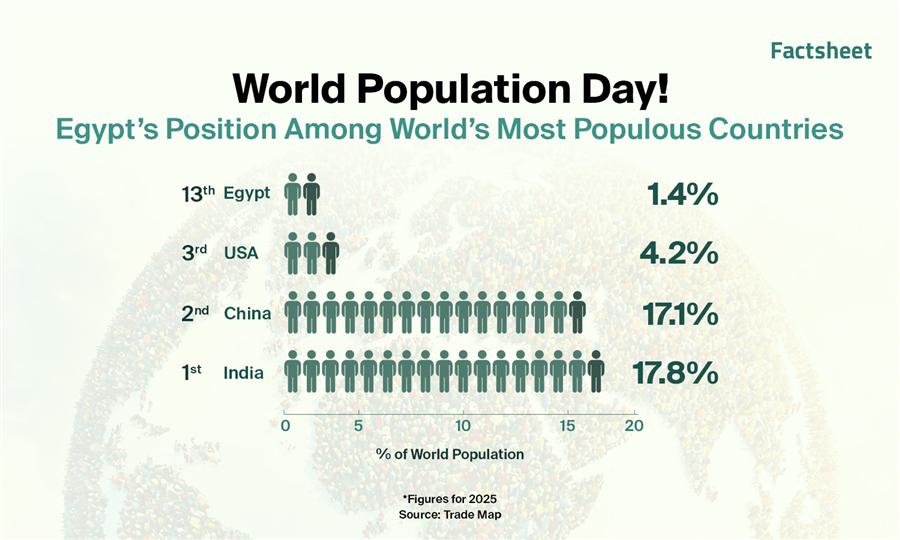
- In 2025, Egypt had the 13th largest population in the world. Egypt’s population represented around 1.4% of the world’s total population.
- At the beginning of 2026, Egypt’s population reached 108.6 million, with males accounting for 51.4% of the total population and females representing 48.6%.
- According to the Central Agency for Public Mobilization and Statistics’ (CAPMAS) latest data, 30.7% of Egypt’s population is under 15 years old, 40% falls within the age group of 15 to 39 years, 23.3% are between 40 and 64 years, while 6% are aged 65 years and above.
- Based on the age structure of the Egyptian population, data showed that the dependency ratio in 2025 was 59, which is a bit lower than the recorded ratio of 59.8 in 2024. Noting that the demographic dependency ratio is the sum of the youth and elderly populations (those not typically in the workforce) divided by the working-age population.
- The urbanization rate in Egypt hit 42.7%, with 46.36 million persons living in urban areas and 62.25 million living in rural areas.
- When it comes to the most populous governorates, Cairo came on top with 10.478 million people or 9.6% of the country’s total population. Giza came second with a population of approximately 9.82 million, followed by 8.155 million living in Sharkia.
- The total population density increased in 2026 to 108.1 persons per square kilometer, compared to 106.8 persons per square kilometer in 2025.
- In 2025, the number of live births reached 1.95 million; hence, the birth rate declined to 18.1 newborns per 1,000 persons from 18.5 in 2024. On the other hand, the total recorded deaths in Egypt during 2025 were 609,912. Accordingly, the death rate reached 5.7 deaths per 1,000 persons. As a result, the natural increase rate reached 12.4 per 1,000 persons.
By: Amina Hussein
Related News