General secondary education in Egypt serves as a critical stage in determining students’ academic pathways and future career opportunities. Every year, students enrolled in both the literary and scientific streams sit for the General Secondary Certificate examinations, which represent a decisive milestone in their educational journey. For the 2025/2026 academic year, students nationwide officially began the examination season, starting with first-round tests, including the core Arabic language exam.
This factsheet provides an overview of Egypt’s general secondary education system, examining its main characteristics and structure during the 2024/2025 academic year.
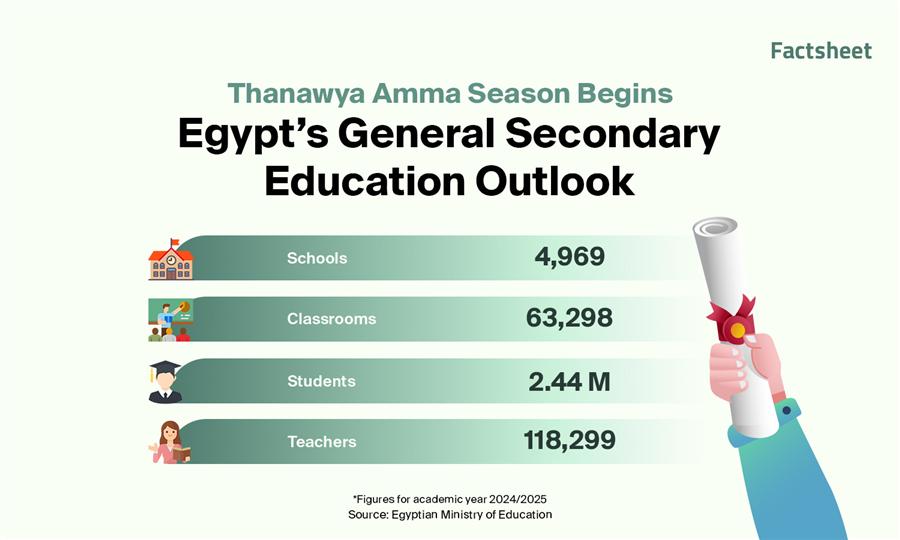
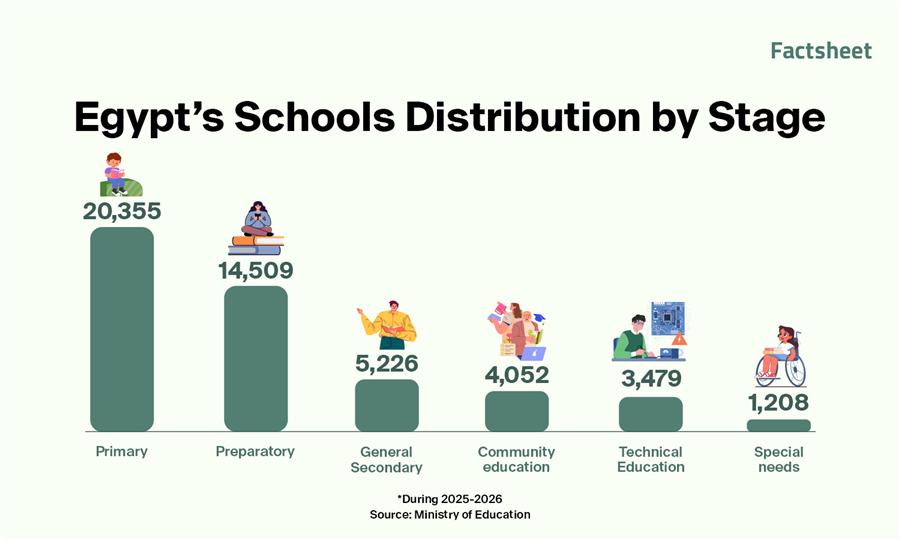
- Egypt has a total of 4,969 general secondary schools, representing 8% of the country's total school count. Of these, 3,545 (71.3%) are public schools and 1,424 are private institutions.
- Urban areas host 3,263 of these schools, with rural areas accommodating the remaining 1,706. Cairo governorate leads with 930 schools, representing 19% of all general secondary institutions, followed by Giza with 537 schools and El Sharkia with 357.
- General secondary schools in Egypt collectively possess 63,298 classrooms, making up approximately 10.3% of the nation's total classrooms. Among these, 53,736 classrooms are found in public schools, while 9,562 are housed within private schools. Notably, 68% of these classrooms are situated in urban areas, with the remaining 32% located in rural regions.
- In the academic year 2024/25, total enrollment in Egypt’s general secondary education reached 2.44 million students, constituting 9.4% of the overall pre-university student population. Of these, 2.17 million students are enrolled in public schools, with 262,401 students attending private institutions.
- Females are prominently engaged in general secondary education, comprising 55% of the total students, while males make up the remaining 45%.
- Regarding geographic distribution, 1.64 million students are situated in urban areas, whereas 795,913 students reside in rural settings. Cairo leads with 347,451 students, accounting for 14.3% of the total enrollment, followed by Giza with 281,227 students and El Sharkia with 198,597 students.
- Egypt currently has 118,299 secondary school teachers, representing approximately 9.4% of the total teaching workforce in the country. Of these, 97,107 teachers are employed in public schools, while 21,192 teach in private institutions.
- In the preceding academic year, 691,303 graduated from secondary education, of which 77.8% were specialized in scientific studies and 22.2% were in literature.
By: Amina Hussein
Related News