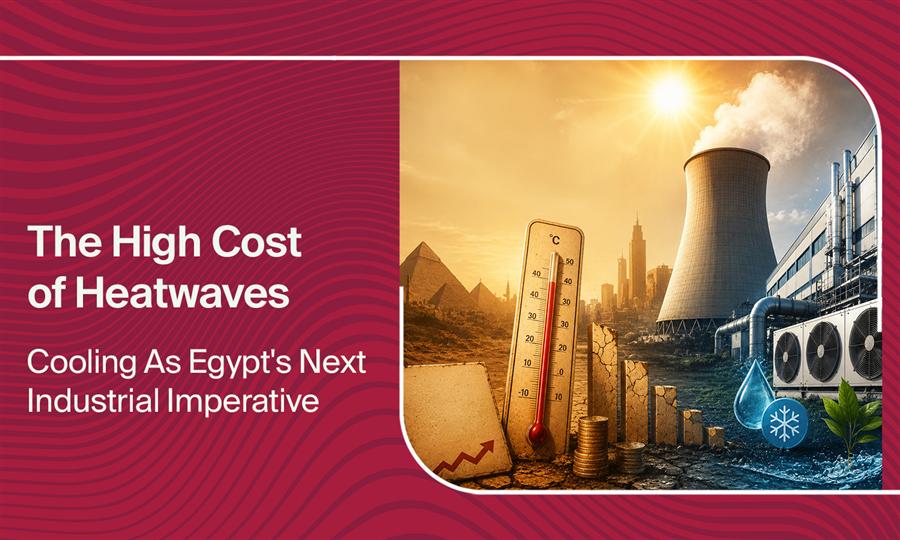
Egypt’s industrial economy is confronting a new frontier of climate risk, with rising temperatures threatening not only worker productivity but also machinery reliability, energy security and investor confidence. Heat stress is already draining productivity and hiking maintenance costs in industries such as cement, steel, textiles and food processing, and soaring cooling demand is straining the national grid.
In this context, advanced heating, ventilation, and air conditioning (HVAC) systems, district cooling, renewable-powered solutions, and AI-driven predictive maintenance are emerging as strategic assets that preserve competitiveness, cut costs, and extend infrastructure lifespan. Yet technology alone is not enough. To unlock its full potential, financing, policy incentives, and partnerships that build local capacity and position Egypt as a regional hub for climate-resilient industry are required.
The Economic Cost of Rising Heat
Economist Ahmed Zayed warns of the scale of losses: “Heat stress has already cost Egypt an estimated $4.5 billion in productivity losses between 2000 and 2020, and research shows that a temperature rise from 26°C to 31°C can cut labor productivity by around 30%. The ILO notes that above 33°C, worker performance can fall by as much as 50%.”
It is worth noting that the weather in Egypt during July and August could exceed 35°C and sometimes break 40°C. According to Zayed, cooling inefficiencies are now a financial stability concern. “Heat-related downtime and equipment failure are increasingly a credit risk factor for industrial lenders and insurers,” he says. “So, efficiency standards indirectly protect the financial sector's exposure to these industries.”
The impact is felt directly on machinery and supply chains. Mohamed Medhat, Energy Efficiency and Renewable Energy Manager at Gascool, tells Arab Finance: “Excessive heat reduces equipment reliability by accelerating the deterioration of insulation, lubricants, bearings, and electronic components, leading to failures and production downtime.”
He stresses that proper cooling and smart monitoring are vital: “Predictive maintenance tools, such as thermal imaging, enable early detection of overheating before costly failures occur.”
Mostafa Madbouly, Intelligent Energy Systems Expert and Coordination Engineer at Petrojet, echoes this view, noting that “Egypt's environment, with its dust, dryness, and high ambient heat, accelerates exactly these failure modes, which is why the payback here is faster than in lower-temperature climates.”
Cooling Technologies as Economic Assets
Cooling accounts for a massive share of industrial energy use. Therefore, Madbouly notes: “In Egyptian industries such as petrochemicals, fertilizers, cement, and food, cooling can account for 30% to 40% of a plant's electricity consumption. Demand also peaks on summer afternoons when temperatures exceed 40°C, exactly when the national grid is under the most stress. So, AI-driven cooling optimization is not just a plant-level saving; it is also peak shaving for the whole country.”
In addition, Zayed emphasizes broader implications: “The most promising developments are not standalone cooling solutions but ones tied to broader thermal management, as cooling itself is a major energy draw. Globally, heating and cooling account for roughly 50% of final energy consumption and over 40% of energy-related CO2 emissions.”
Madbouly highlights the role of AI: “Models trained on process data and weather forecasts can predict cooling demand hours, so operators can pre-cool during off-peak tariffs and run equipment near its efficient design point instead of reacting all day. AI also adjusts setpoints continuously against ambient conditions.”
“In Egypt's desert air, the gap between fixed and optimized setpoints is bigger than almost anywhere else. Additionally, energy-optimized cooling towers use less water, and in Egypt, that matters as it ensures better water consumption,” he adds.
He also emphasizes the role of machine learning (ML) in cooling: “Its real strength is catching slow, invisible problems like fouling, scaling, and refrigerant leaks. Operators do not see these issues until efficiency has already collapsed. ML spots the drift weeks earlier and gives operators room to react wisely, while the fix is still cheap and planned.”
Furthermore, Medhat complements this with practical solutions: “Modern HVAC systems and industrial chillers improve productivity by maintaining stable temperature and humidity while reducing energy consumption through intelligent controls. In large industrial parks and developments, centralized district cooling systems can further enhance efficiency by supplying cooling from a central plant to multiple facilities.”
Incentivizing Sustainable Cooling Adoption
Technology must be matched with policy. Zayed points to financing as the biggest hurdle: “The real constraint is not the technology but financing the upfront cost, which is where blended finance and green credit lines, an area I work on at the Financial Regulatory Authority (FRA), matter most. About 70% of the world's coal-fired blast furnaces will need reinvestment by 2030, and that reinvestment window is exactly when renewable cooling systems and process retrofits should be built in rather than added later.”
He outlines several incentives: “Preferential lending rates, green bonds, and credit guarantees earmarked for industrial energy efficiency and cooling retrofits, consistent with Egypt's broader green finance agenda.” Zayed also calls for tax and customs incentives on imported renewable cooling equipment and public-private co-financing for pilot projects in energy-intensive zones.
Zayed further notes, “For renewable-powered cooling specifically, solar-thermal absorption chilling suits Egypt well given its abundant solar resources. It uses heat rather than grid electricity to drive cooling cycles, making it a natural fit for industrial zones like Suez and Ain Sokhna.”
Meanwhile, Madbouly stresses the importance of building local capacity and partnerships: “The real value of these partnerships is not the equipment. It is what stays in Egypt afterwards, including local assembly lines, trained engineers, and spare parts on the shelf. A chiller is only as reliable as how fast you can repair it, and when a critical part takes weeks to import, with currency risk on top, that is actually where downtime really comes from.”
“Partnerships done right build local capability through technology transfer, service networks, and access to modern high-efficiency equipment and refrigerants. Pure import relationships build dependency. Resilience is the difference between the two,” he points out.
“The way I see it, the cheapest energy is the energy you never waste. Efficiency in cooling is one of the few investments where the savings start from day one and never stop,” Madbouly concludes.
Egypt’s industrial competitiveness will increasingly depend on how effectively the country manages the economic risks of rising temperatures. Heatwaves are not only a challenge to worker productivity and machinery reliability but also a direct threat to energy security and investment confidence.
Consequently, cooling technologies, from advanced HVAC systems and district cooling to renewable-powered solutions and AI-driven predictive maintenance, represent more than technical upgrades; they are strategic assets that safeguard output, reduce costs, and extend the life of industrial infrastructure. To unlock their full potential, Egypt must complement technology adoption with supportive policy frameworks, financing mechanisms, and partnerships that build local capacity.
By Sarah Samir